seperis

joined 2 years ago
[–] seperis@lemmy.world 1 points 3 weeks ago (1 children)

So I read this like, fourteen hours ago, and I started to reply that no, I can't; Orbi Pro 6 will only allow a port to carry one VLAN--which you have to assign--unless it's a Orbi satellite or my Orbi router-turned-AP. Devices won't. I tested this a lot.

But. I hadn't tested my switches, at least since I got these specific ones. Apparently, my Netgear switches also get the full trunk, because they're all smart managed. So I set up the VLANs in the switches, assigned them to ports, and moved Yellow onto the appropriate port. I also had to turn off mDNS sharing between VLAN1 and VLAN20/VLAN30 very quickly because mDNS nightmare but--yeah, that worked.

Thank you. I hadn't even thought about it because it failed (badly) with my other switches, but here we are. Running discovery tests now with the IoT VLAN to see if everything is still reachable and do some fine-tuning.


So I moved a few months ago, and only just now had time between work and school to set up my smart home again. Which turned out to be a sort-of blessing, since HA did some updates and the one for sensor and binary sensor templates dramatically screwed me as I template a lot. It also gave me the opportunity to upgrade my Yellow's Pi module, and I found (though haven’t installed) an internal z-wave module for it, which I'll do when I'm off for Christmas and New Year.

However, since I am starting fresh, I thought I'd ask around on best practices. So I use the Orbi Pro 6 which has three primary and one guest SSID, and I have it behind a Google router in its DMZ because we have Google Fiber here. Which also turned into an advantage because I wanted to a.) do full IoT isolation and also b.) have someplace to put my singleboard computers and my servers that's safer but still have internet access plus c.) avoid wifi congestion (three VLANs plus the primary router's wifi takes care of that nicely).

On the Orbi: VLAN1 is primary and where I keep my singleboard computers, my servers, two TVs, X-Box, Switches, and my laptop. VLAN2 is for IoT hubs, cameras, Roomba, etc. VLAN3 is strictly lightbulbs, which sounds ridic but when I did a wifi analysis they really really super really take up a lot of wifi bandwidth, I've been slowly replacing with Hue and other zigbee, but it's in progress. I may move the cameras there as well.

What I need to figure out is the best way to connect everything to Home Assistant. What I was doing was attaching Yellow to VLAN1 by ethernet and VLAN2, VLAN3, and the primary SSID by wifi. On the Orbi router is an mDNS gateway page so I set it to connect my VLANs so they can exchange some data.

But now I have some time to design, and also, I can run multiple instances of HA on one of my servers. I had been doing that anyway to test any chances and test and run Add-ons that I wrote myself, just not a permanent one (again, test instance; I murdered it a lot and spun up a new one when things got weird).

So for anyone who deals with multiple SSIDs or VLANs (or just has an opinion): keep Yellow as is or go with the multiple instances and use Remote Home Assistant (which I used with my test instance and it worked very well) to send entities in the VLANs back to Yellow? Anyone?
[–] seperis@lemmy.world 1 points 1 year ago

Oh, I backup religiously since Blue failed right after I moved and backup my backups on my laptop as well. (literally failed; I lost everything and had to run photorec and three other tools to pick out everything I'd done for the previous six months, since that I hadn't copied to a backup on my server because I was prepping to move at the time).

So far, OTBR is the biggest stopping issue since HA runs it but nothing sticks. I admit, moving zwave is my actual biggest dread; zigbees I can do probably in a weekend, but zwave is such hell to unpair and re-pair (thought it makes up for it by sticking forever). That's part of the reason I love Thread and Matter; they're almost as sticky as zwave once they pair, and while pairing them is variable (sometimes fast, sometimes not so much) they repair themselves pretty consistently if the outage is under 24 hours and you can deliberately unpair them fairly easily.

[–] seperis@lemmy.world 1 points 1 year ago (3 children)

I've been running Home Assistant for roughly five-six years (Pi, then Blue, now Amber and a second instance on my server for network integrations like nmap and netgear), but since my SmartThings hub was taking care of zigbee/zwave, until now I used HA as a coordinator for every smart device ecosystem I was using (Hue, Wyze, Ring, Blink, Alexa, August, Arlo, et al). Sorry that wasn't clear.

While Ive started slowly adding zigbee devices directly, I haven't started with zwave and thread isn't working for me yet (OTBR is running but nothing sticks). And I really don't want to have my hub fail and all my thread/matter devices useless when I don't have anything that can access them.

[–] seperis@lemmy.world 1 points 1 year ago

So far, the OTBR on HA isn't working, but...if it's an age and device issue, it may be migrating the zigbee and zwave over to HA and leave my SmartThings for my OTBR devices will work for now. That may at least buy some time to work out how to make the HA's OTBR work.

[–] seperis@lemmy.world 1 points 1 year ago

It's not reliable on thread/matter.

[–] seperis@lemmy.world 1 points 1 year ago (2 children)

I use zigbee, zwave, and thread. I've migrated half my contact sensors, a few motion and presence, and two rooms of light bulbs to thread, which HA is...questionable on, hence beginning my search.


My SmartThings Hub is (slowly) starting to error out more and more. I'm doing a soft reset monthly to keep everything up ( I did a hard reset about a year ago when I moved), which works, but I think it's time I start learning a new hub, preferably one not discontinued. My original plan was to put everything in Home Assistant when this time came, but a.) I really like it as my home coordinator with my custom scripts and addons and I don't want to mess with what is working right now and b.) while I'm getting the hang of running zigbee on there, zwave is in progress and thread...not really working most of the time.

So. I need to buy a general all-protocol hub; any recommendations that are fully compatible with Home Assistant? One with custom scripting would be a huge plus; I miss doing that in SmartThings.

[–] seperis@lemmy.world 0 points 1 year ago (1 children)

So it can be done, it just--required a lot of steps and me making a mapping spreadsheet of all the containers. But! Automations and scripts run in the homeassistant container, while when you ssh, you're going into the ssh addon container which should have been obvious and really was once I finished mapping all the containers.

Goal: I need /usr/local/bin in the ssh container so I can run scripts over ssh and access my function library script easily without ./path/to/script.

Summary: ssh into HAOS from the homeassistant container with an HAOS root user (port 22222), run docker exec to get into the ssh addon container, then make your symlinks for /usr/local/bin.

(Note: this is ridiculously complicated and I know there has to be a better way. But this works so I win.)

  1. Get access to HAOS itself as root: https://developers.home-assistant.io/docs/operating-system/debugging. Verify you can login successfully.
  2. In homeassistant container:
  • a. create an .ssh folder (/config/.ssh)
  • b. add the authorized_keys file you made for step one.
  • c. add the public and private keys you made for step one (should be in the ssh addon container).
  • d. set permissions;
chmod 600 /config/.ssh/authorized_keys
chmod 600 /config/.ssh/PRIVATE_KEY
chmod 644 /config/.ssh/PUBLIC_KEY
chmod 700 /config/.ssh
  • e. In /config/shell_scripts.yaml or wherever you put your shell scripts, add the script you want to use to update /usr/local/bin: UPDATE_BIN_SCRIPT: /config/shell_scripts/UPDATE_BIN_SCRIPT
  • f. Restart HA.
  • g. Check it in Developer Tools->Services

I have no idea how consistent the ssh addon container name is usually but it's different on all three of my installs, so insert your container name for SSH_ADDON_CONTAINER_NAME

Steps: login to HAOS, go into the SSH Container, and do the update. This is horribly messy but hey, it works.

UPDATE_BIN_SCRIPT

#!/bin/bash

# OPTIONAL: Update some of the very outdated alpine packages in both homeassistant and the ssh addon (figlet makes cool ascii art of my server
# name).   You'll need to run it twice; once for the homeassistant container, then again in the ssh container.  Assuming you want to update packages,
# anyway
# update homeassistant container packages
apk add coreutils figlet iproute2 iw jq ncurses procps-ng sed util-linux wireless-tools

# ssh into HAOS and access docker container
ssh -i /config/.ssh/PRIVATE_KEY -p 22222 root@HA_IP_ADDRESS << EOF
	docker exec SSH_ADDON_CONTAINER_NAME \
	bash -c \
       'apk add coreutils figlet iproute2 iw jq ncurses procps-ng sed util-linux wireless-tools; \
	if [ ! -h /usr/local/bin/SCRIPT1 ]; then echo "SCRIPT1 does not exist"; \
	ln -s /homeassistant/shell_scripts/SCRIPT1 /usr/local/bin/SCRIPT1; echo "Link created"; \
	else echo "Link exists";fi; \
	if [ ! -h /usr/local/bin/SCRIPT2 ]; then echo "SCRIPT2 does not exist"; \
	ln -s /homeassistant/shell_scripts/SCRIPT2 /usr/local/bin/SCRIPT2; echo "Link created"; \
	else echo "Link exists";fi'
EOF

echo "Done"

I am going to feel really stupid when I find out there's a much easier way.


I hope I can explain this correctly; I am only somewhat familiar with docker.

I have a script that I run after Home Assistant OS updates; it updates the alpine operating system with some extra packages and creates three symlinks in /usr/local/bin for three scripts in /config/shell_scripts. Up until now, it's run perfectly when I run it manually over ssh.

Then I decided to create an automation to run it automatically after an HAOS update, and while the package updates work, the script says those symlinks exist already so it doesn't create them; they do not exist, HAOS deletes them after an update (and Core updates might too, but I usually update them together so never checked).

After a lot of frustration, I logged into Home Assistant with root on the 22222 port and found it's checking and finding the previously created symlinks from earlier HAOS updates inside /mnt/data/docker/overlay2/../usr/local/bin and /var/lib/docker/overlay2/../usr/local/bin. At least, that's my guess; googling docker and overlays has been a trip.

So my question: how do I structure the script so that the symlink check is within the docker container's version of /usr/local/bin so it will create the symlink?

I get the answer is probably super obvious, but I am not seeing it. The only other thing I can think to do is export /homeassistant/shell_scripts to PATH but while that works over ssh, I haven't tested that running as a shell script service and I really want to automate this process.

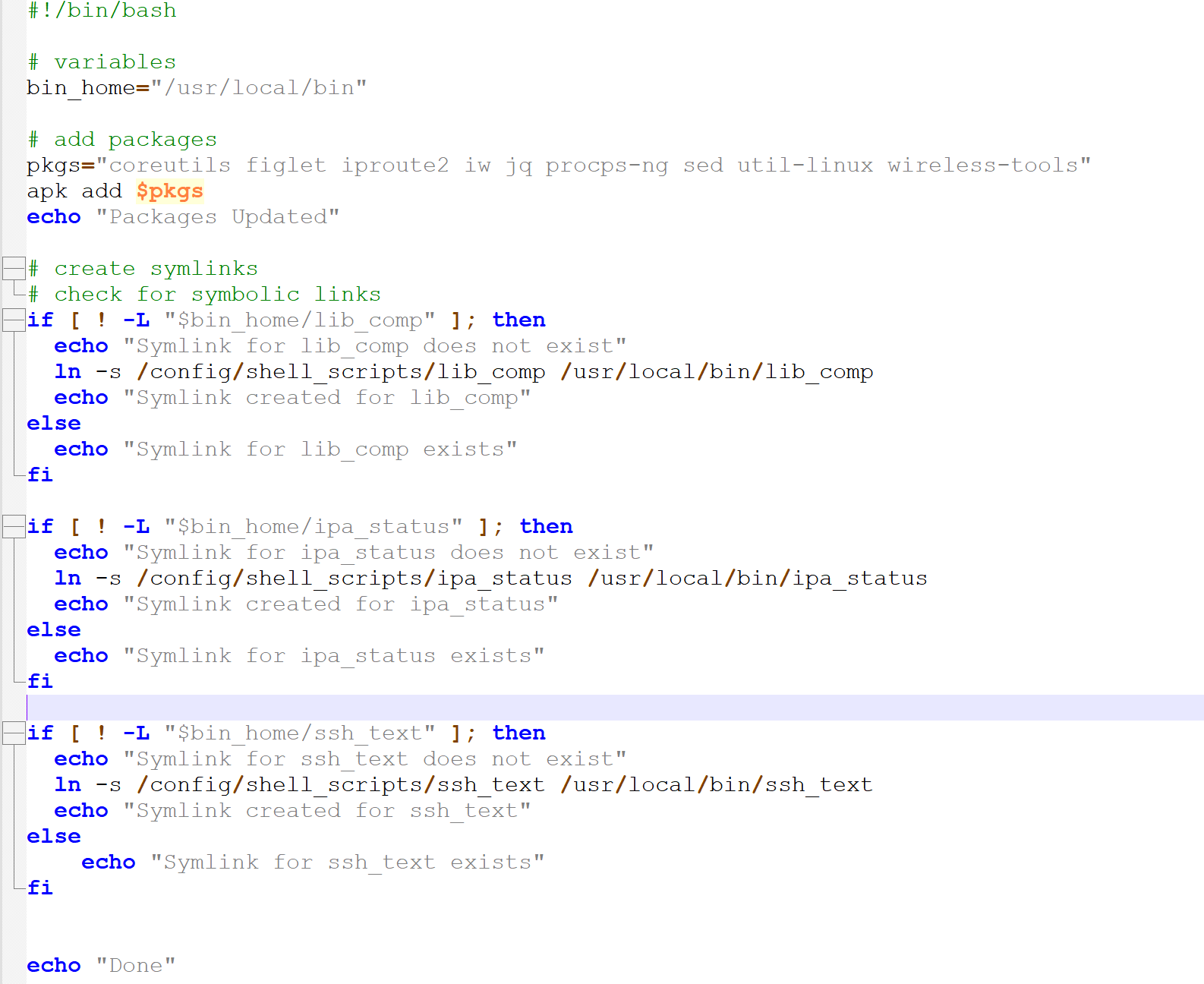
Screenshot of full script attached; here's the short version I'm using for testing. This has been checked with and without variables for paths.

#!/bin/bash

# variables
bin_home="/usr/local/bin"
shell_home="/homeassistant/shell_scripts"

# add packages
pkgs="coreutils figlet iproute2 iw jq procps-ng sed util-linux wireless-tools"
apk add $pkgs
echo "Packages Updated"

ln -s "$shell_home/lib_comp" "$bin_home/lib_comp"
ln -s "$shell_home/ipa_status" "$bin_home/ipa_status"
ln -s "$shell_home/ssh_text" "$bin_home/ssh_text"

echo "Done"
 

So my Home Assistant Blue suffered a tragedy last year and I temporarily switched to using a Pi 4. Then Ameridroid had the Yellow (PoE!) available, and here I am with a Yellow, waiting for the CM4 ( CM4108032) and SSD to arrive tomorrow, and realizing I have no idea what to expect or if there is anything I should expect when I start the config and move this weekend.

Background: I've run HA for roughly four years now on Pi4, Odroid, and in Docker on my server, but since moving it to the Pi while waiting for the Yellow to come in stock, I've only done basic maintenance and working on other projects, so on a guess, I'm going to have to brush up my python and yaml. And anything that's changed that I may have missed.

This will be a scratch initial installation; after linking up my integrations and getting my naming conventions consistent, I'll start copying my yaml files and code over and decide how much of my interface I want to keep.

Any advice would be appreciated if there's anything that's very different with the Yellow hardware. I use two SmartThings Hubs for zigbee, zwave, and matter over Thread control for the most part but have been dipping my toes into direct zigbee control (just not that well yet) and trying to get direct matter over thread to work (not going well at all). And do I need my skynet dongle or Sonoff zigbee dongle or will the built in module work across the board?


So I just did my first install of Proxmox a few months ago in my home server, and I'm seriously, seriously in love, enough that I decided to use it to run my media server as well; it runs Plex, act as a NAS for my media and backups, etc.

Specs: CPU: AMD Ryzen 5 5600G Board: ASRock B550 Steel Legend RAM: 32 GB DDR4 3200 OS Drive: Samsung 970 Evo 500GB PCIe 3.0 Storage: 50 TB over six drives (all media), all mounted directly to Proxmox

RGB: Fans: 10 CORSAIR iCUE RGB Elite Performance Power Supply: Corsair CX750F RGB

Running (always): Containers: Plex, Docker, Jellyfin (still experimenting) (Docker runs docker images for MakeMKV, Handbrake and MediaInfo, but it's only up when I am using them.(

Before Proxmox, Cassiope ran on Solus Budgie and before that Xubuntu, and while OpenRGB could be cranky, with Solus I had full control all the RGB elements so I know how to use it. I spun up a Xubuntu VM and installed OpenRGB in it and connected to it after some tinkering but not to everything, but I figured that was just because I hadn't done the hardware connections to the VM correctly. Still, it was there.

It not only did not let me control them, it turned everything RGB off. I had to shut down the server and restart cold for them to come back on and I could not connect and it also started fucking with my lights. I killed the VM, tried again, couldn't connect at all. Just to see what happened, I installed directly to Proxmox with the image and it connected.

It did not go well. Short version, I had to scrub the install and flash my board's BIOS, and so no more experimenting on my media server. I moved some of it to my other server, Watson (similar specs but AMD Ryzen 7 3700X CPU and less storage and 64 GB RAM CORSAIR Vengeance RGB Pro) .

I tried in Xubuntu, Solus, EndeavourOS, Linux Mint, then--just to see what happened--directly on Proxmox. This progressed and ended literally the same way but with more and weirder steps: the VMs would fail, my board started acting up, I (again) tried with a direct install to Proxmox, and yes I had to scrub, flash the BIOS, and reinstall everything.

I am new to Proxmox but I've been jumping distros in Linux for well over a decade and except for EndeavourOS (which is amazing, I finally like Arch), all the VM OSes I used I know very, very well and all worked with OpenRGB perfectly. I have broken many installs and had to scrub over the years like a lot but generally it was something I did either on purpose or because I made a mistake. (or while root, deleted my entire OS; it happens). I was very methodical and very careful, especially when I switched to my other server and took notes; there was nothing I did--or for that matter, was even able to do--that should have caused this. So my guess is I need to do some configuration in Proxmox to get my hardware to connect to the VM (or to use it directly on Proxmox) , but I don't even know where to start and after flashing two separate boards, I'm a little shy on guessing randomly. Yes, I have googled a lot but nothing I read that I tried worked.

I would really really like control and use of my fans and lights but I really, really love Proxmox and the flexibility of a hypervisor and I'm learning so much and barely scratched the surface, so I'd like an alternative to having a lot of very pretty lights that I can't control. Right now, OpenRGB seems to be the only game in town for iCue or Polychrome when not in Windows, so--help?