That's an interesting perspective! Care to share some data?
Personally, I think the fact that the median person in capitalist nations has enough food to eat is a pretty big plus! I don't think that's been the case throughout most of history.
That's an interesting perspective! Care to share some data?
Personally, I think the fact that the median person in capitalist nations has enough food to eat is a pretty big plus! I don't think that's been the case throughout most of history.
Capitalism isn’t you buying a tool and using it. It’s buying the 3D printer, paying people to design and build widgets, paying people to sell the widgets, then taking most of the money for yourself.
Yes, I agree that this should be possible. Of course, if I'm taking too much money, the capitalist system will encourage my competitors to defeat me. Meaning that there a dis-incentive in place for doing bad/selfish things. Sounds like a pretty good system!
I hate that I can work (with others) to build a company from the ground up and have nothing to show for it, because the owner is using us to fund his lifestyle. I hate that landlords can buy up all the homes, driving up the cost to the point no one can afford one, then rent them out and sit on their ass while I pay their mortgage. That’s capitalism. People profiting off of ownership. It inevitably ends with some people owning almost everything, and the majority owning nothing.
Yes I agree! I hate these things too. But capitalism doesn't prohibit every bad thing. Bad things can still happen under capitalism. I'm just saying that such things are harder to do under capitalism than any other system. For example, you mention landlords have to buy up every home before they can take advantage of you through their monopoly. That's way harder than other systems, where the government already owns all the homes, and can simply drive up the cost whenever they want :/
I’m really not trying to be a dick, but uhh… Look around? The world is literally on fire and efforts to put it out or even to stop pouring more gas on it are put down at every turn by capitalists in the never ending pursuit of more money for it’s own sake.
Well I mean it's unclear to me that we're much worse than previous points in history. I'd rather have the climate crisis over the nuclear one, or either of the world wars, or live under a feudal system where I'm owned by the local lord in his castle.
I sympathize (and agree) with the belief that the current system isn't serving everyone, much less serving everyone equally. But the world is a complicated thing and we've got >7 billion people to feed! I think we should be very careful before deciding "yeah it's time to tear down the existing systems and hope that there are better systems out there". It's easier to make things worse than to make things better.
Let’s start here: are you a capitalist? Do you own any actual capital? I don’t mean your own house or car, that is personal property not private property or anything resembling the means of production.
I guess? I've wanted to start my own business a couple of times. I'm a programmer, so I've toyed with the idea and done some research into creating a few apps which I believe people would find useful, and might pay my bills. I don't own a house or a car-- I live in an apartment in a mid-size US city.
I ask because many people consider themselves capitalist when really they are just workers who happen to own a bit of personal property, and they make themselves essentially useful pawns for actual capitalists. And, if you’re not an actual capitalist, why are you so pro capitalism?
I'm guessing you'd consider me a pawn, but I don't. I fit your description of owning a bit of personal property, and being a worker. I've worked for some large companies in the past which are supposedly the "actual capitalists". But I promise they don't give two shits about social good (or social bad). They are just desperately trying to make products that people want to buy. In my view, it's a pretty good system which constrains huge organizations like Apple to making devices, when the alternative is that they could be setting up their own governments.
Because it’s objectively unsustainable?
I don't think we know that. Indeed, what we're currently doing as a species to the environment is unsustainable. But it's not clear to me how it's the capitalism that's the unsustainable part. My understanding is that capitalism is a system which allows us, as a society, to produce things very efficiently, and to distribute resources. It hasn't failed in that role, has it?
I don’t really get what it even means to be “pro capitalist” at this point.
I believe that, for example, if I wanted to open a bookshop, I should be able to. Or that if I wanted to rent a couple of 3D printers and sell widgets, that I should be able to. Or if I wanted to hire some dude on fiverr to write some music to my screenplay, I should be able to. This is capitalism. Do you disagree? This is what confuses me, and why I asked the question-- on my side of the fence, I don't really understand what it means to be anti-capitalist. Hence why I asked.
We know, for a fact, that capitalism will lead to disaster if we keep doing what we’re doing. Do you disagree with that? Or do you not care?
Well no need to be rude! Of course I care! And yes, we're headed towards disaster in terms of the environment. But I don't understand, like I said above, how capitalism is causing it and how not-capitalism would solve it. We have 7 billion people on the planet and they all need to be fed. Capitalism is the most efficient system we know of to create and allocate resources. Should we... move to a less efficient system? Wouldn't that be worse for the environment? How does that solve anything? This is my confusion.
What is your general plan for what we should do when we can see that something we currently do and rely on will have to stop in the near future? Not that we will have to choose to stop it, but that it will stop because of something being depleted or no longer possible.
This is an interesting question! I'm parsing it to mean "how can the current problems be solved within a capitalist system?". It's a good question, and I don't have a 100% guaranteed answer. But I don't see that any capitalism alternative has a good answer either, so still I don't see how capitalism is the "bad guy".
In any case, my answer is this: A side effect of all of capitalist driven efficient production is that the environment is harmed. Here, I think the governing bodies have failed in their roles: their role is to define what "capital" means and rules of ownership. They haven't done that for environmental concerns, which is why capitalism isn't taking it into account properly. My desired solution is that the government could define a "total amount of carbon emissions" that would be allowed by the country as a whole, and then distribute transferrable carbon credits on the open market. This turns "rights to emit carbon" into a form of capital, and capitalism will do what it do and optimize for it.
In essence, I believe that governments have done a bad job of using the tool of capitalism to solve the problem of pollution.
If you imagine that we’re trying to find the best long-term system for humanity, and that the possible solutions exist on a curve on an X/Y plane, and we want to find the lowest point on the function, capitalism is very clearly a local minima
Great analogy! But.... have we seen a lower minimum? What's the rationale behind that system? That's my question
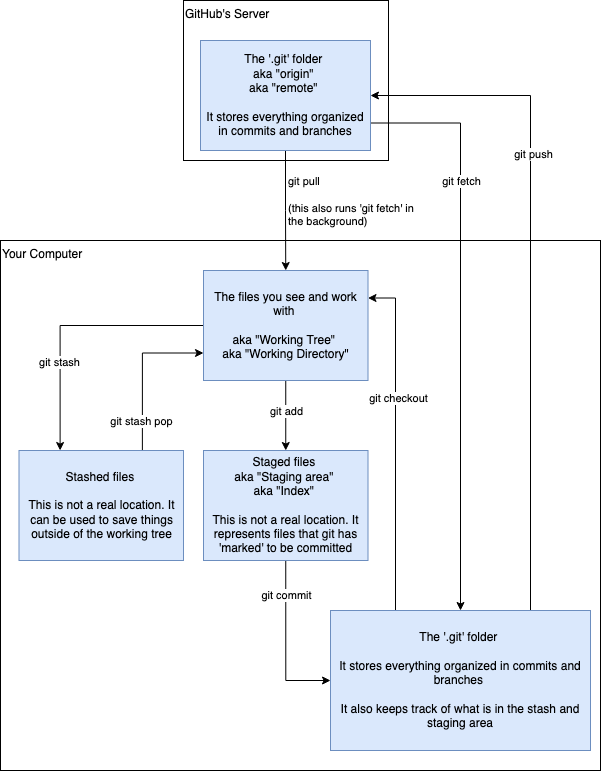
cross-posted from: https://programming.dev/post/223663
Hey folks!
I've noticed that it's often difficult for newcomers to
gitto understand what the heck is happening and how the commands work.Here's a flowchart that has helped me explain things in the past, and (more than once) folks have asked me for a copy of it to use as a cheat sheet. Hope it's helpful!
That would be the last time I moved, so about a year ago.
Also, I happen to very much like my landlord. This is because they're heavily incentivized to address my concerns because otherwise I'd leave a bad review which they care about. Examples are: they fixed a couple of times the laundry facilities were broken, they fixed broken windows a couple of times, etc. etc.
EDIT: Actually, you're making a very good point which I didn't address properly! You're saying that voting gives society more power than prices do. This is a good point, but I disagree. I think prices control production more than any government can, because it allows a much more granular decision-making. For example, every single individual can "vote" that their apartment is too expensive by leaving and finding cheaper places, driving prices down.