lystytsiaverschmitzt

joined 8 months ago
 

!https://anarchist.nexus/c/announcements/p/567879/the-button-season-2-is-now-open

Since I missed season 1, it wasn't really an option in my case, so I went with the underdogs at the time (red)


Rough translation below, as original is in German:

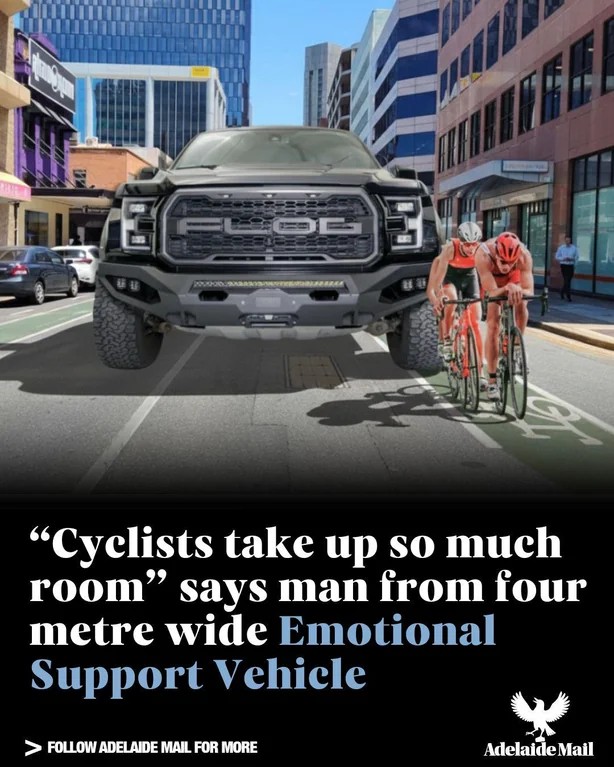
For years, SUVs have been getting bigger and more luxurious. However, the people who drive these vehicles have not grown with them. To ensure road safety, a child seat requirement for SUV drivers has now been added to the Road Traffic Regulations (StVO). It will apply to numerous car models starting March 1.

“For safety reasons, child seats are now simply a necessity for adults driving SUVs,” explains traffic expert Manfred Salamonik, who was involved in drafting the new regulation. “Firstly, so that the seat belt fits properly and does not constrict the driver's neck in an emergency. Secondly, so that you can actually see over the steering wheel and reach all the controls and the gear stick in a modern SUV.”

All SUV models built in 2018 or later are affected by the child seat requirement. In these vehicles, it can be assumed that the interior is so large that, relatively speaking, the driver is about as small as a child in a conventional car.

The first adult-sized child seats with five-point harnesses approved by TÜV have been available in stores since this week. Extras such as a built-in cup holder or a Velcro fastener for attaching a favorite cuddly toy or teething ring are available at an additional cost.

Drivers who are at least 2.20 meters tall or weigh more than 250 kilograms are exempt from the child seat requirement.

But it's not just adults who have to adapt: children traveling in a new SUV will in future need two child seats – one adult-sized seat that is attached to the seat, and one child-sized seat that is attached to the first child seat.


That's a great way to at least get more people to give it a try


Comment ta ville change-t-elle?


C'est toujours agréable de voir plus de verdure autour


Quelques conseils pour rouler à vélo dans la neige, en sécurité :

▶️ Dégonflez un peu vos pneus.

▶️ Baissez la hauteur de votre selle.

▶️ Modérez votre vitesse.

▶️ Freinez doucement et privilégiez le frein arrière !

▶️ Et si vous n'êtes pas à l'aise, laissez votre vélo pour aujourd'hui

source: https://piaille.fr/@parisenselle/115848079715186560

[–] lystytsiaverschmitzt@anarchist.nexus 3 points 3 months ago (2 children)

Were you off grid in France as well? What made you quit being off grid?

D'accord et toutes mes excuses


Qui sabote la lutte pour le climat en France ? Comment s'organisent ceux qui nient l'évidence scientifique ?

Enquête cartographique ici:
https://deni-climatique.fr/wp-content/carto.html

[–] lystytsiaverschmitzt@anarchist.nexus 61 points 3 months ago* (last edited 3 months ago)

Did they have too many quotable anti-fascist moments?


YT link for those that prefer it: https://www.youtube.com/watch?v=aucsiGWbEyU

What about you? Would you have done anything different?

Synopsis from the video description:

Five years ago, Mathieu Munsch walked away from the “normal” script— rent, bills, loans, a 40-hour workweek (35 in France)— and headed for a sloping meadow in northeast France to build something radically simple: a small home made from the earth under his feet, wood from nearby, and straw bales from local farmers.

He kept it to 50 m² on purpose—small enough to draft the plans himself, and to build without hiring an architect or engineer. He simply asked a friend studying engineering to double-check his calculations. The result is a softly rounded earth-and-straw house the town didn’t quite know what to do with at first (“round walls” aren’t exactly the local tradition)… yet they couldn’t argue it didn’t belong: the materials are literally from the land around it.

And the price tag? About €15,000. No mortgage. No utility bills. Just time, patience, and a lot of mud.

But the house is only the beginning. Mathieu is building an entire life around low inputs—less energy, less money, less dependence.

He lives off-grid on roughly €200/month, powered by solar panels, with solar thermal for hot water in summer and a wood stove for winter warmth (and water-heating when needed). For water, he doesn’t rely on the town at all: he encourages groundwater into an underground pipe and stores it in a cistern halfway down the hill—made easier by the slope of his land.

Food is where his project becomes something more than “self-sufficiency.” He grows what he can, forages what he can’t—and then he goes a step further into what he calls “tending the wild.” Instead of clearing and controlling nature, he collaborates with it: inoculating mushrooms on logs, encouraging edible plants to thrive, even turning a wet patch of land into a cattail pantry. “Tending the wild is sometimes easier than erasing everything that’s there and starting from scratch," says Mathieu, "it does all the farming for you.”

And he keeps evolving the site. In the pit left from building the house, he created a submerged greenhouse—a walipini—to extend his growing season. He’s also now building a second earth unit, Japanese-style, as a bathhouse.

This is a story about natural building, yes—but also about something deeper: emancipation from debt, from high-energy living, and from a life spent earning money just to hand it straight back over to the system. “It’s actually the whole possibility of emancipation from labor… If I don’t have a 20-year loan, that’s 20 years less of my life that I have to work.”

We visited on a freezing winter day, and were welcomed into his warm, cozy home—heated only by a few logs burned the night before. He made our family lunch from his foraged, grown, and preserved foods, and it felt like the whole philosophy in one meal: simple, local, deeply satisfying.

If you’re curious about earth-and-straw construction, off-grid systems, permaculture, wild foods, or what it really takes to live with less—this one is a full, grounded tour. If you enjoy these deep dives into people quietly building real alternatives, consider subscribing—and let me know in the comments: what part of this life feels most possible for you, and what feels hardest to imagine?

—Check Mathieu's project and philosophy of life: https://habiterlaterre.com/en/

248
submitted 3 months ago* (last edited 3 months ago) by lystytsiaverschmitzt@anarchist.nexus to c/fuckcars@lemmy.world
 

Declining childhood independence over the years (%):

Driven less by internet brainrot, and more by media "stranger danger" as well as loss of wild spaces near homes for kids to roam and explore unaccompanied by an adult

The whole article is worth a read

Relevant bits to fuckcars:

Adult employment patterns and lifestyle changes have also been slowly trending toward car-dependency, which means that kids often end up living far away from their friends. If children want people to play with, the most efficient solution is for their parents to drive them to an organized sport or other structured activity.

In the Play England survey, though, parents were most afraid that their kids would get hit by a car. Sadly, this isn’t an unreasonable fear. All the forests are covered in concrete. What would we make of a city-bound parent who let their toddler roam the streets without an adult nearby?

Unfortunately cattle farmers have a very strong lobby on their economy and I wouldn't be surprised if they get what they want permanently.

view more: next ›