andrew0

joined 3 years ago
[–] andrew0@lemmy.dbzer0.com 2 points 1 month ago (1 children)

Your mind is your body + brain. Your behavior and all of your memories are due to how your synapses and intermediary cells were developed. Similarly, it also depends on the body chemistry.

If you were to fully transplant a brain to a new body and correctly link all the nerves, in theory you could have the same brain in a different body. In practice, this can fail miserably due to differences in all of your sensory connections to the brain and hormone levels.

It's been a while since I looked into neuroscience, so there might be some things I am missing. The conclusion is that altering the chemistry around your body could change you as a person, even if your hypothalamus is the same (i.e., same memories).

[–] andrew0@lemmy.dbzer0.com 6 points 1 month ago* (last edited 1 month ago) (10 children)

I was thinking about getting one, but then I read more about it and realised you can't really use it without the Steam client. Kind of put me off since I have a large part of my library on GOG. Maybe this won't be a problem in the future though.

[–] andrew0@lemmy.dbzer0.com 2 points 1 month ago* (last edited 1 month ago)

Dubious open-source practices on the part of Ollama devs. Other than that, LM Studio is using the latest stable llama.cpp rather than the one developed by Ollama, which brings significant speed improvements. You also have a better understanding of what model you're deploying by not using Ollama, and instead looking into the HF repository. For example, Ollama states that they're serving DeepSeek-R1, but pulling this one gives you a distilled 8B billion version that is not actually the DeepSeek-R1 (671B parameters) that one would have expected.

I get it that it might make it easier to use, but you will not learn much by using it. Even worse, competition is even better with performance and similar out-of-the-box capabilities.

[–] andrew0@lemmy.dbzer0.com 3 points 1 month ago (2 children)

Don't use Ollama. If you're on Windows, better try LM Studio and look into HuggingFace models rather than relying on the Ollama repository. Much better.

[–] andrew0@lemmy.dbzer0.com 2 points 2 months ago* (last edited 2 months ago) (4 children)

Dogs were not originally seen as pets in these countries, but rather as work animals. If you were to visit rural areas in an Eastern European country 5-10 years ago, you'd find that people that owned a dog had them chained up next to their fences, used them for protecting their livestock, or used them for hunting. If one were to escape, the village would have an extra litter of puppies that would most likely be dumped in the middle of a field or another village.

I'm not arguing for horror stories like puppy mills, which I am completely against and agree with you in those kinds of cases. But countries like Romania, Bulgaria, Greece, etc. are a bit different. Most of these dogs come from rural areas, which managed to live off of garbage until now.

The alternative to the shelter is euthanasia, but I am honestly glad if a responsible person decides to adopt the animal instead. What you should really be against is people paying to adopt a specific breed from a breeder, not those that free up space in actual shelters.

[–] andrew0@lemmy.dbzer0.com 6 points 2 months ago (6 children)

This is not it, chief. Eastern Europe has lots of problems with street animals, and it's not because people get pets. Most of the time, the animals in these shelters are just "wild" street dogs, which end up forming packs and may attack people.

There's campaigns to neuter dogs and cats to limit the population, but you'll find out that, very frequently, funds will be siphoned off to the pockets of local politicians. Also, some people won't neuter their animals because they believe they won't be useful anymore for defending their yards or catch mice.

And what's the outcome? Dogs and cats end up on the streets, reproduce, and end up increasing the population further, thus propagating the problems.

Western European countries don't struggle as much with this, and even import pets from other countries. The conditions are also much better for animals in these countries. The problem in countries like Romania is corruption and a lack of empathy towards animals, not people owning pets.

[–] andrew0@lemmy.dbzer0.com 1 points 3 months ago (1 children)

Although I don't have much of a sway in these votes, I'd still say no. If they're the the only ones interacting on that instance, what stops them from making another instance in a month or two? Do we trigger another vote then to block that one as well? It could be a fun activity to have the monthly "Defederate from Grail's instance", but this doesn't really make sense. I vote to leave the clean-up to mods of instances where this person creates problems. If they don't give up, all they need is yet another account/instance to troll communities here.

[–] andrew0@lemmy.dbzer0.com 2 points 5 months ago

Oh, I remember this! Thanks for sharing, very nice find! Could be a worthwhile approach once we have the data :)

[–] andrew0@lemmy.dbzer0.com 2 points 5 months ago (2 children)

Apologies for the late reply! Busy days :D

I agree with you. Crowd-sourcing this type of research would be a completely different goal than what the AI Horde was built for, and would probably not be sustainable with part-time / volunteer researchers. Perhaps it's best for us to just wait until others make more substantial progress.

The goal would still have been inference for the Horde, but with sharing of feedback based on the model's outputs, to align it more with the original one. However, after considering this approach more, I am afraid that the maths behind it makes it impossible to "reconstruct" the original model's manifold, or at least capture the same behaviour in all use cases.

I came here to propose this idea because, to the best of my knowledge, this is only LLM community that actually pushes for sharing of resources. However, I have seen a few days ago a post on the LocalLlama community advocating for sharing of OpenCode sessions in order to crowd-source a fine-tuning dataset, so it seems that more people are having the same thoughts! :)

I will keep an eye out on other advancements, and if I actually end up having some time, perhaps I'll return with some contributions. I agree with you that such a project mostly relies on inference, in which case the AI Horde is not the only one that can provide that capability. What we would need is deploying such a model on HuggingFace, and creating an API endpoint for sharing training data for people that are interested in contributing.

Thanks a lot for offering your thoughts, and taking the time to write such lengthy responses to me! I hope you have a nice weekend!

[–] andrew0@lemmy.dbzer0.com 12 points 5 months ago (2 children)

I hope things get better for you! I would have recommended you get out of your country before they cancel your passport or something, but I'm not sure if it gets any better in other places. Even Europe seems to be speed-running fascism, and it's probably a matter of time before we follow in the US' steps...

Stay strong, and if things get really hairy, consider living off-grid. Gather together with other people that go through this, and make an escape plan. I believe it's becoming more and more sustainable nowadays with the advancements of solar panel technology to live outside civilization well.

[–] andrew0@lemmy.dbzer0.com 3 points 5 months ago (4 children)

Indeed, the quantization described in the Microsoft paper (and even in this NanoQuant paper) severely messes up the behaviour of the model. Even in this newer paper, you'd still incur ~2x performance loss (which is better than what was reported by 1.68 bit paper, if true), in terms of perplexity. However, as per the other paper I have added in the edited post, it is possible to further align a quantized model with the original one. In the end, LLMs are just fancy math that seek to maximize human preferences, and most of the bigger models were just better trained at doing that. With this approach, all we would have to do is just further refine the LoRA weights until we can match the behaviour of the unquantized model, which wouldn't be that expensive if all we have to do is fine-tune a few million parameters. It might be that at the beginning we're seeing worse performance compared to a 3B parameter model, but with more refinement we can further unlock some of the original performance.

Regarding the use of the Horde, I believe that behaviour alignment can't be done without actually using it. Just like corpo-AI are giving away their models so that they can further get data, we could have a similar, but much more compute-efficient, community-driven approach. Models by the people, for the people, if you will. Furthermore, as I mentioned, I think this would be the only community that has the compute and desire to push improvements on such an idea long-term, as it isn't profit-driven.

Let's say that this whole experiment starts with an extreme case, the MiniMax M2.5 model, and we abstract away from any architectural fancy stuff. At ~230B parameters, we would have a 1-bit model size of ~28.75 GB, and, as per Table 2 of NanoQuant, ~23 GB if we were to prune 20% of the weights. This would be enough to fully fit it on a 24GB VRAM GPU. Following this, we could get a well-balanced list (i.e., easy, medium, hard) of reasoning tasks, and fine-tune the LoRA layer to match the output. Heck, we could even tailor this to specific tasks, such as role-playing, coding, etc. It will be a long-term experiment where we might serve two answers (depending on Horde availability), one generated by the quantized model + LoRA and another that is regularly deployed. The user could then choose the model they prefer, and use that information later for further training.

This would indeed be quite cumbersome to set up, and could very well be wasted time. Users might even opt out from this because it could take too much time to help. But hey, I still think it would be a cool experiment to see if consumers could actually use these larger models on regular hardware, and get close to the original performance without paying for all the compute that is needed.

[–] andrew0@lemmy.dbzer0.com 2 points 5 months ago (6 children)

The models themselves would indeed be costly to train if you were to go for the regular approach. You would have to "upscale" the weights to be fp32 from binary, which would make the models only trainable on the usual amount of GPUs. That is because the training process relies on back-propagation, which only makes sense if your operations are differentiable. Since addition is not differentiable, your binary weights would only be updated by 0, so no change.

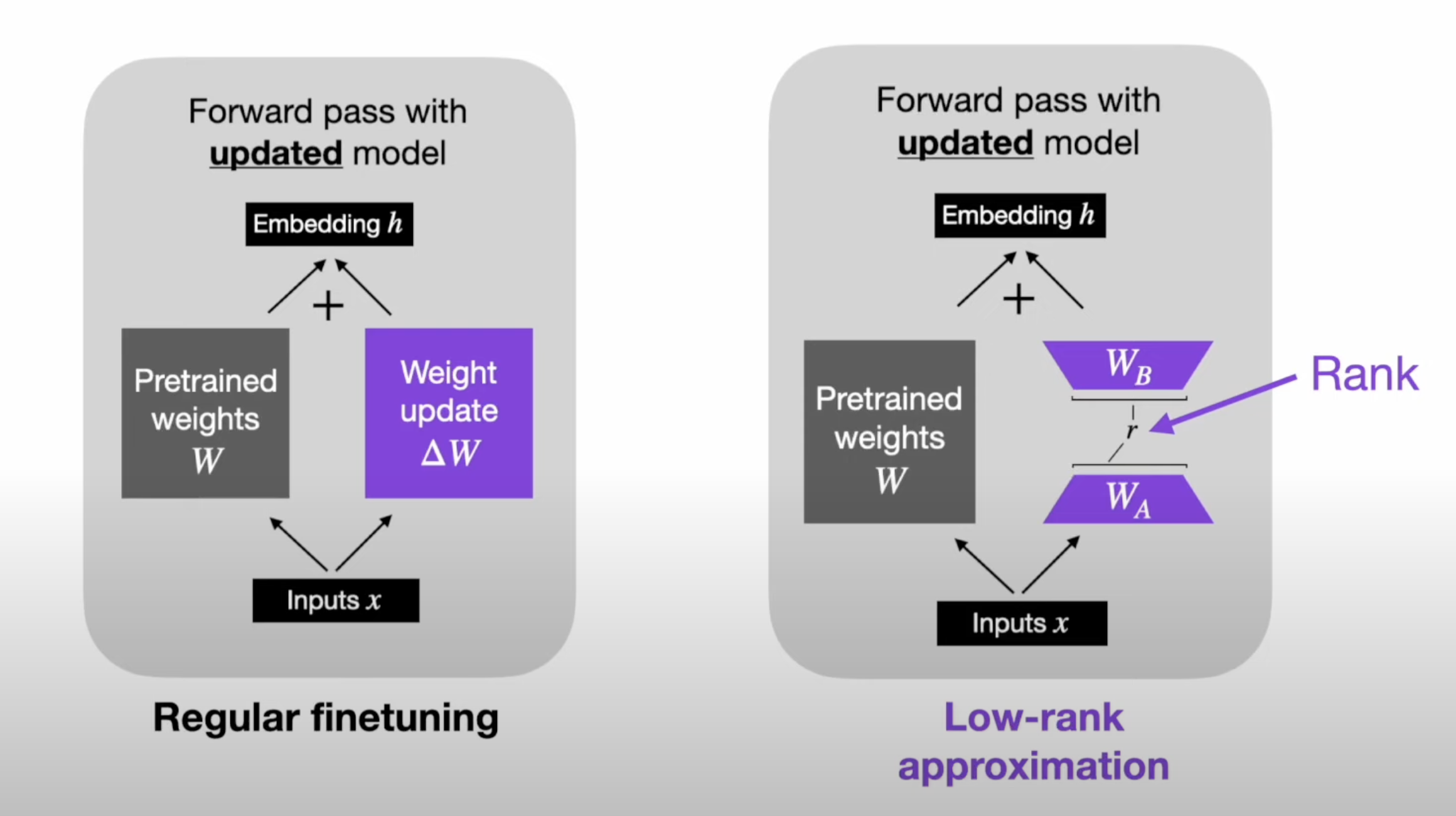
However, LoRA (16-bit) QLoRA (4/8-bit) fine-tuning can be done on a single GPU, assuming you can fit the model on it. Everything is frozen, except for a separate small network, which is updated during training. This can have BF16 or F32 precision, and would be trained as you would a regular network.

What I am suggesting is to actually leverage bigger models that come out, and attempt to compress them using the proposed algorithm (if it actually scales to bigger models). From there, we could employ some tricks to improve performance, think latent reasoning, community-driven RLHF only on the (Q)LoRA layers, etc. With time, we would be able to pool together a dataset and a pipeline that can be applied to any open-weight model that is released.

But it does sound a bit easier than it would be in practice. This heavily relies on re-purposing the Horde to also store training data (with user consent, of course), user scores, and later introduce a training queue.


Hello everyone!

TL;DR: I want to propose a community-driven effort to research and improve 1-bit LLM models, for use within and outside the Horde. I think having access to such models would be very useful for the overall project, as you do not need a lot of compute to run "bigger" models if they're compressed well. Relevant paper.

We currently live in very interesting times regarding AI development. The big companies in the US seem to still be ahead, but groups from China, working on open-weights models, are making very impressive strides. However, the focus has been and still is on developing really big models. Most of the impressive models that keep coming out are bigger and bigger, leaving most people to pay for API tokens if they want something useful. Probably this is also incentivised, as Nvidia wants to make more money from sales to data centers.

I have been keeping an eye out for the AI Horde project, and I always wanted to help out, but never got around to setting it properly up due to my AMD GPU and running Windows. However, really cool project, and I wanted to congratulate everyone involved!

In my opinion, the goal of the AI Horde community also positions it as one of the very few that are capable of bringing forward some LLMs that can be "smart" on consumer-level hardware. That is, getting models that can handle long-horizon tasks well without paying providers for API access.

Since the first paper on 1.68-bit LLMs, there has been quite a few other suggestions thrown around (recent example). No one really uses these models much, as the quality is seriously degraded. Similarly, no one is really trying to improve these models further, as there is no incentive to do so when you can just pay someone 3$ per million token output from an existing open-weight model. For example, to the best of my knowledge, no one has tried to introduce latent reasoning (example) in this context, or specifically training/fine-tuning models at 1-bit levels.

So, to get to the point, would it make sense to get some community-driven research in this area? I believe that we could all pool together compute, good training data, ideas for fine-tuning / RL-training, etc. If it works out, we could have a method that makes existing larger models (say, up to 200B) available on a single 24GB GPU.

First thing I would try is to expand on the recent NanoQuant paper:

  1. Wait for weights to be released.
  2. If no weights come out, quantize a Qwen 3 32B, and try a more diverse dataset, with more tokens to see if fidelity can improve. I could get some access to GPUs for this myself. Another option for 1-bit models would be using other existing ones (e.g., Unsloth), but performance degradation is much bigger in those versions, from what I have seen. Furthermore, the compression of these models is not as efficient, and you would not be able to fully run a 70B parameter (as described in the paper), with only 8GB VRAM.
  3. Get an LLM (or human volunteers) to determine behaviour on various tasks: find limitations, strengths, etc. Get some human preferences for RLHF, or use a bigger LLM to grade output quality. Preference here on logic tasks.
  4. Perform fine-tuning of 1-bit model based on the gathered data, and deploy for use. Return to step 2 after a while.

Fine-tuning the 1-bit model might get a bit hairy, as the binary operation are not differentiable. We also wouldn't be able to up-cast back to F32 for regular training, as this would completely invalidate the consumer-driven access to these models. Simplest idea would be to train a LoRA head, or do some stochastic-driven training (e.g., flipping bits). However, the latter would probably be very unstable, and not work out, and LoRA might be the only option. I'm not a mathematician, so I am open to suggestions here :)

Past the initial prototype, I would consider the following stuff that's already implemented in other quants:

  • Try to re-calibrate the LayerNorm / RMSNorm parameters based on the original model's activations.
  • Perform some regular KL-divergence distillation
  • Other than using an LLM as a judge for RL, perhaps one could also fine-tune using a semantic similarity metric while aligning with the output of the original model. This could ensure that the intent is the same, even if the style differs.
  • Depending on token complexity, look into reducing compression just for difficult tokens and compressing further for easy ones (à la FlexQuant)
  • Mixture-of-Experts-style quantization, where we increase compression for experts that are not important, and reduce it for higher-frequency ones.

Curious what everyone thinks!


Hello everyone! I am interested in replacing the Google Speech Recognition and Synthesis app on Android. For Speech-to-Text (STT), I've tried Whisper and FUTO, and settled on the latter because it seemed to be more versatile. Also, FUTO seems to have some decent recognition, but not yet capable of handling all the languages that I want. Regardless, so far happy with STT. The only annoyance I have is that it does not appear as an option in the settings for Speech recognition :(

However, I can't seem to find any replacements that have good Text-to-Speech (TTS) quality. I tried espeak-ng and RHVoice, but both have robotic outputs.

Given the recent advancements in AI, I was expecting that there would be ways to incorporate open source TTS models like Kokoro to generate speech on the go. Nevertheless, I could not really find any such apps so far.

Has anyone managed to completely replace the Google app with (an)other privacy-focused FOSS app(s)?

32
submitted 1 year ago* (last edited 1 year ago) by andrew0@lemmy.dbzer0.com to c/europe@feddit.org
 

Some great news regarding the development of computer chips in the EU. However, the total of €240 million allocated to the project is not as much as I would say we need to invest in this area. Let's see how things change in the next few years!


Previously used link: https://archive.ph/ICJZZ

Link to petition

Until now, the EU has allowed a majority of countries to rely on American big tech companies for communication and storage of sensitive data. For example, many universities across Europe rely on Google or Microsoft for email services, research data storage, and department communication. Similarly, many of them write their research using Microsoft Word, which could be used by these big companies to train their own AI models.

A majority of regular citizens rely on Meta for instant messaging apps (WhatsApp), Facebook, Instagram, but also on X (formerly Twitter), and TikTok. None of these apps are properly regulated even with EU's efforts, leaving people unshielded to other states' attempts at polarization. There is also the problem of mass profiling of users, which is used to supply targeted advertisements and sometimes influence public opinion on certain topics (cough Musk tweaking the Twitter algorithm to promote AfD cough).

The article that I supplied focuses mainly on the aspect of maintaining data privacy when our data is harvested by outside entities. However, this is, in my opinion, a horrible approach. We need to move everything ASAP to open source alternatives, and preferably EU based ones. Some attempts at this have been previously made in Germany, which should give hope to other countries in the EU.

The cost of moving away from Google/Microsoft tech stacks will be a drop in the bucket compared to the wealth that these companies extract from EU. Similarly, offering alternatives to social media like Friendica, Mastodon, Pixelfed, Lemmy, and perhaps PeerTube, would be a huge win against disinformation and propaganda from other countries. We should also push for instant messaging platforms like SimpleX that do not rely on Google's proprietary Push Notification services, and perhaps deGoogled Android devices.

If the recent events are not a catalyst to push everyone away from US software in the EU, I do not know what else will. Do you think that this would be possible at all?

235
submitted 1 year ago* (last edited 1 year ago) by andrew0@lemmy.dbzer0.com to c/europe@feddit.org
 

I have never donated money in my life before, but what happened yesterday really upset me. Ended up sending some money this morning. I know that my small donation won't contribute to much, but I am trying to help :D

I hope this post doesn't break any rules!


Hi! I'm trying to archive papers as soon as they appear in a scientific journal, and I've attempted to search for PDF links on each page using some regular web scraping.

The problem is that most of these journals will add their fancy PDF readers, and downloading the file is not as straight-forward as it seems. However, the Zotero Connector works flawlessly when you trigger the extension. Therefore, I attempted to set up a selenium instance with this extension to download the papers given a link, but I struggle to actually get the extension to trigger. I tried sending a Shift + Ctrl + S command, but that doesn't seem to get picked up. Similarly, I can't figure out how to call the extension from the console.

Did anyone else attempt such a workflow before? Am I doing something completely unnecessary, as there are better options available? Help a fellow sailor out. Thanks a lot in advance for your help!

91
submitted 2 years ago* (last edited 2 years ago) by andrew0@lemmy.dbzer0.com to c/technology@lemmy.world
 

I recently discovered that Redox OS got a new release earlier this month. I'm quite surprised how far they managed to get, given that only a handful of people are working on this project (compared to the Linux kernel).

Now, I'm curious what it would take to get bigger players to focus on this project. Given the recent Linux + Rust drama, it would surprise me if the backers of Rust for Linux would not give this project some attention.

view more: next ›