Wave

joined 2 years ago
[–] Wave@monero.town 3 points 4 months ago* (last edited 4 months ago)

If you are a miner yourself, use P2pool.io. It has some advantages over the pools as they used to be known. The decentralization makes it hard to block. Every operator helps. Also, P2pool has no fees or high withdrawal limits. GUPAX makes P2pool very easy if you only want to mine with a single desktop computer.

[–] Wave@monero.town 3 points 4 months ago

With over 11 years of history, we can now say with certainty that Monero was started by individuals. Over time, autonomous systems, scripts and high-performance computers have also played a part, albeit a small one. As long as we have XMR in our private wallets and use them, we are already participating in the Monero system. Operating a network node ourselves and, at best, connecting our wallets to it is a further step that allows the individual to become a large part of the system. Anyone who also mines with their computer actively participates in the consensus logic and helps the entire network. And anyone who actively participates in the community and tells others about Monero is definitely also an important part of Monero.

[–] Wave@monero.town 2 points 4 months ago

Monero recomended wallets:

It is best to stick to the suggestions on the official website getmonero.org

[–] Wave@monero.town 2 points 4 months ago* (last edited 4 months ago)

With every use of Monero we show that we are against surveillance, control and paternalism of states and institutions. Monero is for the individual, for the single person.

Never Meant to Be Controlled — So Why Are We Letting It Happen?

Monero is permissionless. Nobody has to ask to participate in the system. If, for example, Microsoft or Amazon decide to mine XMR on all their instances next week, nobody can or should do anything about it. See it as a accolade if others turn to Monero and, however, take advantage of it and actively use the system.

[–] Wave@monero.town 1 points 5 months ago

You are spreading salty untruths. Are you sad now because in this case their communication was obviously not perfect? No problem.

[–] Wave@monero.town 1 points 5 months ago

use cakepay.com

[–] Wave@monero.town 0 points 5 months ago (2 children)

I watched the video. You should view this gentleman's opinion with skepticism and not share and spread it. It only unsettles technically inexperienced users, who most likely do not increase the security level in the Tor browser anyway. This has been discussed, so the majority of users never adjust the security slider in the Tor browser. And now only the Tor Browser user's operating systems are recognizable for visited websites. So Linux, Mac, Windows, not every system is always spoofed as Windows anymore. This was a conscious decision by Torproject. You shouldn't put the opinion of a guy on Youtube above the competence of the developers.

[–] Wave@monero.town 0 points 5 months ago

This news is definitely not all positive, but should be viewed with skepticism.

Please remember to use two wallets: One for receiving XMR and another for sending/paying. Only use the wallet for receiving XMR to top up the other payment wallet. The receiving wallet is never used to send to other wallets and the address is never published. - Two Wallets Increase Your Privacy

[–] Wave@monero.town 3 points 5 months ago* (last edited 5 months ago)

In their proof of concept, they show that they can use their computing power to mine Monero during idle times.

There is no attack, it just makes other pools less profitable because they have a lot of computing power. And no, the display is not incorrect, it just fluctuates a lot.

I only see it as positive! It brings variety to the existing mining infrastructure and makes Monero's widely distributed system that little bit better.

[–] Wave@monero.town 1 points 6 months ago

Makes the traffic pattern statistically indistinguishable from honest noise.

That sounds very interesting to me. Presumably certain network participants already stand out from the crowd. These can be external factors or internal ones. For example, could the transaction propagation of devices with weak computing power already be identifiable as such? Or those of a particular internet provider?___


XMR p2pool-mini meets XTM Tari

  • 20 MH/s - May 5th, 2025
  • 77 MH/s - May 6th, 2025

https://tari.com/

https://p2pool.io/mini/#pool


X @zachxbt zachxbt/status/1917535854085497185

Update: It is confirmed to be a social engineering theft from an elderly individual in the US.

X @zachxbt zachxbt/status/1916756932763046273

Nine hours ago a suspicious transfer was made from a potential victim for 3520 BTC ($330.7M)

Theft address

bc1qcrypchnrdx87jnal5e5m849fw460t4gk7vz55g

Shortly after the funds began to be laundered via 6+ instant exchanges and was swapped for XMR causing the XMR price to spike 50%


Julkaistu 24.01.2024 🤦‍♀️ 🤷‍♀️ https://www.mtvuutiset.fi/artikkeli/vastaamo-jutussa-iso-paljastus-krp-jaljitti-jaljittamattomana-pidettya-kryptovaluuttaa/8864046

According to Binance, the funds received in the account were exchanged from Monero back into Bitcoins. According to the KRP report, most of the funds were again transferred onwards, this time in two different directions.

Binancen mukaan tilille tulleet varat vaihdettiin Moneroista takaisin Bitcoineiksi. KRP:n selvityksen mukaan suurin osa niistä siirrettiin jälleen eteenpäin, tällä kertaa kahteen eri suuntaan.

Another path followed by the KRP led police from Binance to an online service that promises to exchange virtual currency for cash instantly.

Toinen KRP:n seuraamista poluista johti poliisin Binancesta erääseen verkossa toimivaan palveluun, joka lupaa vaihtaa virtuaalivaluuttaa rahaksi välittömästi.

The dates of the transfers also coincided perfectly with the payments traced by the KRP.

Siirtojen ajankohdat myös menivät täydellisesti yksiin KRP:n jäljittämien maksujen kanssa.


What should I do with my Monero (XMR) before support ends?

You have until August 10, 2025, to send XMR to another supported wallet.

How do I send XMR from Exodus to Cake Wallet?

After creating your new Cake Wallet, you can send XMR from Exodus to Cake Wallet as a normal transaction.

To get started, follow the appropriate guide based on your device: https://www.exodus.com/support/en/articles/10862085-what-should-i-do-with-my-monero-xmr-before-support-ends


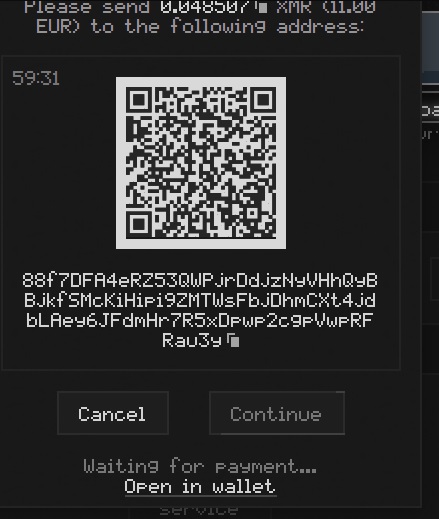
On kyun.host you top up your balance by sending Monero. They give you 10% for free. Clear terms and conditions and you only need a password, not even an email address.
 

Two Wallets Increase Your Privacy - O.S.P.E.A.D with ArticMine & Duke Leto

  • RULE 1: Only give out stealth addresses (starting with an 8...) to your Incoming wallet.
  • RULE 2: Always make a new stealth address for different people/services. For example, don't give the same address to two different exchanges, that hurts your privacy.
  • RULE 3: Only send out out funds from your Outgoing wallet. Never give out any addresses from this wallet, ever!
  • RULE 4: The only time you send funds out of Incoming is to "top up" funds in your Outgoing wallet. Never send funds to a third party from your Incoming wallet, ever!

Copied from this website mentioned in the video 'O.S.P.E.A.D with ArticMine & Duke Leto'.


“Monero can do what I thought bitcoin could, which means it has value

The question is, how much is it worth?”- @PeterSchiff

8:03 PM · Mar 11, 2025 https://x.com/CrashiusClay69/status/1899551812291543445

https://files.catbox.moe/0kz3s3.webp

https://www.reddit.com/r/Buttcoin/comments/1jbn89m/even_less_useful/


Stealth addresses represent a significant step forward in the push for greater privacy on Ethereum. By concealing transaction details and allowing users to send and receive funds without revealing their identities, ERC-5564 and ERC-6538 enhance blockchain security and usability. However, challenges like potential centralization risks and transaction fee limitations must be addressed for widespread adoption.


Activate the blocklist in the Monero GUI wallet or Monero node.

I've written this here before, but even if it only draws the attention of a few wallet and node operators to the banlist, it's already worth it. It reduces the connections to suspicious, potentially useless or even counterproductive nodes in the Monero network.

Monero GUI wallet

If your run your own local node through the GUI wallet, go to Settings. In the “Daemon startup flags” box, input “–ban-list ”. Then click the orange “Stop daemon” button. It will take a few seconds for the daemon to shut down. Then click the orange “Start daemon” button. If you use a remote node, whoever operates the remote node will decide if the ban list is enabled.

node operators enable a ban list

The Monero Research Lab (MRL) has decided to recommend that all Monero node operators enable a ban list

https://github.com/Boog900/monero-ban-list/blob/main/ban_list.txt

Download the ban list and:

./monerod --ban-list

🧐 https://gist.github.com/Rucknium/76edd249c363b9ecf2517db4fab42e88


cross-posted from: https://monero.town/post/5362939

P2P Economy

  • A Peer-to-Peer Electronic Cash System.

As we all know, Bitcoin, the origin of blockchain, is widely recognized as the most decentralized blockchain and the most valuable cryptocurrency. However, few people realize that in the Bitcoin whitepaper, Satoshi Nakamoto never mentioned “blockchain” nor “decentralization.” Instead, he used the term “peer-to-peer” (P2P), even placing it directly in the title — “Bitcoin: A Peer-to-Peer Electronic Cash System.”

A P2P service is a decentralized platform whereby two individuals interact directly with each other without a third-party intermediary. When we return to first principles and rethink what blockchain truly is, one straightforward explanation comes to mind — blockchain is essentially a P2P network.

The truth is, what we refer to as “on-chain” is actually the consensus layer built on top of the P2P network. However, many business processes don’t need to be on-chain and rely on the consensus layer; they can be handled directly at the P2P network layer. For example, if Alice wants to pay Bob, the ideal way would be for Alice to send the money directly to Bob in a peer-to-peer manner rather than through unnecessary intermediaries (e.g., consensus validators or block producers). This approach is not only faster but also naturally provides privacy protection.

Moreover, building applications at the P2P network layer avoids performance bottlenecks and high transaction fees, enabling the creation of truly useful applications that can achieve mass adoption.

  1. The P2P Economy addresses real-world problems with genuine user demand and practical application scenarios (e.g., P2P payment, decentralized storage). This has been thoroughly proven for years rather than being an imaginary need. It can truly create value rather than merely providing tools for speculation.

  2. In the P2P Economy, most business logic does not need to be on-chain, eliminating performance bottlenecks and transaction fee issues. As a result, the user experience is greatly improved, making mass adoption more likely.

  3. The P2P Economy uses stablecoin payments, making it easy for users to understand and convenient for participants to evaluate service costs and revenue. The use of stablecoins also weakens the speculative narrative of token issuance.

👍 Read the entire article: hackernoon.com - p2p economy blockchain renaissance


cross-posted from: https://monero.town/post/5362939

P2P Economy

  • A Peer-to-Peer Electronic Cash System.

As we all know, Bitcoin, the origin of blockchain, is widely recognized as the most decentralized blockchain and the most valuable cryptocurrency. However, few people realize that in the Bitcoin whitepaper, Satoshi Nakamoto never mentioned “blockchain” nor “decentralization.” Instead, he used the term “peer-to-peer” (P2P), even placing it directly in the title — “Bitcoin: A Peer-to-Peer Electronic Cash System.”

A P2P service is a decentralized platform whereby two individuals interact directly with each other without a third-party intermediary. When we return to first principles and rethink what blockchain truly is, one straightforward explanation comes to mind — blockchain is essentially a P2P network.

The truth is, what we refer to as “on-chain” is actually the consensus layer built on top of the P2P network. However, many business processes don’t need to be on-chain and rely on the consensus layer; they can be handled directly at the P2P network layer. For example, if Alice wants to pay Bob, the ideal way would be for Alice to send the money directly to Bob in a peer-to-peer manner rather than through unnecessary intermediaries (e.g., consensus validators or block producers). This approach is not only faster but also naturally provides privacy protection.

Moreover, building applications at the P2P network layer avoids performance bottlenecks and high transaction fees, enabling the creation of truly useful applications that can achieve mass adoption.

  1. The P2P Economy addresses real-world problems with genuine user demand and practical application scenarios (e.g., P2P payment, decentralized storage). This has been thoroughly proven for years rather than being an imaginary need. It can truly create value rather than merely providing tools for speculation.

  2. In the P2P Economy, most business logic does not need to be on-chain, eliminating performance bottlenecks and transaction fee issues. As a result, the user experience is greatly improved, making mass adoption more likely.

  3. The P2P Economy uses stablecoin payments, making it easy for users to understand and convenient for participants to evaluate service costs and revenue. The use of stablecoins also weakens the speculative narrative of token issuance.

👍 Read the entire article: hackernoon.com - p2p economy blockchain renaissance


P2P Economy

  • A Peer-to-Peer Electronic Cash System.

As we all know, Bitcoin, the origin of blockchain, is widely recognized as the most decentralized blockchain and the most valuable cryptocurrency. However, few people realize that in the Bitcoin whitepaper, Satoshi Nakamoto never mentioned “blockchain” nor “decentralization.” Instead, he used the term “peer-to-peer” (P2P), even placing it directly in the title — “Bitcoin: A Peer-to-Peer Electronic Cash System.”

A P2P service is a decentralized platform whereby two individuals interact directly with each other without a third-party intermediary. When we return to first principles and rethink what blockchain truly is, one straightforward explanation comes to mind — blockchain is essentially a P2P network.

The truth is, what we refer to as “on-chain” is actually the consensus layer built on top of the P2P network. However, many business processes don’t need to be on-chain and rely on the consensus layer; they can be handled directly at the P2P network layer. For example, if Alice wants to pay Bob, the ideal way would be for Alice to send the money directly to Bob in a peer-to-peer manner rather than through unnecessary intermediaries (e.g., consensus validators or block producers). This approach is not only faster but also naturally provides privacy protection.

Moreover, building applications at the P2P network layer avoids performance bottlenecks and high transaction fees, enabling the creation of truly useful applications that can achieve mass adoption.

  1. The P2P Economy addresses real-world problems with genuine user demand and practical application scenarios (e.g., P2P payment, decentralized storage). This has been thoroughly proven for years rather than being an imaginary need. It can truly create value rather than merely providing tools for speculation.

  2. In the P2P Economy, most business logic does not need to be on-chain, eliminating performance bottlenecks and transaction fee issues. As a result, the user experience is greatly improved, making mass adoption more likely.

  3. The P2P Economy uses stablecoin payments, making it easy for users to understand and convenient for participants to evaluate service costs and revenue. The use of stablecoins also weakens the speculative narrative of token issuance.

👍 Read the entire article: hackernoon.com - p2p economy blockchain renaissance

view more: ‹ prev next ›