Heikki

joined 1 month ago
[–] Heikki@sopuli.xyz 1 points 3 weeks ago

Fair point, its in the StVO (§ 5(6)), but I believe you that quite nobody gets fined for it. I put it on the map because caravan drivers asked whether pulling over on mountain roads is just good manners or actually expected; legally its the second, in practice its the first.

Do you know any stretch where its actually checked?

[–] Heikki@sopuli.xyz 1 points 3 weeks ago

Well put and thats the trap with planning these from a map.

The NC500 is 516 miles, but on the single-track west coast you're doing 20–30 mph between passing places, so "a day" on Google becomes three or four.

Thats also why I list days rather than hours for these roads. And yes, meeting that coach on a blind bend is a rite of passage, reverse to the last passing place and wave. Altought like in Germany theres autobahns with no speed limit and I can drive in night time 100mph for long distances

[–] Heikki@sopuli.xyz 1 points 3 weeks ago

Yes thats why its amber ("with a bypass") rather than red on the map.

The sign at the Tornapress end says the road isnt advised for learner drivers, very large vehicles or caravans after the first mile, and the official NC500 site tells anything bigger than a VW T5-size camper to take the low road via Shieldaig instead (same for the B869 Drumbeg road). Not banned, just a bad idea and the low road is lovely too.

[–] Heikki@sopuli.xyz 1 points 3 weeks ago (2 children)

True, like Germany has it in the traffic code: StVO §5(6) says the driver of a slower vehicle must slow down at a suitable place, and wait if necessary, when that's the only way several vehicles right behind can overtake.

In the UK it's in the Highway Code (rule 169: "Do not hold up a long queue of traffic… pull in where it is safe and let traffic pass"), though there it's guidance rather than law. Thanks I will put the German rule on the German Alpine Road's caravan row.

[–] Heikki@sopuli.xyz 3 points 3 weeks ago

Hehe, I think your right, from the page you can choose where to start your own trip and these "Road Trips" are the one highlight of the trip, the short ones are "a day for 50 km" roads - Stelvio is 46 km with 48 hairpins on one side, Grossglockner 48 km and you'll still stop every few bends.

Most Europeans string them into a longer trip: the Route des Grandes Alpes is ~700 km (435 mi) over 17 passes, the North Coast 500 is 516 miles, the Wild Atlantic Way 2,500 km (1,550 mi), and Iceland's Ring Road 1,322 km. And getting there is half of it: from Amsterdam to Stelvio is already ~900 km (560 mi) before the first hairpin.

[–] Heikki@sopuli.xyz 1 points 3 weeks ago

Agreed, and it seems to be spreading. In the Picos de Europa the road up to the Covadonga lakes is closed to private cars on set dates (most of June to mid-October) and a shuttle bus takes you up instead, and South Tyrol has been testing access limits on the Passo Gardena with possible measures from summer 2027.

The Amalfi rule is a bit odd in one way though: the plate days apply only 10:00–18:00, so the early birds still get the road to themselves.

[–] Heikki@sopuli.xyz 2 points 3 weeks ago

Thanks! There's no public API at the moment and the code isn't open source, but most of the data is open: each map page has a CSV download under CC BY 4.0 (free to use, self-host and change, with a credit to copilot.travel) winter tyres, low-emission zones, compulsory equipment, caravan speed limits, licence rules, gas bottles on ferries and more, with every rows source.

A CSV for these famous roads is coming in the next few days. Everything is listed at https://copilot.travel/press. If you need something specific, fields, countries, how often it is updated, tell me at a private message what you have on your mind, and lets see what we can do!

[–] Heikki@sopuli.xyz 2 points 3 weeks ago (4 children)

You have a good point, and I have been on the other side of it too. The map only shows what's legally allowed "yes" doesnt mean it is a good idea, and on the narrow passes its often better to leave the caravan in the valley and do the pass as a day trip.

If you do tow over one, the decent thing is to pull into the next lay by whenever a queue builds behind you. Locals on their way to work or family didnt choose to be part of someone's holiday that understandable. I will add that to the caravan notes for the mountain routes!

[–] Heikki@sopuli.xyz 3 points 3 weeks ago (2 children)

Fair question!

Every fare and rule comes from the road authority's or operator's own page,each row on the page links to its source. I used tools to collect and compare them, and I re-checked the three figures in this post against the sources today: Grossglockner's €46.50 / €36.50 is on grossglockner.at, and the Geiranger–Hellesylt fares are Fjord1's 2026 price list (NOK 810 car, NOK 2,000 for 10–14 m, NOK 650 motorcycle, converted to euros).

Fuel is calculated, not looked up: the EU's weekly pump prices for each country on the route times a typical consumption. If you spot anything off, tell me and I'll fix it, database is on the copilot.travel site that holds quite a lot of information.


20 famous European road trips, each coloured by whether a car towing a caravan may drive it: 10 the whole road, 7 with a bypass, 3 not at all (Stelvio, the Amalfi coast road, the Lake District's Hardknott/Wrynose loop).

A few things that surprised me while reading the rules:

  • Amalfi coast road (SS163): campers and caravans are banned 06:30–24:00, while motorbikes are exempt from the odd/even number-plate days cars get in summer.
  • Grossglockner: a motorcycle's day ticket is €36.50 against €46.50 for a car — and a car with a caravan pays the car rate.
  • Geiranger–Hellesylt ferry: about €76 for a car with its driver, €187 for a car + caravan (10–14 m), €61 for a motorbike.

Rules read on 5 Nov from the road authorities and operators (where only a secondary source says it, the page says so). Each road is priced for car, car + caravan, motorhome and motorcycle: https://copilot.travel/maps/famous-road-trips Corrections welcome.

[–] Heikki@sopuli.xyz 2 points 1 month ago

Thanks, that matches what we found. The map shows Denmark as "no winter-tyre law", with the note that since 1 July 2025 "obviously unsuitable" tyres for the conditions can be fined (Færdselsstyrelsen, linked in the table).

One small difference from Germany: the Danish authority says M+S tyres count as approved winter tyres and only recommends the snowflake mark for hard winter driving, so it isn't required the way it is in Germany.

[–] Heikki@sopuli.xyz 2 points 1 month ago

Thanks, that matches what we read from Statens vegvesen: studs from 1 November to the first Sunday after Easter Monday 16 October to 30 April in Nordland, Troms and Finnmark, and longer when conditions call for it.

That's why Norway is shown as "wintry conditions at any time" the grip rule is the one that decides. And Oslo's stud fee applies even when you only drive through ofcourse.

[–] Heikki@sopuli.xyz 3 points 1 month ago (1 children)

The shades are close. Three on purpose: the lighter grey (Poland, Hungary, the Netherlands) means "no winter-tyre law" the darker one (Ukraine, Belarus, Moldova) means "not verified / not covered" we only map what we can read in a countries own law or traffic authority, Russia is just the base map, outside what is covered


Made in October 2026. Each country's rule was read from its own law or transport authority on 24–25 Oct 2026; every source is linked in the full table: https://copilot.travel/maps/winter-tyres

A few things that surprised me:

  • Estonia requires winter tyres 1 Dec–1 Mar whatever the weather; Finland 1 Nov–31 Mar only when conditions require.

  • Germany only accepts tyres with the snowflake (3PMSF) mark in wintry conditions; old M+S-only tyres no longer count.

  • Caravans need winter tyres too in Finland, Sweden, Estonia and Lithuania; in Germany, Austria and France the rule only covers the towing car.


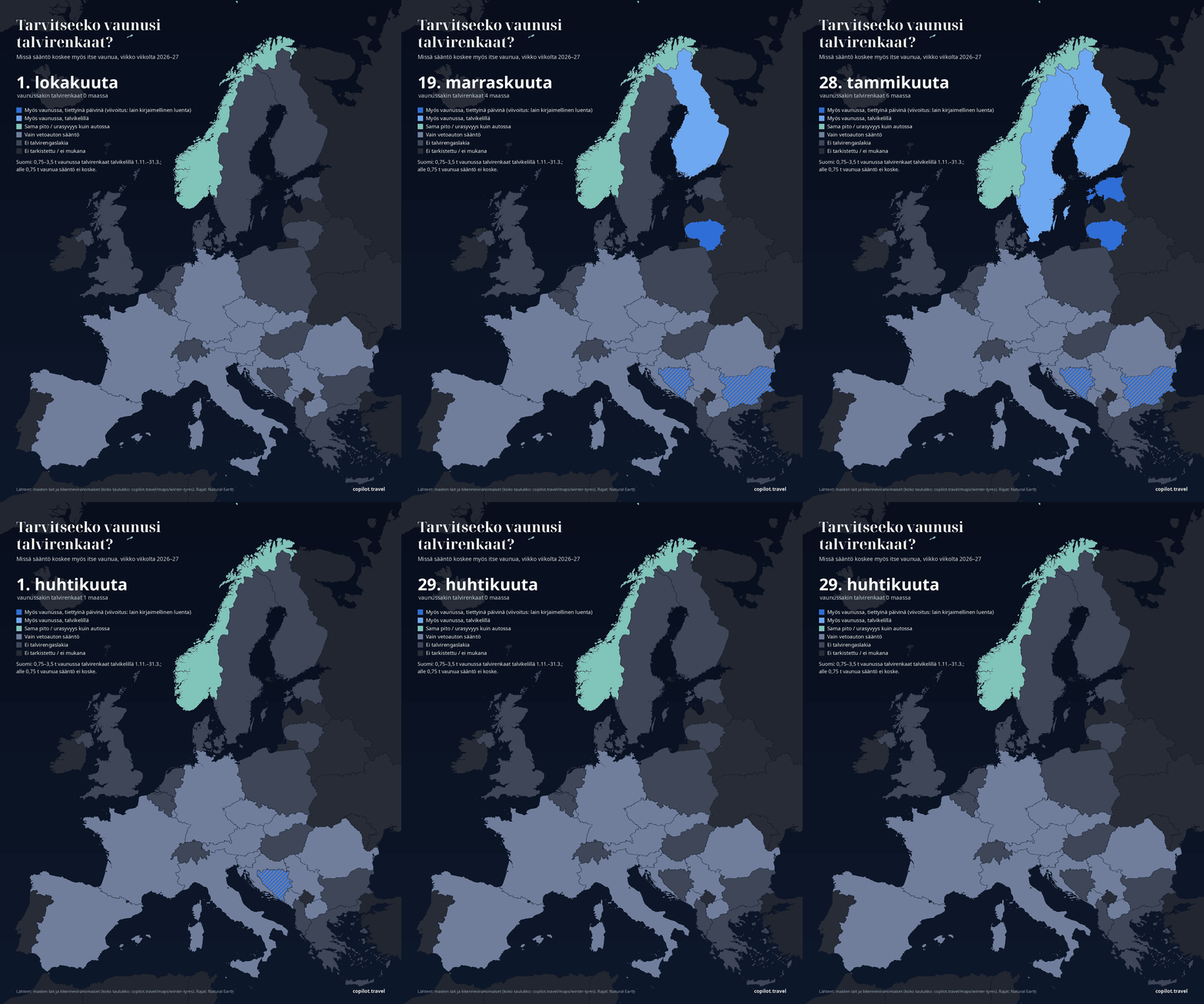
Tein kartan talvirengassäännöistä Euroopassa lokakuusta huhtikuuhun. Jokainen sääntö on luettu maan omasta laista tai liikenneviranomaisen sivulta.

  • Suomi: talvirenkaat 1.11.–31.3., jos sää tai keli vaatii (Traficom). Kitkarenkaissa lumihiutalemerkki (3PMSF) 1.12.2024 alkaen.

  • Viro 1.12.–1.3. kelistä riippumatta, Ruotsi 1.12.–31.3. talvikelillä, Saksa aina liukkaalla – ja siellä kelpaa vain lumihiutalemerkitty rengas.

  • Vaunussakin talvirenkaat: Suomi (0,75–3,5 t), Ruotsi, Viro, Liettua.

  • Puolassa enintään 3,5 tonnin auto vaunun kanssa ei 21.9.2026 alkaen enää maksa e-TOLL-maksua.

Asuntovaunut : https://copilot.travel/maps/winter-tyres/vaunun-talvirenkaat.gif

Koko taulukko lähteineen: https://copilot.travel/maps/winter-tyres

view more: next ›