GlobalMagenta

joined 2 years ago
MODERATOR OF
 

The flight crew reported that the first officer (FO) was the pilot flying and the captain was the pilot monitoring. The departure from EWR and the cruise segment of the flight were uneventful. Upon arrival at IAH, they were cleared for the DOOBI2 arrival and the ILS 26L approach. According to the flight crew, the airplane was fully configured for landing, on speed and in compliance with the company’s stable approach criteria and the initial touchdown on the main wheels was normal. The FO stated that after the main landing gear touched down, he held aft pressure on the control yoke to keep the nose wheel from hitting the runway; however, the nose wheel made contact with abnormal force. The airplane appeared to bounce, and he reacted by pulling aft on the control yoke, in an effort to keep the nose wheel from impacting the runway a second time. Subsequently, the speed brakes deployed, and the auto brakes engaged which resulted in a second bounce of the nose wheel. He deployed the thrust reversers, and the airplane began to decelerate. The captain assumed control of the airplane and the remainder of the landing rollout was normal with no risk of runway overrun or excursion.

A preliminary review of the flight data recorder (FDR) revealed that after the initial touchdown on both main wheels, the airplane rolled to the left and right main gear lifted off the runway’s surface. Subsequently, the nose wheel touched down with a gravitational force equivalent (g) of about 1.4 g and bounced. The speed brakes deployed, and the nose wheel impacted the runway a second time with a force of about 1.6 g followed by another bounce. The right thrust reverser (TR) deployed, and the nose wheel impacted the runway again with a force of about 1.6 g followed by the deployment of the left TR.

A postaccident examination of the airplane revealed substantial damage to the crown of the upper fuselage.

Source


A Westjet 737 (C-FWSI) collided this week with a C130 at Comox Airport, Canada. The flight was operated from Comox to Edmonton and was cancelled.


Cathay Pacific A350 makes a very hard, high pitch landing at London Heathrow.


cross-posted from: https://lemm.ee/post/3435410

White Elephants are frequently seen in cases involving bridges, and Belgium has quite a few examples. This particular bridge in Belgium serves as an illustration of a White Elephant.

A new bypass road was planned by the city and the government of Wallonia. While planning this bypass, this bridge was already constructed in a farmers field over a low-used agricultural road. This occurred even though the route of the bypass had not been established, and the funding had not yet been secured.

As time went on, a change in the City Council's leadership and objections from the farming community led to the project being put on hold and eventually scrapped altogether. Today, the bridge stands as the solitary relic of the abandoned bypass plan.

Source

1
submitted 2 years ago* (last edited 2 years ago) by GlobalMagenta@lemm.ee to c/whiteelephant@lemm.ee
 

White Elephants are frequently seen in cases involving bridges, and Belgium has quite a few examples. This particular bridge in Belgium serves as an illustration of a White Elephant.

A new bypass road was planned by the city and the government of Wallonia. While planning this bypass, this bridge was already constructed in a farmers field over a low-used agricultural road. This occurred even though the route of the bypass had not been established, and the funding had not yet been secured.

As time went on, a change in the City Council's leadership and objections from the farming community led to the project being put on hold and eventually scrapped altogether. Today, the bridge stands as the solitary relic of the abandoned bypass plan.

Source


A nuclear power plant was built in Kalkar, Germany, and was completely constructed, ready to accept nuclear fuel. However, the project was put on hold and later canceled.

Background

The SNR-300 project began in the 1970s as a collaboration between Germany, Belgium and the Netherlands and aimed to demonstrate the viability of fast breeder reactor technology. However, due to various factors including safety concerns, cost overruns, and public opposition to nuclear energy, the project faced multiple delays and controversies. In the late 1980s, following the Chernobyl disaster and growing anti-nuclear sentiment, the governments decided to cancel the SNR-300 project.The construction of the reactor was halted, and the project was officially abandoned in the early 1990s.

Some of the structures were later demolished and equipment was either sold or destroyed. The already received nuclear fuel was transported to France, where it was used in their nuclear reactors.

Repurpose

The site where the SNR-300 was being built, was repurposed into an amusement park known as "Wunderland Kalkar." The reactor building was transformed into a hotel, and the surrounding area now hosts various attractions.


Als kruisbericht geplaatst vanaf: https://lemm.ee/post/3221727

In Charleroi, Belgium, a significant portion of the light-rail network was built using shell structures, but it never became operational due to financial limitations. This was due to insufficient funds to complete the construction and cover operational expenses.

During the 1960s, the government initiated plans for an extensive light-rail network consisting of a central ring with 8 outward lines. The network's design aimed for maximum efficiency by avoiding road intersections, leading to the inclusion of numerous tunnels and viaducts in the blueprint.

Over the subsequent decades (70s, 80s, and 90s), only a portion of the central ring was actually built, and construction was limited to just 3 outward lines. Unfortunately, the project proved too costly, exacerbated by the economic decline in the Wallonia region caused by industrial downturn. As a result, certain parts of the network were constructed using basic structures and remain unused to this day.


In Charleroi, Belgium, a significant portion of the light-rail network was built using shell structures, but it never became operational due to financial limitations. This was due to insufficient funds to complete the construction and cover operational expenses.

During the 1960s, the government initiated plans for an extensive light-rail network consisting of a central ring with 8 outward lines. The network's design aimed for maximum efficiency by avoiding road intersections, leading to the inclusion of numerous tunnels and viaducts in the blueprint.

Over the subsequent decades (70s, 80s, and 90s), only a portion of the central ring was actually built, and construction was limited to just 3 outward lines. Unfortunately, the project proved too costly, exacerbated by the economic decline in the Wallonia region caused by industrial downturn. As a result, certain parts of the network were constructed using basic structures and remain unused to this day.


cross-posted from: https://lemm.ee/post/3163065

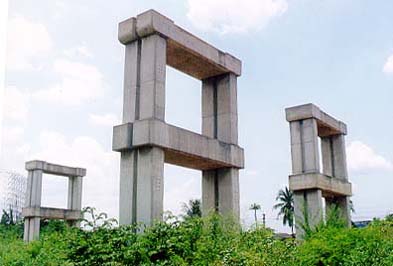
Construction commenced in 1990 for the Bangkok Elevated Road and Train System (BERT), connecting central Bangkok to the former main airport, Don Mueang International Airport. The initiative aimed to alleviate escalating traffic congestion by implementing an elevated roadway and rail network.

However, the project was largely halted in 1992 and was eventually terminated in 1998 due to legal and financial complications. By then, around 13% of the project had been executed, mainly in the form of concrete pillars designed to support the highway and railway tracks.

Some of these pillars have been dismantled, while the remainder still stands. These abandoned pillars have garnered the nickname "Thai Stonehenge" due to the artistic appearance of certain pillar structures.

The construction company estimated the works to have costed US$575 million.


Construction commenced in 1990 for the Bangkok Elevated Road and Train System (BERT), connecting central Bangkok to the former main airport, Don Mueang International Airport. The initiative aimed to alleviate escalating traffic congestion by implementing an elevated roadway and rail network.

However, the project was largely halted in 1992 and was eventually terminated in 1998 due to legal and financial complications. By then, around 13% of the project had been executed, mainly in the form of concrete pillars designed to support the highway and railway tracks.

Some of these pillars have been dismantled, while the remainder still stands. These abandoned pillars have garnered the nickname "Thai Stonehenge" due to the artistic appearance of certain pillar structures.

The construction company estimated the works to have costed US$575 million.


cross-posted from: https://lemm.ee/post/3090669

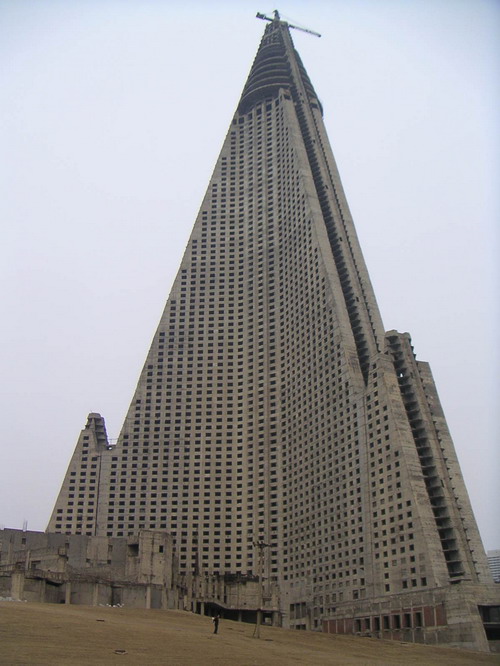
The Ryugyong Hotel in North Korea's capital, Pyongyang, is an uncompleted hotel. Construction started in 1987 and was halted several times. Most prominently during the colapse of the Soviet Union.

The hotel existed largely in a rough construction state until 2008. From then, a Egyptian construction company, Orascom, re-started construction on the exterior part of the building. By 2011 they had completed the exterior part of the building.

Up until now, only the exterior part of the building is completed. The interior part is largely empty and no works have commenced on the interior part. In recent years, a large LED panel was fitted to one of the sides of the building.

The building is up until now never used as a hotel. Unkown is why the Egyptian construction company never finished the interior.

view more: next ›