The Climate Crisis
The impacts and solutions of the Climate Crisis
That is a verifiable lie.
I disagree, but I'm open to having my mind changed.
I don't suppose you saw my post about meat and the environment? https://hackertalks.com/post/8020602
I found these two paper's from the episode particularly interesting about the environmental impacts of ruminants and nutritional arbitrage of a PBF diet (the proposed replacement for all pasture land).
Ruminants have exist before humans, they are not hurting the environment, they are the environment. Sustainable regenerative ruminant based agriculture is key to maximizing the output of the land.
https://doi.org/10.1073/pnas.1707322114 Nutritional and greenhouse gas impacts of removing animals from US agriculture
only reduced total US GHG by 2.6 percentage units.
This assessment suggests that removing animals from US agriculture would reduce agricultural GHG emissions, but would also create a food supply incapable of supporting the US population’s nutritional requirements.
Interestingly on this model, calories and carbohydrates would increase but there would be more nutritional gaps.
http://dx.doi.org/10.1038/s43247-023-00945-9 Levelling foods for priority micronutrient value can provide more meaningful environmental footprint comparisons
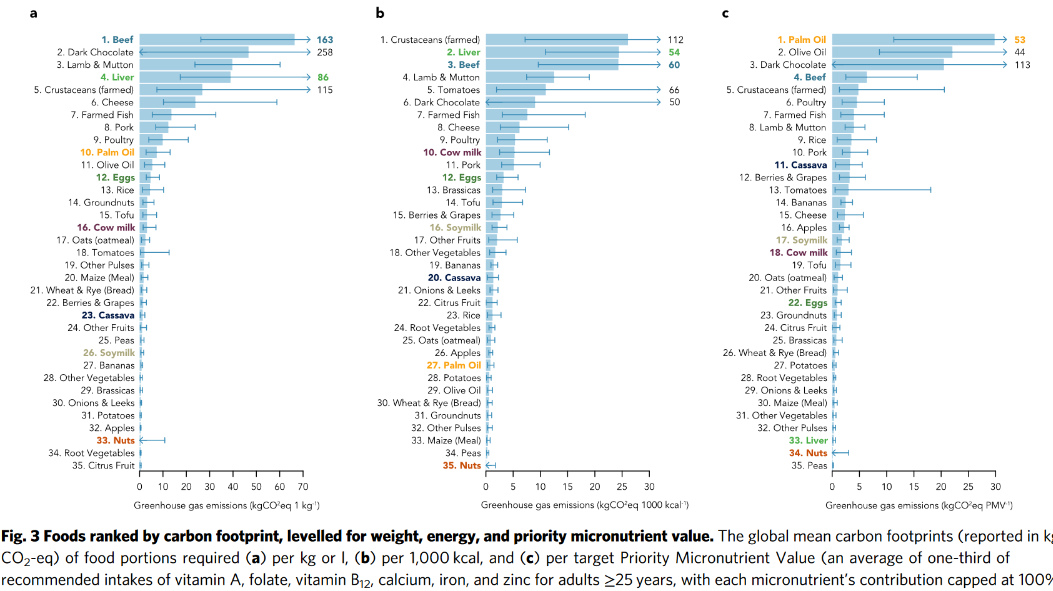
"Use of agricultural land for livestock
It’s often thought that livestock farming consumes land that could support crops, but a large portion of agricultural land is unsuitable for other uses. Livestock can convert non-arable land into nutritious food while also improving soil health."
This is a red herring. Livestock takes up 80% of agricultural land while providing only 20% of the world's supply of calories. Removing livestock would free up a significant amount of crop growing land (where crops are currently grown for livestock consumption,) which would first be repurposed for human consumption. Most pasture land could be rewilded without affecting the supply of calories to humans.
Improvements to soil health are meaningless where in its natural state, that land would take the form of forests, peatlands etc. which can sequester huge amounts of carbon.
If livestock was restricted to non-arable land and not fed any arable crops : it would be a net positive, no?
No. Without addressing water sources, if livestock only produced carbon dioxide they might come close to net neutral, but the methane they produce is a huge component of their effect on the climate; that methane simply wouldn't be a factor if the land were left fallow. They also engineer the land, preventing the growth of forest and creation of peat in areas where it would naturally occur.
The methane cycle is from the ruminates eating the grass, which is to say the microbes processing grass. The grass is going to grow with or without ruminates eating it, and microbes will process the grass all the same in a stomach or out on the grassland. I.e. the methane load is a function of the plant growth and not of the animals.
Is that not correct?
No, removing livestock will generally lead to increased vegetation and biodiversity, longer growth and more photosynthesis. There would be an increase in plant litter leading to increased microbial activity - releasing some carbon as CO2, and sequestering most of the rest in the soil.
Methane production would occur in anaerobic conditions (e.g. waterlogged or more compacted soil,) but nowhere near as efficiently as it does in the rumen of livestock.