this post was submitted on 02 Mar 2026
1487 points (99.0% liked)

Political Memes

11264 readers
1597 users here now

Welcome to politcal memes!

These are our rules:

1) Be civilJokes are okay, but don’t intentionally harass or disturb any member of our community. Sexism, racism and bigotry are not allowed. Good faith argumentation only. No posts discouraging people to vote or shaming people for voting.

2) No misinformationDon’t post any intentional misinformation. When asked by mods, provide sources for any claims you make.

3) Posts should be memesRandom pictures do not qualify as memes. Relevance to politics is required.

4) No bots, spam or self-promotionFollow instance rules, ask for your bot to be allowed on this community.

5) No AI generated content.Content posted must not be created by AI with the intent to mimic the style of existing images

founded 2 years ago
MODERATORS
top 50 comments
sorted by: hot top controversial new old
[–] merc@sh.itjust.works 25 points 2 days ago (12 children)

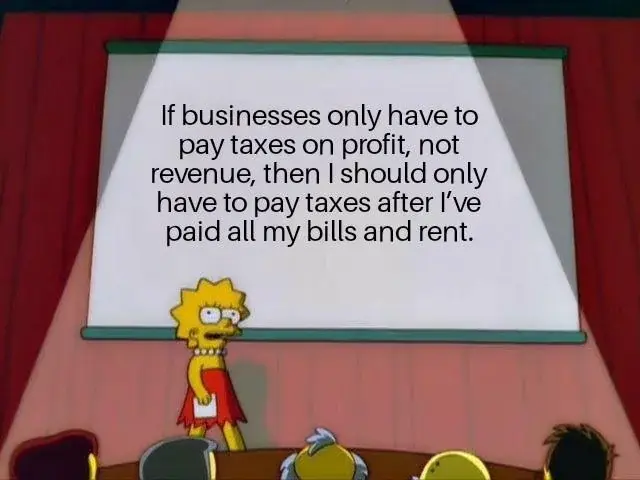
You have to think about why it works that way.

A profit from a business is money that is taken out of the business. If the activities of the business generate more money than the business is spending, it doesn't have to become profit. It can also be re-invested in hiring more people, buying more equipment, training their workforce, expanding to new locations, even given as raises or bonuses to their employees. In theory, all of the things other than generating a profit are generally things that are good for the community. Employees can get hired, or trained, or raises. The business can expand allowing more people to buy from them, etc.

A profit is taxed because it's basically what a business does when it doesn't have any other useful ways of spending its money. In that case the excess money is just going to the business owners. The government is basically saying "ok, well if you aren't going to use that money for something that benefits everyone, and are just going to give it to the owners, we'll take our cut now. If the profits go directly to the business owners as income, they're then taxed again as income tax (again, in theory, in practice business owners don't want to pay that as income tax so they'll try to arrange to avoid it).

Income taxes are a different kind of taxation. They're basically a way for the government to own part of your labour. They go back to the time when peasants worked on the land. In exchange for the soldiers protecting them from bandits, the peasants shared some of their harvest. (I realize it was much more coercive than that, but the idealized theory is that taxes were to support the government which protects you or provides you services.)

The obvious problem with "after I've paid all my bills and rent" is that "all my bills and rent" is something that someone could always adjust so they had to pay zero taxes. Even if you just limited it to "my housing expenses, food expenses, water bill, and electrical bill" someone might buy a huge house, or buy only the finest groceries, or install lavish fountains, or run up their electrical bills. So, instead you might want to say that someone only gets taxed after reasonable living expenses are deducted... and that's how things work.

Progressive taxation schemes typically mean that you pay 0 tax on your first X dollars earned per year. X is supposedly set to the minimum of what someone needs to get by. The way it's done on the US is that the lowest tax rate is set at 10%, but the standard deduction is set at $15,750, so the 10% only kicks in once you've passed that. $15,750 is absurdly low. It should really be at least double that, if not triple, but the idea is there. That's the "only after I've paid all my bills and rent" number, if you assume someone is paying the lowest rent possible and their bills are the absolute necessities. But, I don't think anybody could realistically live on their own for $15,750 per year.

So... yeah, Lisa. Things already work like that. It's just that the numbers are all fucked, there are too many loopholes and exceptions.

[–] Unlearned9545@lemmy.world 8 points 2 days ago

Businesses do the exact same thing to hide their profits, espicially since the owners can now borrow money against the value of their shares instead of relying on profits.

[–] glibg10b@lemmy.zip 2 points 2 days ago* (last edited 2 days ago)

Here's my opinion, as someone who has zero education in economics. Feel free to voice your disagreement if you know better

If your personal expenses match your income but those expenses can't be written off, the resulting taxes result in a net loss for that month. This would be the same with a business if expenses could not be written off

And in my opinion, buying a house should not be written off as a personal expense, and neither should a business buying a warehouse be able to write it off either. If something can be sold, only the permanent loss should be considered an expense -- the remainder should be an asset

But bills and rent are generally permanent expenses. You don't get anything back after paying them, except the continuation of your services. I think these should be deductible. Similarly, if a business has to pay for a SaaS solution, I'm okay with that being a deductible

Is my thinking flawed?

load more comments (10 replies)
[–] thevoidzero@lemmy.world 9 points 2 days ago* (last edited 2 days ago) (1 children)

That's how it works in many countries.

Business pays tax on profits (revenue - expenses). Salary has smaller tax for business compared to pure profits, employees don't pay it because it's not profit. So businesses have incentives to keep human employees instead of keeping all the profits for themselves.

And that applies to all businesses. So if you, for example, bought a carrot for $10, tax is included, you don't pay tax on it.

  • The distributor bought it for $6, spent $1, pays tax on their profit ($3),
  • farmer grew it, used fertilizer, seeds, labor, etc., pays tax on profit (maybe $2),
  • the fertilizer company again pays tax on their profit, and so on

In US you pay tax on every transaction. You get salary, you pay tax, you buy a thing, you pay tax, you eat something, again tax. This makes you more aware government is taking money, compared to the first scenario. But it also gives government ways to make complicated rules and give different tax benefits to different people. In the first scenario, government help goes to everyone whether they have a job or not. In this case you only get Tax cuts if you already make money.

[–] Eximius@lemmy.world 4 points 2 days ago* (last edited 2 days ago) (1 children)

This is the first time I hear that there are countries that have company profit tax more than employee tax. What countries are those?

[–] thevoidzero@lemmy.world 3 points 1 day ago* (last edited 1 day ago)

Interesting, I thought that'd be a normal thing because it makes so much sense.

I didn't go deeper into it, but I could see several examples in just the first 10 entries here:

https://en.wikipedia.org/wiki/List_of_countries_by_tax_rates

The corporate tax rate starts from high amount, while individual starts from lower amount, and in many case even the top earners don't have as high. It's mostly because top earners are still salaried and that's not "profit", if you have a business you already are paying corporate tax. Many rich people employ their family to pay less tax, but you can't do anything that requires specific qualifications.

Edit: for individual tax brackets and what is a reasonable salary, would take more research. I might do that later in the month because now I'm interested.

[–] paultimate14@lemmy.world 128 points 3 days ago (16 children)

That is basically why the Standard Deduction exists.

[–] Lodespawn@aussie.zone 50 points 3 days ago (1 children)

I dunno how it works in the US but in Aus I can't deduct anything unless it's related to work, apparently feeding and housing myself doesn't contribute to that ..

[–] huppakee@piefed.social 35 points 3 days ago* (last edited 3 days ago) (2 children)

In a lot of places a part of your income is exempt from taxes (eg brackets where you pay 0-20k @ 0%, 30-60k @ 30%, 60-100k @ 40%, 100k+ @ 50%; then your first 20k is not taxed), i think this is what they are talking about.

Edit: another possibility would be they do mean actual expenses, just reminded you can (partially) deduct education expenses from your taxes in the Netherlands.

[–] Lodespawn@aussie.zone 13 points 3 days ago

I guess you could argue that that's the reasoning behind the progressive tax regime. Australia's progressive tax lines up with the low end of that but if you were going to claim that the tax free threshold was to cover general living expenses then it's going to need to be a lot larger, 20k bere is not enough to cover rent, food and utilities here, a 3x2 near Perth is like $800/week for rent and I would argue interest on a mortgage is comparable and Perth is on the cheap end of Australian cities. That's like 40k without utilities and food. So either the tax free threshold was poorly implemented without indexation against inflation and cost of living or the driver of it isn't to cover basic cost of living and is more to ease the burden on the poor end of town. I guess you could say it's a little bit of both but arguably indexation should be implemented.

load more comments (1 replies)
[–] jj4211@lemmy.world 20 points 3 days ago (9 children)

True, and perhaps credible for a married couple with a 31k deduction, but the 15k deduction for an individual might be a bit rough for single folks.

[–] ugandan_airways@lemmy.zip 9 points 3 days ago (4 children)

It’s complete bullshit. What city can you rent an apartment for 15k/year even with roommates?

load more comments (4 replies)
load more comments (8 replies)
load more comments (14 replies)
[–] OwOarchist@pawb.social 58 points 3 days ago (5 children)

I wrote a free spec script for a charity organization, enabling me to write off ~$50k in charitable donations for putting in a few hours of work.

Everyone should be looking for loopholes and ways to prevent the US government from getting their money.

[–] TherapyGary@lemmy.dbzer0.com 29 points 3 days ago (2 children)

I asked a CPA about this idea a couple months ago and was told that it doesn't work that way, and everything I can find on the internet backs that up. Can you provide a source saying otherwise?

[–] AuroraZzz@lemmy.world 17 points 3 days ago (1 children)

I'm gonna agree with you. If OP gets audited, this will not hold up. OP cannot deduct money for a service that the charity pays nothing for. Only unreimbursed or out of pocket expenses can be deducted this way

[–] OwOarchist@pawb.social 13 points 3 days ago (1 children)

If OP gets audited, this will not hold up.

The IRS actually already did look it over. They decided (rather arbitrarily) that the script I donated was worth ~50,000 instead of ~70,000 as I was trying to claim. Definitely not a full audit, but they already reviewed it at some level and it passed muster.

[–] roguetrick@lemmy.world 8 points 3 days ago* (last edited 3 days ago) (10 children)

Right because you're donating intellectual property which is property. And that distinction is fucking nonsense but here we are. I doubt a full audit would allow market prices to survive on that though. They'd be like "hey now, this didn't cost you that." But to do a full audit we'd actually have to fund the IRS. Good luck getting that to happen.

load more comments (10 replies)
load more comments (1 replies)
load more comments (4 replies)
[–] AdolfSchmitler@lemmy.world 6 points 2 days ago (1 children)

That's kind of what the standard deduction is. Horribly out of date and not on pace with inflation, but still.

[–] architect@thelemmy.club 2 points 2 days ago

Even then a whole lot of people wouldn’t get as much as the standard.

[–] dovah@lemmy.world 15 points 2 days ago

My CPA always reminds me, US tax laws are not written for us.

[–] maplesaga@lemmy.world 4 points 2 days ago* (last edited 2 days ago)

Whats next, removing the inflation targeting that is actively eroding salaries and the minimum wage?

Imagine not having to ask for a raise but your cost of living getting cheaper, cant have that because no one would buy anything and we would all starve to death. Trust in the science told to us by the gods of corporate bailouts.

[–] chiliedogg@lemmy.world 38 points 3 days ago (4 children)

Homeowners can write off the interest paid towards their mortgage. Renters can't write off shit.

[–] JasonDJ@lemmy.zip 25 points 3 days ago* (last edited 3 days ago) (3 children)

If we have enough deductions to justify itemizing instead of taking the standard deduction.

I haven't had a need to itemize in several years.

That's not nearly as much of a perk as people make it out to be. It's good for a couple of years when you're mostly paying interest, but it's really not much.

Remember, a deduction is just removing the expense from your taxable income. It's not like we get that back from taxes...that'd be a credit.

So if I pay $5000 in interest over the course of the year, im not getting $5k back on my taxes. We just pretend my gross income is $5k less. And most the time, the standard deduction ends up being more anyway.

Most W2 workers take standard deduction. You aren't missing anything.

[–] ramble81@lemmy.zip 1 points 16 hours ago

Itemizing stopped being beneficial for me when they capped the mortgage interest deduction at $10K.

load more comments (2 replies)
load more comments (3 replies)
[–] Omegamanthethird@lemmy.world 8 points 2 days ago

Progressive taxes are kind of supposed to take into account basic necessities and tax you more on estimated expendable income. So if you earn more, you can pay a higher portion of what you earn.

But also, I agree. Especially with cost of living being radically different depending on where you live. House, car, utilities, and grocery should all be deductible.

Makes more sense than it might seem, since when you pay all those bills, that's usually taxable income to the recipient. So if it isn't a write off, taxes can be paid many times on the same item.

[–] minorkeys@lemmy.world 5 points 2 days ago (3 children)

Should make myself a business and right off everything as reinvesting in my life.

load more comments (3 replies)
[–] Multiplexer@discuss.tchncs.de 21 points 3 days ago

Where are you from?
I can file a lot of the bills for my flat (e.g. things like repairs and facility service) at the tax office, as well as stuff like child care and most of my car's mileage (or my bike's mileage :-) ), to be exempted from income taxing at least (there are still other taxes).
Rent money would be fully taxed, though, as well as other cost of living like food and clothing.
Country is Germany.

[–] null@lemmy.org 17 points 3 days ago

I've tried writing everything off, but it's always been less than the standard deduction.

[–] FiniteBanjo@feddit.online 14 points 3 days ago* (last edited 3 days ago) (7 children)

Businessmen don't get to write off their living expenses either, but feasibly you could start a business and become a contractor for your employer so you could write off things like footwear, home office square footage, and a standard deduction per mil driven between two work locations.

Best part is the ~~(Canadian?) IRS?~~ CRA will never audit you unless they have the staff and they can get more out of you than the cost of the audit (roughly 20k minimum).

[–] ch00f@lemmy.world 20 points 3 days ago* (last edited 3 days ago) (1 children)

I know a guy who started a business just to throw parties for his friends. He’d take a cover charge at the door and buy booze tax free and make sure to never turn a profit.

Got by with a banquet license which is like $8 for the night.

load more comments (1 replies)
load more comments (6 replies)
load more comments
view more: next ›