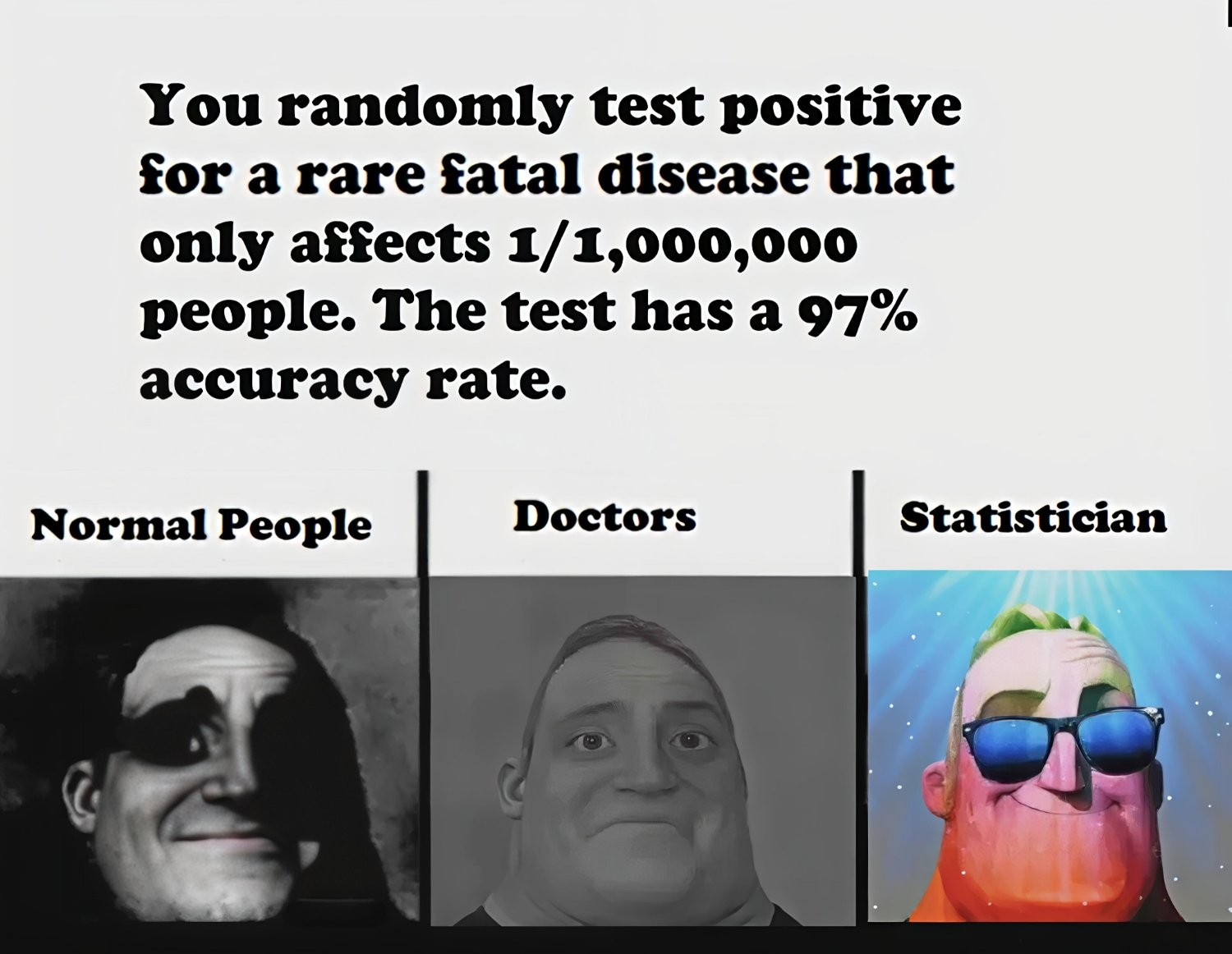
The meme is talking about a common probability error that surveys have shown even doctors are prone to making.
Why you're probably ok:
The rarity of the disease far exceeds the error rate of the positive test. Meaning, the disease occurs in 1 out of a million people, so if you are tested at random and show positive, you only have a 1 out of 30,000 chance (the 3% false-positive rate) of being the the 1 person who truly has the disease.
How does that matter if I have a 97% chance of actually having the disease? A lot more people than I have won the lottery, doesn't have a thing to do with whether I will.
Its right 97% of the time. That does not mean you have a 97% chance of having the disease. The 3% error rate accounts for significantly more false positives than it accounts for false negatives on a disease that's 1 in a million. Again, with a 3% error rate, there will be 30000 false positive test results in a million. 30000 in a million is a larger number than 1 in a million.