Title text:
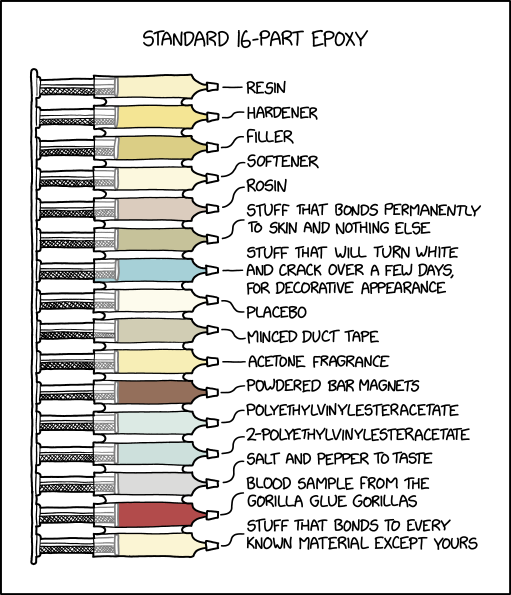
Some surfaces may seem difficult to glue. But if you research the materials, find tables of what adhesives work on them, and prepare your surfaces carefully, you can fail to glue them in a fun NEW way that fills your house with dangerous vapors.
Transcript:
Transcript will show once it’s been added to explainxkcd.com
Source: https://xkcd.com/3194/
Would it be possible to make powdered magnets work..? Not as an adhesive, probably, although that would be pretty neat actually..
Like I know magnets are magnets because of the alignment of many many atoms, but say you powdered the magnets, somehow kept them from clumping up (because of course they would) and then applied a low-level magnetic field (or something a magnet would stick to, maybe?) to whatever you were setting the powder in, could you hypothetically make a magnetic table or something with it?
So magnetic tape (tape cassettes, VHS/Betamax, 8 tracks, etc) is powdered iron (II) oxide and works by being magnetized to write data to it. So yeah. Quick search revealed it's totally a thing and you can buy it, primarily in industrial quantities.
As for a magnetic table, you don't even need it powdered, hell you could probably just get two stainless steel sheets, four stainless steel strips, a matrix with holes in the proper positions, and a bunch of high powered small permanent magnets and make your own magnetic table without it being that difficult to make