Title text:
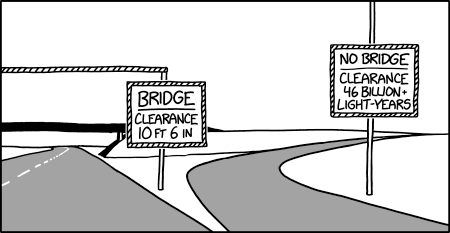
A lot of the highway department's budget goes to adjusting the sign whenever the moon passes directly overhead.
Transcript:
Transcript will show once it’s been added to explainxkcd.com
Source: https://xkcd.com/3174/
A community for a webcomic of romance, sarcasm, math, and language.
Title text:
A lot of the highway department's budget goes to adjusting the sign whenever the moon passes directly overhead.
Transcript:
Transcript will show once it’s been added to explainxkcd.com
Source: https://xkcd.com/3174/
True. But wind sheer in the lower atmosphere could be an issue. Sometimes the moon gets in the way, too.
Not just the moon. You can’t just drive here with a 46 billion light year tall lorry without crashing into some stars, galaxies, black holes and what not.
Really?
Can we calculate this? Let's do specs first. Let's say we only drive until the next overpass, which is likely in the next few km , let's say 5. And we drive 40kmh so for 450 second the lory is swinging around the universe trying to hit anything. Would it?
Well.. Earth's rotation would mean that the top of the lorry would be moving at 3.3 million light years per second ... Or you know, about 100 trillion times the speed of light.
That might break some things.
At this point I'm actually curious about the mass of the lorry.
I wonder if we could estimate the mass of a lorry, 2.5 meters wide, 20 m long, 46 billion light years tall. Let's assume it's filled with jars of peanut butter.
At that size, it could well be the most massive object in the universe.
Now that I think about it, it could also be too tall, possibly a tipping hazard around turns.
That truck tipping over could wipe out every lifeform on the planet with nut allergies.
The sheer mass of Skippy would become a fully functional ecological system of its own before cleanup was finished.
I mean, it has the potential to wipe out all life even without nut allergies. I for one have an allergy to things falling from the sky at c fractional speeds.
Take a Claritin, you'll get over it
Unless the lorry was driving over the exact geographic north or south pole.
Side note: the tallest lorry where the top doesn’t move faster than the speed of light at the equator is 3.8 light hours tall, which is weird to think about because the top doesn’t start moving until well after the bottom has reached it’s destination.