this post was submitted on 07 Jun 2024
1 points (100.0% liked)
memes
22730 readers
1544 users here now
Community rules
1. Be civil
No trolling, bigotry or other insulting / annoying behaviour
2. No politics
This is non-politics community. For political memes please go to !politicalmemes@lemmy.world
3. No recent reposts
Check for reposts when posting a meme, you can only repost after 1 month
4. No bots
No bots without the express approval of the mods or the admins
5. No Spam/Ads/AI Slop
No advertisements or spam. This is an instance rule and the only way to live. We also consider AI slop to be spam in this community and is subject to removal.
A collection of some classic Lemmy memes for your enjoyment
Sister communities
- !tenforward@lemmy.world : Star Trek memes, chat and shitposts
- !lemmyshitpost@lemmy.world : Lemmy Shitposts, anything and everything goes.
- !linuxmemes@lemmy.world : Linux themed memes
- !comicstrips@lemmy.world : for those who love comic stories.
founded 3 years ago
MODERATORS
you are viewing a single comment's thread
view the rest of the comments
view the rest of the comments
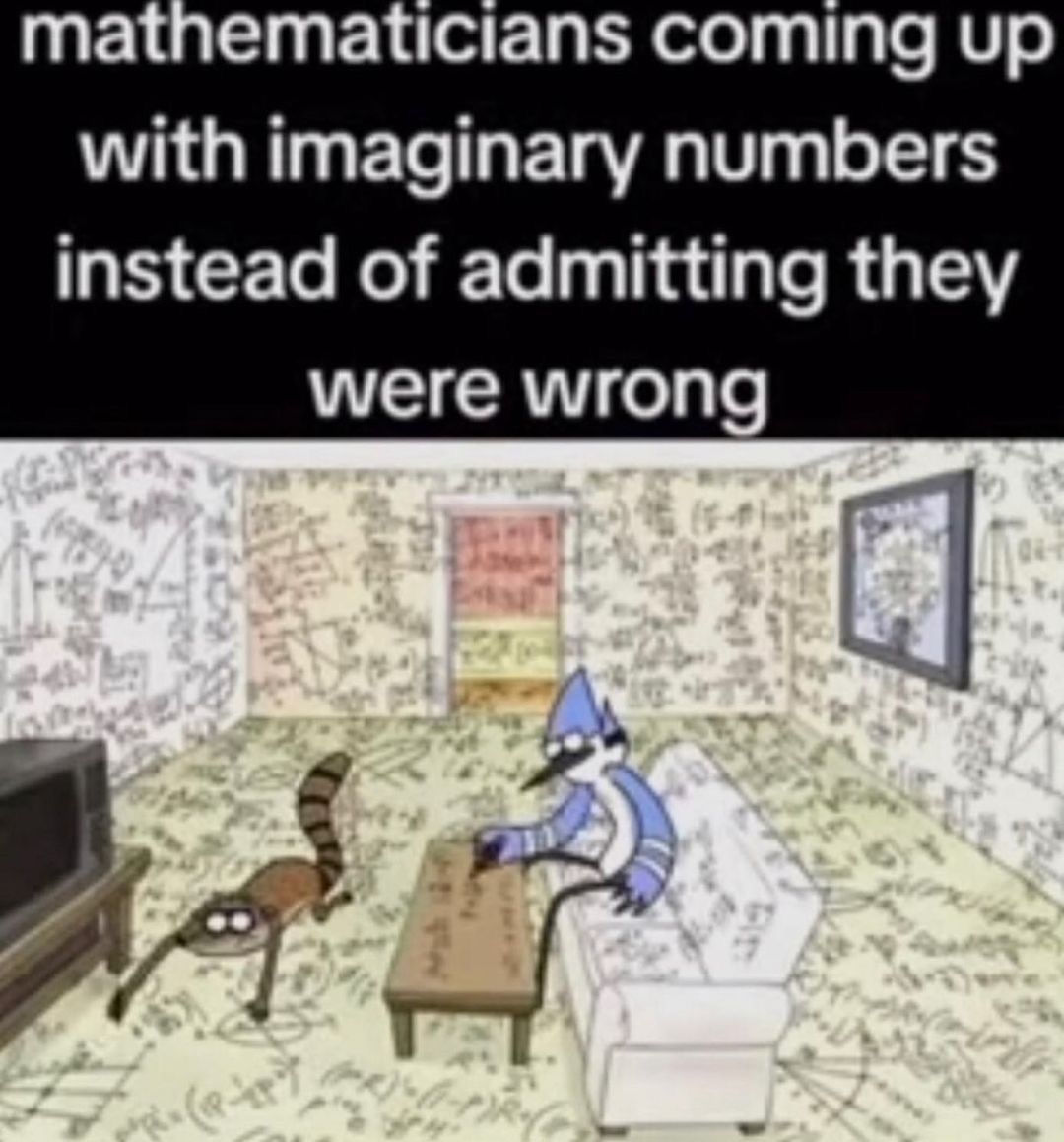
I know this is a joke, but wrong about what, exactly? I don't get it.
Also, and maybe this has something to do with the joke I'm not getting, the way complex numbers are motivated in school is a lie, and a stupid one. Mathematicians were perfectly comfortable with certain equations having no solutions; the problem was when their equations told them there were no solutions when they could see the solutions: the curve x^3^ - 15x + 4 crosses the x-axis, but Cardano's cubic formula gives up due to negative square roots. Imaginary numbers were originally no more than an ephemeral reasoning tool, and were only reluctantly accepted as entities in their own right because of how damn useful they were.
If I'm not meant to think about it until understanding emerges, then that means it should be immediately understandable without thinking. It is not.
I might not find a joke funny, or I might not have the necessary context to appreciate it; that's "not getting" a joke. If it's possible to have too much context to appreciate a "joke", it's at the expense of people who know more than the audience.
It might seem harmless, but the purpose of a joke is to draw a distinction between those who get it and those who don't, fostering a sense of community. In this "joke", the in-group is people who don't know something; the community ideal fostered there is that knowledge is undesirable, that anything that seems unintuitive to the uninformed mind is inherently ridiculous. The "joke" has no effect if it doesn't do this. Entertaining the idea without challenge is dangerous.