this post was submitted on 11 Nov 2024
-47 points (18.7% liked)
Linuxsucks
367 readers
86 users here now
For knowledge and awareness about what using Linux is really like and pointing at its cultish toxic community. We also cover FOSS /FLOSS failures, and issues with GPL since it relates to Linux. Moderation is heavy handed to appeal to our target users.
Rules:
- FOSS (especially GPL) advocates and Linux (specifically GNU/Linux) evangelists aren't welcome (GNU Hurd will count as Linux). -We ask that you block us and we will perma-ban for violations of this rule.
- Try to stay on topic (that is LINUXSUCKS!). No bashing other OSs or each other. We aim for a cohesive non-toxic community with the interest of cautioning people / would be victims from Linux. At our discretion, we will remove what we consider pollution.
- Moderators run the sub, not the users. It's not democratic, and we don't care how you think it should be run. -Feel free to make and run your own community.
- "Not your Billboard" -Over-represented companies will have positive posts removed and appropriate bans may be issued. -Those companies included so far will be Valve/Steam/Proton, Google, and Brave (browser).
Linux/FOSS can damage hardware or firmware
Linux running servers isn't a brag
Is Linux Running Games Near Windows Performance Impressive?
Wasted Ram on Different Toolkits and Distro-Agnostic Packages in Linux
Critical ISS Systems do NOT run Linux
Abandoned Software is Dangerous (and common on Linux)
founded 2 years ago
MODERATORS
you are viewing a single comment's thread
view the rest of the comments
view the rest of the comments
Correct. But the thing configured there is "to act on behalf of root for these items", not the "things" themselves.
It is not you executing stuff with
sudo.file1is owned by you, butfile2is owned byroot.There is a point. See above.
That's not an argument I've made, nor make.
Both of which are much easier to defeat than a pop up confirmation dialog with a text box for your password.
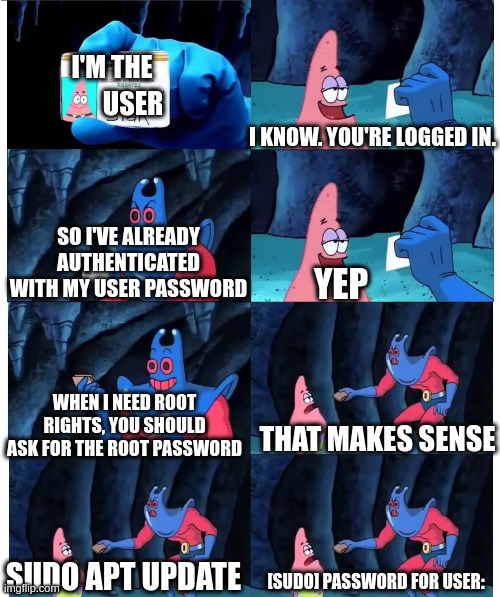
No it doesn't - you seem to be making things up to justify your lack of understanding. Authentication is not the same as authorisation, nor should it be treated the same way.
When you type in your password on a login prompt - you authenticate who you are.
When you type in your password on a sudo prompt - you authorise a command to be carried out on behalf of
root.I'm not sure you realise how little you do on a windows machine. Good luck installing system software or altering system files on an AD managed Windows machine without authorisation. Which is what your meme(?) is implying.
There is no justification here, just a manufactured statement.
See above.