this post was submitted on 02 Oct 2024
1699 points (95.5% liked)
Microblog Memes
11591 readers
1836 users here now
A place to share screenshots of Microblog posts, whether from Mastodon, tumblr, ~~Twitter~~ X, KBin, Threads or elsewhere.
Created as an evolution of White People Twitter and other tweet-capture subreddits.
RULES:
- Your post must be a screen capture of a microblog-type post that includes the UI of the site it came from, preferably also including the avatar and username of the original poster. Including relevant comments made to the original post is encouraged.
- Your post, included comments, or your title/comment should include some kind of commentary or remark on the subject of the screen capture. Your title must include at least one word relevant to your post.
- You are encouraged to provide a link back to the source of your screen capture in the body of your post.
- Current politics and news are allowed, but discouraged. There MUST be some kind of human commentary/reaction included (either by the original poster or you). Just news articles or headlines will be deleted.
- Doctored posts/images and AI are allowed, but discouraged. You MUST indicate this in your post (even if you didn't originally know). If an image is found to be fabricated or edited in any way and it is not properly labeled, it will be deleted.
- Absolutely no NSFL content.
- Be nice. Don't take anything personally. Take political debates to the appropriate communities. Take personal disagreements & arguments to private messages.
- No advertising, brand promotion, or guerrilla marketing.
RELATED COMMUNITIES:
founded 2 years ago
MODERATORS
you are viewing a single comment's thread
view the rest of the comments
view the rest of the comments
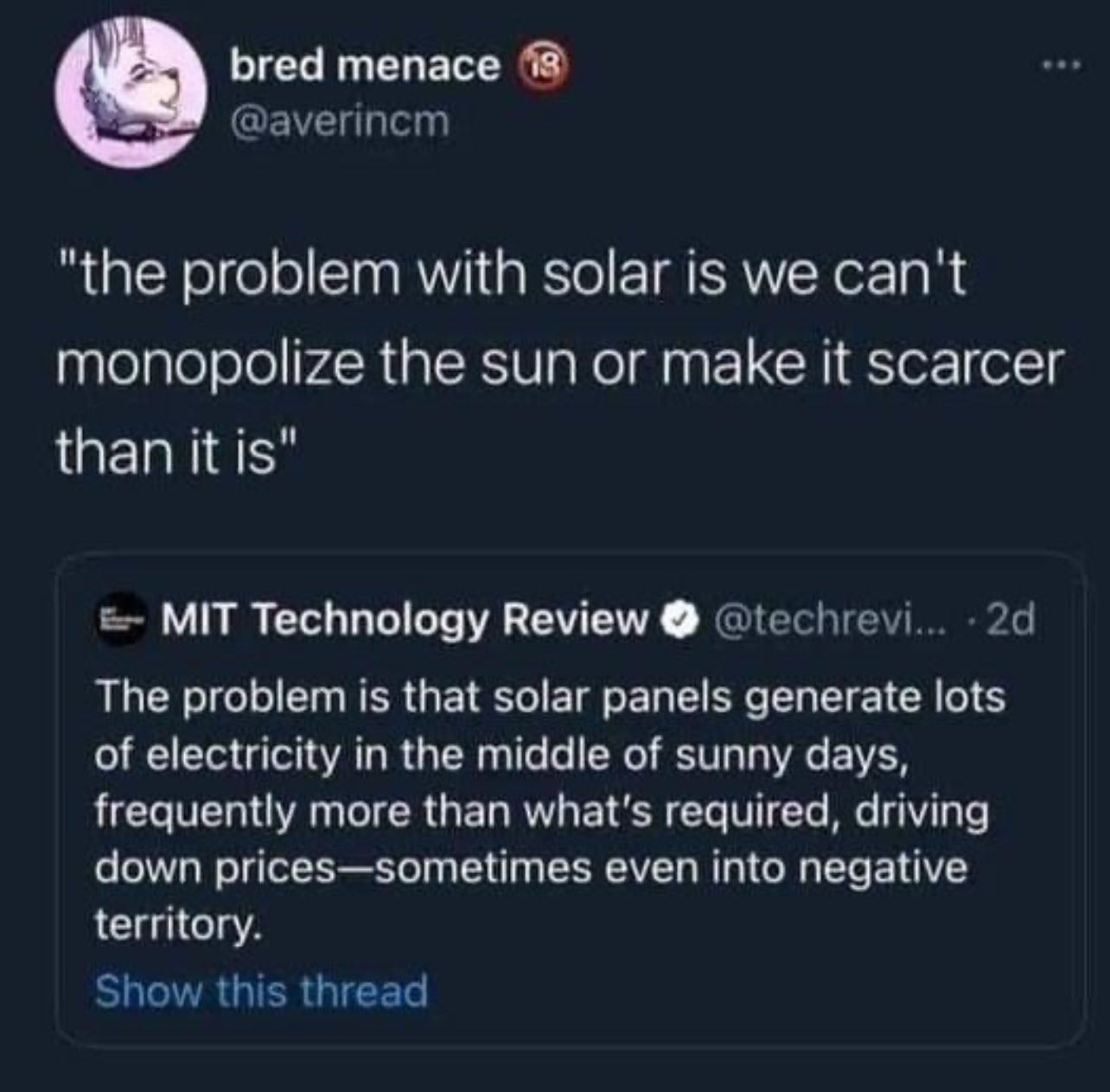
I can't speak to other countries, but in the US peak electricity demand generally occurs in the early evening.
Cheap electricity is great for consumers, but not necessarily for producers. Some people might say, "well, screw producers," but even if you take profit out of the equation, electric utilities need to be able to at least cover their expenses, and you can't do that if the amount of electricity you're generating relative to the demand is so high the price actually goes negative (meaning the utility is actually paying the consumer). Again, that's good for consumers, but I'm sure you can see how that's not a sustainable business model. And, like I mentioned before, it would be one thing if utilities could make up for this by selling for a higher price during peak, but by that point the sun is either setting or already set, depending on the time of year, so there's just no solar electricity to sell, at any price.
Fully agreed: let's eliminate business from the issue, and create national, for-service electric grids, that produce the cheapest renewables at all possible times in the most efficient way possible, disregarding hourly profit and taking into account exclusively the cost in €/kWh produced over the lifetime of each energy source.
Suddenly it's obvious that the problem isn't with renewables, but with organising the electric grid as a market
Public utilities still need to cover their expenses, and they're not going to be able to do that if they're charging negative rates in the middle of the day and have no electricity to sell once the sun goes down.
Do I really need to explain the concepts of taxes, subsidies, or fixed prices regardless of demand, to an adult?
I'm not sure what you mean. Are you saying that public utilities should be funded from taxes instead of charging for service? I don't think having tax payers pay public utilities to overproduce electricity is going to fix the problem, especially since no amount of tax dollar funding can allow utilities to produce solar electricity when the sun isn't shining.
The solution is obviously not exclusively from pricing models, we need other energy sources than renewables for the time being, that doesn't mean we need to have market-based electricity pricing.
Imagine the state installing as many solar panels as society, guided by experts, democratically decides it wants, basically deciding as a society the energy mix instead of hoping that companies will install enough if we bribe them enough with taxes to do so, and if it's profitable. Then, it decides a pricing model based on a mixture of subsidy and incentivising consumption during production hours.
Problem solved, innit?