this post was submitted on 28 Jul 2026
1154 points (99.7% liked)

Political Memes

12240 readers
2540 users here now

Welcome to politcal memes!

These are our rules:

1) Be civilJokes are okay, but don’t intentionally harass or disturb any member of our community. Sexism, racism and bigotry are not allowed. Good faith argumentation only. No posts discouraging people to vote or shaming people for voting.

2) No misinformationDon’t post any intentional misinformation. When asked by mods, provide sources for any claims you make.

3) Posts should be memesRandom pictures do not qualify as memes. Relevance to politics is required.

4) No bots, spam or self-promotionFollow instance rules, ask for your bot to be allowed on this community.

5) No AI generated content.Content posted must not be created by AI with the intent to mimic the style of existing images

founded 3 years ago
MODERATORS
 
you are viewing a single comment's thread
view the rest of the comments
[–] Eristalis@reddthat.com 1 points 20 hours ago (1 children)

Yeah... Only

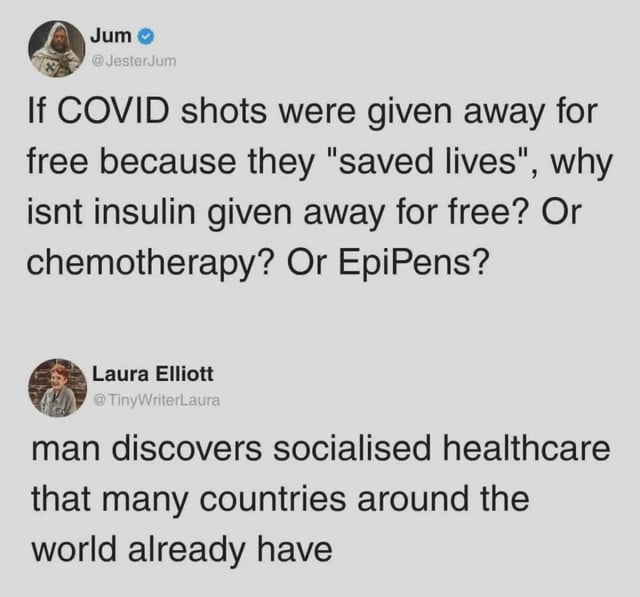
  1. Covid significantly affected the elderly and those from poorer neighbourhoods. Net draws on government funds, not net producers of income. If the government were being callous capitalists they'd have let covid rip and saved themselves a packet in pension payouts and welfare.
  2. The government were widely criticised at the time for not doing enough (too late with lockdown, too lax with mandates). The government cannot simultaneously find it prudent to not care about covid and care terribly that it is kept in check. Their callous calculation should have come out with either 'save everyone' or 'let everyone die'. It can't be both.
  3. Pharmaceutical companies made a fortune, as did anyone with shares in them. No one 'paid out' there was no trade off of expense against predicted income. The taxpayer paid for the research, paid for the shots, and paid for the shutdowns. The corporations didn't pay for anything at any time.
[–] MrVilliam@sh.itjust.works 1 points 15 hours ago (1 children)

They did sort of try to just let it run its course. Dan Patrick even said on TV that a bunch of old people should sacrifice themselves to save the economy. Hell, even after it was found to have really spread and start killing everybody else too, Dr. Oz said we should send kids back to school because it would only result in 2-3% total mortality. They tried to do nothing. They tried to demonize wearing a mask. They tried to keep businesses and schools open. They really didn't want to do anything differently, and they didn't until cases and deaths skyrocketed. And there are still an embarrassing amount of people who think that the shots didn't help and were actually harmful, most COVID deaths were not from COVID, and masks are for "woke libtards". The post that we're commenting on is far from an anomaly.

[–] Eristalis@reddthat.com 1 points 15 hours ago (1 children)

I don't disagree with your description of events, but you're imposing a reasoning behind them for which there is little evidence. The idea I'm pushing back against is that vaccines (here Covid) and I suppose now Covid policy in general, resulted from some clever metric of keeping people alive because of their income generating value. There's no evidence government works like that, and masses of evidence that government decisions are in fact a mix of submission to industry lobbying, blatant electioneering, and simple incompetence.

Whatever the policies were, they would almost certainly have been whatever the loudest industry lobby, focus group committee, or egotistical politician wanted at the time. Not some sociopathic genius doing life-value calculus.

[–] MrVilliam@sh.itjust.works 1 points 8 hours ago (2 children)

I'm not saying that it was the government who did that calculation. I think that companies did that calculation. I think that losses in revenue and even worse forecasting led companies to loudly call for blanket changes in policies so that the bleeding could be stopped. And then they got massive loans to get through the tough times, and most of those were forgiven, so it was effectively a business stimulus package.

I think it had nothing to do with life value and everything to do with consumer confidence. A loud minority still wanted to go out, but that wasn't adding up to a whole lot of money, and they were gonna soon run out of customers at the rate they were getting hospitalized. Not to mention the impact to the workforce.

I was just talking with my wife about flu shots. Health insurance covers an annual flu shot, and it's because it lowers their cost to have as many people vaccinated as possible, even though they have to pay for that shot. Similar sort of calculation.

[–] Eristalis@reddthat.com 1 points 1 hour ago* (last edited 1 hour ago)

What losses in revenue? As I said earlier, deaths an hospitalisations were overwhelmingly in older age brackets and poorer neighbourhoods. Companies were compensated for closures, and able to profit enormously from the 'supply chain problems' by price gouging. They made a fortune on the vaccine itself, not to mention the increase in future products off the back of the RNA research. What losses in revenue were on the horizon?

Health insurance costs in America have risen by over 130%, so there’s no evidence of insurance companies offering flu shots to save money, they just demand more premium to cover it.

Far more likely, in my view, is that taking regular vaccines has become a marketable product (for various reasons) which insurance companies have jumped on. Offer the shot, up the premium to cover it (plus a healthy profit). It simple market expansion.

If there’s a market (or one can be fabricated), then there’s a product to sell. If you can add a flu shot, up the premium to cover it, and not lose customers, then it makes sense to do so. Doesn’t have any bearing on whether it works. Same metric would apply to a medicine which did absolutely nothing whatsoever. As long as advertising it justified a rise in premiums larger than the cost of it, and customers don’t jump ship.

This is want I mean by comfortable narratives around medicine. If literally any other industry had added a service to their product, you'd assume it was simply something they thought they could market, and probably be suspicious that it was any use at all. But when a medical company adds a service (and charges more for it) people have to do this mental gymnastics to make the company's actions all for the best in the end.