this post was submitted on 25 Jul 2026
562 points (95.0% liked)
People Twitter
10229 readers
1319 users here now
People tweeting stuff. We allow tweets from anyone.
RULES:
- Mark NSFW content.
- No doxxing people.
- Must be a pic of the tweet or similar. No direct links to the tweet.
- No bullying or international politcs
- Be excellent to each other.
- Provide an archived link to the tweet (or similar) being shown if it's a major figure or a politician. Archive.is the best way.
founded 3 years ago
MODERATORS
you are viewing a single comment's thread
view the rest of the comments
view the rest of the comments
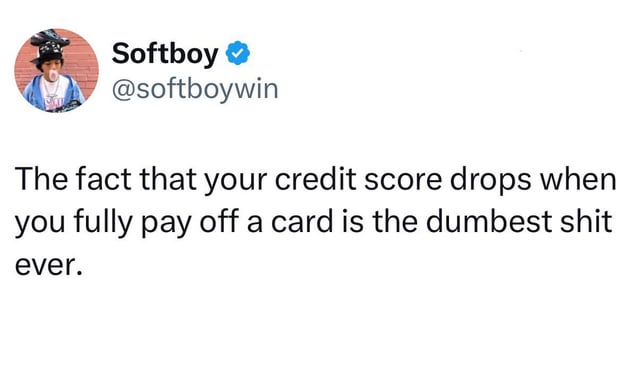
Your score does not drop when you fully pay off a credit card. If you pay your balance in full before the due date, not only are you not charged interest for that month, but your credit score is likely to go up due to making a payment on time. I used to carry a balance but have been paying it off monthly for many years now and my score is higher.
If you close an account, the total amount of credit you have decreases and your score may drop, however this is often transient. It's not useful to worry about your score week to week unless there's an obvious problem, follow it over the long term instead.
Credit utilization absolutely counts towards your score.
If you have a credit card with a $1000 limit, but you run an average balance of $100, go ahead and close that card and watch your score immediately increase.
Credit utilization definitely contributes to your score, however your example doesn't comport with that. In your example, if you close that card, your score is likely to go down, as the total credit available to you goes down. If you're paying off $100 each month on that card, your score will continually creep up. At some point, the credit card company will probably increase your limit to $2000, at which point your score will again go up. It's on you not to spend more than you can afford or fall into all the debt traps our society has set for us, but as long as you're paying it reliably your score will creep up
Or not, because your credit utilization % would decrease. (Edit: Actually I guess maybe two things are happening: an increase to the general score for having more available credit, but also a (likely smaller) decrease to the score for now having a lower utilization %).
I've literally had this happen to me. It wasn't a large decrease, maybe something like 8-10 points, but it definitely happened.
I'm sure the algorithms that these agencies uses are much more complex than what we can get into here, so I'm sure the exact end results can vary wildly from person to person.
However, I can tell you from personal experience, that my score went down slightly after the bank increased my credit limit on one of my cards. This was years ago, maybe they tweaked things, I dunno...
edit:
re-read the other part of your comment:
I think this is true as well... If i recall, it didn't seem to be a "total credit utilization" as in, add up all availabale credit from all sources (including student loans, etc.), and use that as the denominator so to speak, that was what hurt my score. But more like on a per-card/account basis. If that makes sense at all lol.
Like "credit cards" is just one of many sections that factor into the total score. You could be doing great with your student loans, car loans, mortgage, etc. and that will give you a good score.
But then if credit card aspect (module?) only has 1 card open with a $5,000 limit, and you keep the balance at $0-$200 or whatever, then that's going to negatively affect the overall score.
Man I hope that made sense at all, I'm a bit stoned at the moment lol. Made sense to me haha... I think I remember creditkarma explaining this to me years ago when my credit was in the shitter. I do know that paying attention to credit card utilization % did quite a bit to help me get my credit back up.
Utilization at a low percentage on your cards is what increases your score. Keeping it below 10% gives you an excellent rating for that card. These card companies make money by skimming pennies off every transaction you make. Sure interest makes money but it makes it at a higher risk, they want low risk consistent income you keeping a low Utilization tells them that according to the risk profile. You can literally open a card never use it and keep it open and your score will go up over time from "on time payments" a higher total credit limit with low Utilization and a longer credit age as that card ages.