this post was submitted on 06 Jun 2026
142 points (100.0% liked)
196
6194 readers
12 users here now
Be sure to follow the rule before you head out.
Rule: You must post before you leave.
Other rules
Behavior rules:
- No bigotry (transphobia, racism, etc…)
- No genocide denial
- No support for authoritarian behaviour (incl. Tankies)
- No namecalling
- Accounts from lemmygrad.ml, threads.net, or hexbear.net are held to higher standards
- Other things seen as cleary bad
Posting rules:
- No AI generated content (DALL-E etc…)
- No advertisements
- No gore / violence
- Mutual aid posts are not allowed
NSFW: NSFW content is permitted but it must be tagged and have content warnings. Anything that doesn't adhere to this will be removed. Content warnings should be added like: [penis], [explicit description of sex]. Non-sexualized breasts of any gender are not considered inappropriate and therefore do not need to be blurred/tagged.
Also, when sharing art (comics etc.) please credit the creators.
If you have any questions, feel free to contact us on our matrix channel or email.
Other 196's:
founded 3 years ago
MODERATORS
you are viewing a single comment's thread
view the rest of the comments
view the rest of the comments
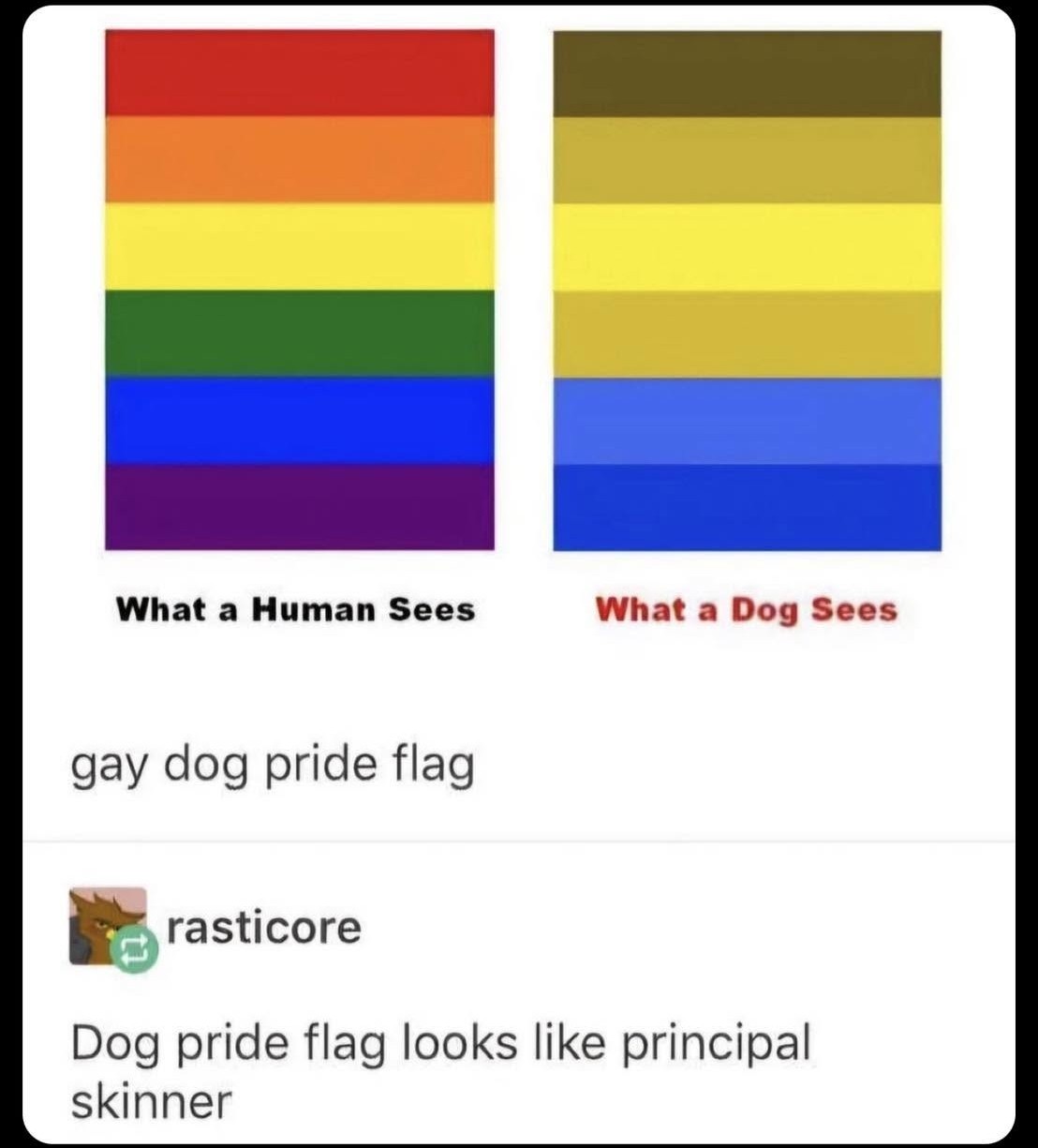
Is this what color blind people see? Can someone confirm?
I have an app on my phone (called "CVSimulator") that represents types of colorblindness. I’ve shown it to people who are actually red/green colorblind and got confirmation from them that it’s pretty accurate.
Red/green colorblindness in humans can be either protanope or deuteranope. I’m not sure which one dogs would have (if someone is more knowledgeable on this, please chime in!) However, this is how my app interprets this image. The top is protanope, the bottom is deuteranope:
So it's a little off, but some of the colors are correct.
Evolutionarily, most mammals are color blind. Old world primates duplicated one corn and changed it a bit so we have three. Some lost one of them and so they are color blind. Since this is on the Y chromosome, it's much more common in males. Other vertebrates have 4 cones that are much more evenly distributed but early mammals were nocturnal so there was no need in color vision.
This doesn't answer which kind of human color blindness is closer to what most mammals see but it's not too different either way. Thanks!