this post was submitted on 09 May 2026
770 points (99.1% liked)
People Twitter
10426 readers
582 users here now
People tweeting stuff. We allow tweets from anyone.
RULES:
- Mark NSFW content.
- No doxxing people.
- Must be a pic of the tweet or similar. No direct links to the tweet.
- No international politcs
- Be excellent to each other.
- Provide an archived link to the tweet (or similar) being shown if it's a major celebrity, figure or any politician. See stickied post https://web.archive.org/save is an option. Archive.is is no longer recommended because they remove/alter content.
- If a tweet (or similar) makes a statement of fact, either mark it as "satire" in the body or provide the original source link backing up the statement (see rule 6)
founded 3 years ago
MODERATORS
you are viewing a single comment's thread
view the rest of the comments
view the rest of the comments
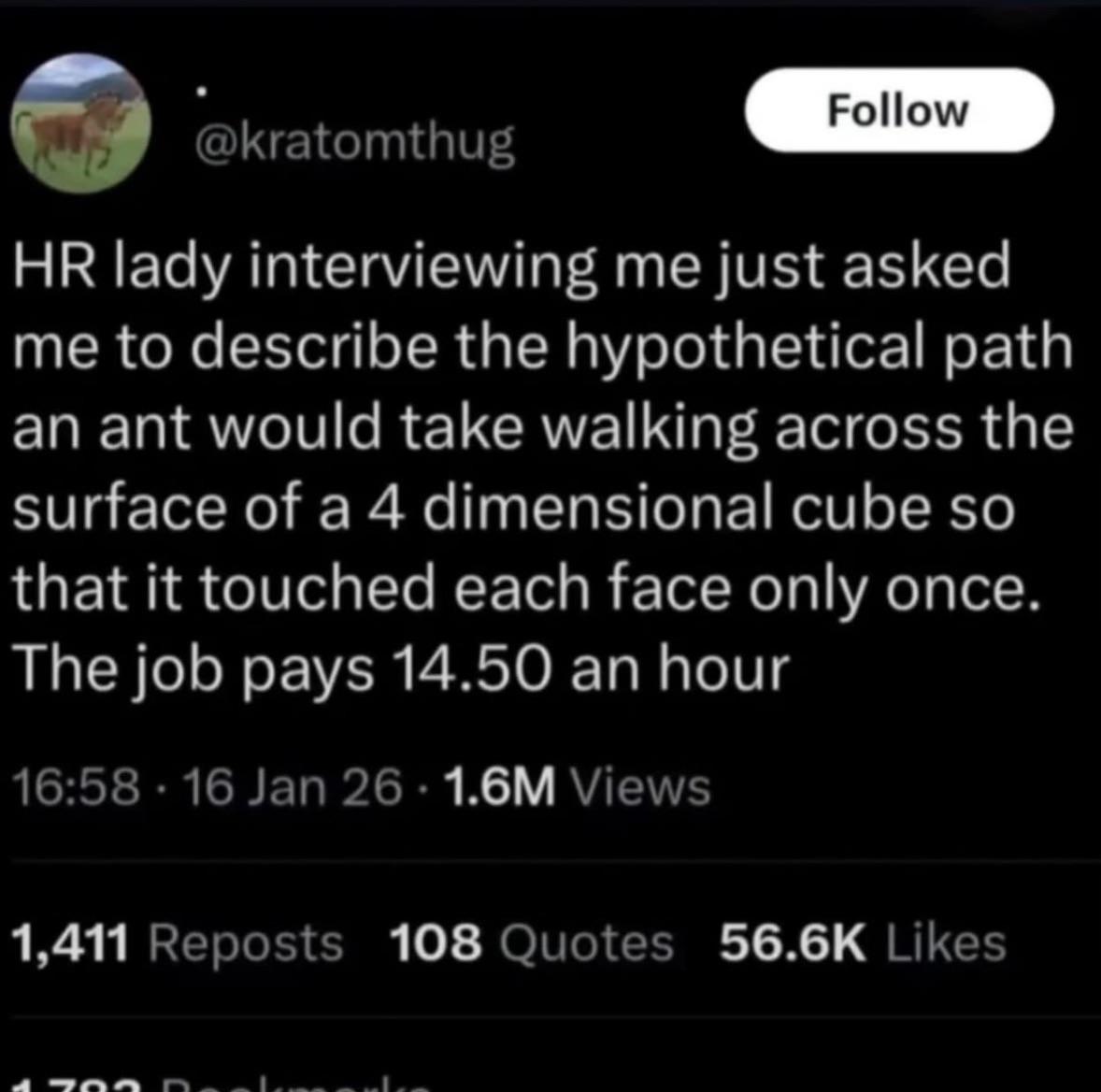
This is actually quite fun and simple! Even if the problem and my following explanation look complicated :P
Let's look at the three dimensional case. One can parametrize a 3 dimensional cube as the Cartesian product of intervals [0, 1] x [0, 1] x [0, 1]. This means a cube is a set of points (a, b, c) where a, b and c are real numbers between 0 and 1. The 2 dimensional sides of the cube are then given by fixing one coordinate. That is, the 6 sides are
Now we just start in the middle of a side at (0, 0.5, 0.5). To get to the next side we walk towards an edge (0, 0, 0.5) and then to the middle of the next side (0.5, 0, 0.5). We iterate this process until we run out of sides with a fixed 0, then walk towards a side with a fixed 1 and continue there. That is:
This path basically spirals around the cube, going through every side only once. Here's a visualization (sorry, I'm no artist :P)
The same procedure works on a 4 dimensional cube or any other higher dimension. For the 4 dimensional cube it goes like this:
This works for arbitrary dimension except for the 1 dimensional cube (which is just a line) because the "sides" there are the two end points of the line and not connected at all. Additionally note, that it is never specified how edges count in this problem, whether they somehow count towards a face or whether you're allowed to go back and fourth on edges. You could technically only walk along edges and step into the sides every now and then.
You owe me $14.50 for reading that.
I skipped all the blabla and looked at the drawing and was pleased to see the path I started visualising in my head was exactly like that. I do think I would've needed a cube in my hands to confirm it, or a bit longer thinking about it instead to complete it.
I don't usually do this, but I'm gonna go out on a limb and say this didn't happen.