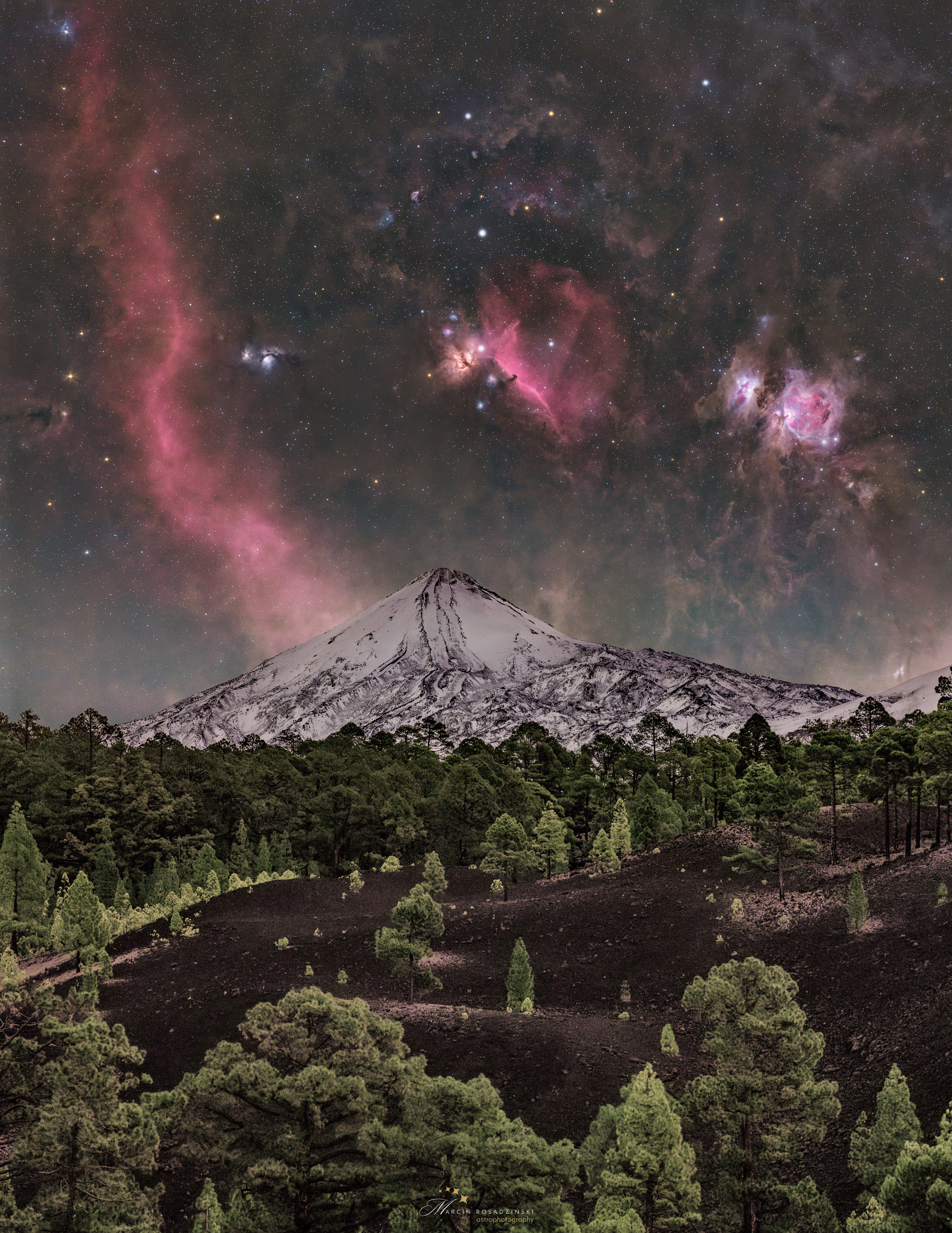
Orion is rarely seen like this. To achieve this majestic vista, you need a camera capable of taking such long duration exposures that faint features in the night sky become revealed. Iconic nebulas that appear include the Orion Nebula, the Flame Nebula, and Barnard's Loop. For contrast, it also helps to have a volcano on the foreground, in this case the Teide volcano on Tenerife on the Canary Islands of Spain. But if you want your Teide volcano snow-covered, you also need good timing -- because that only happens, typically, for a few days each year. Good timing also includes waiting for Orion to appear just behind Teide, which occurred late last year after sunset. The featured image is the result of a series of images taken consecutively with the same camera from the same location.
I converted a Sony nex5r to IR last year, but only managed to get around to trying to capture Orion's belt just recently. Cranking ISO all the way up I get the faintest red band where it should be, but also a ton of noise.
I need to get out again and take a lot more shots next time. Unfortunately the Nex5r doesn't allow for continuous shooting, so I've been writing an app to trigger the shots for me.
Hopefully one day I'll get something this good!
Hope so too!