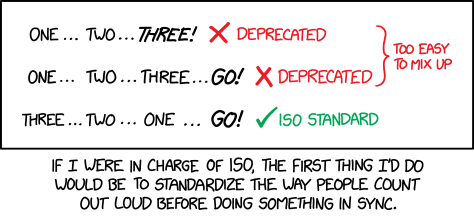
xkcd #3232: Countdown Standard
Title text:
Anyone who is caught counting 'three ... two ... one ... zero ... GO!' will be punished with a lifetime of eating only ISO standard food samples.
Transcript:
Transcript will show once it’s been added to explainxkcd.com
Source: https://xkcd.com/3232/
Edit: I've realized this definition was wrong and sleep-deprived and that the actual definition I use is: "This" refers to within this 7-day period of Su–Sa, "Last" refers to the last 7-day period, and "Next" refers to the next 7-day period. I was depriving myself of sleep to finish some work and came up with this. So "this" remains the same, but I just made up some definition of "next" that's inconsistent with how I'd describe months in years. Hopefully the work is okay.
Is this not universal? It seems so obvious.
"This Thursday" is the closest Thursday coming up, "next Thursday" is the next one after that. The exception is if you're already passed "Thursday" that week, then it's "next Thursday" until the new week starts.
Internal consistency test:
It's May 2024. You're talking about February 2025. Given the choice only between "This February" and "Next February", which do you call it?
Edit: In fairness, I realize I fail this consistency test too. If, in January 2024, someone said "Next February", I'd assume they're referring to February 2025, since I would only ever say "this February" to refer to February 2024 to avoid confusion (even though February 2024 technically is "next February"). Urgh, my brain. "You're making me think about this way more than I ever have. Come with me!"
I think scale matters. A year is quite a lot longer than a week or two. It's easy to consider both the next Thursday you're going to encounter and the one after that as subjectively "soon". The same can not be said of a month at least nine months away.
I would agree that your ruleset works on a longer timescale, but not on a shorter one. There's too much ambiguity and crossover for it to work properly. Having exclusivity in definition allows for better communication, especially for something much more personal like something sooner rather than later.
You're right, after some further thought I forgot one rule that I use. Will edit to fix this.
To answer your question, the February that had recently passed would just be "February" until later in the year (likely when February 2025 would be closer or similar distance to the past one) it would shift to "last February" or "back in February". It would be "next February" until the end of the year, then "this February" once into the new year.
I think you misread my comment. February 2025 from the perspective of May 2024 is not "last Thursday" by any definition.
Sorry, it being 2026 now was making be constantly think of 2025 in the past instead of the "future"
I disagree with the last part of your statement. If you say 'next thursday' on a Friday, it still means the second Thursday away. This Thursday always means the next upcoming, so next Thursday should always mean the one following 'this Thursday'. The weekly period rolls with whatever day you're talking about.
I’m with you so far as “next” should always the next occurrence of the day, and maybe in some places it does. But practically it doesn’t work. In every place I’ve lived it works like this: “this week” isn’t a set Monday – Sunday like you suggest, but a rolling seven days. Its Monday as I write this, “this Wednesday” is two days from now, while “next Wednesday” is the following. Same for this vs next weekend. If it’s Friday, “this Monday” is three days away. Rolling seven days.
“This” cannot be used for the day of week you are currently on, nor can it be used for previous days.
If next was the next occurrence of the day you’d be saying “next Wednesday on a Tuesday” and be talking about tomorrow, which is frankly ludicrous. I’ve also never heard anyone use a rolling week for “this” and this is such a funny conversation to come up because I literally had this confusion last Sunday (not this previous Sunday, as in yesterday, also note that this lines up well with using “last week”), because I was talking with several Venezuelans, a Chilean, a Mexican, and a Salvadoran, along with some Americans and this exact confusion came up but not because it was a rolling week, or because next means the next occurrence, but because they considered the week to start on Monday, not Sunday. So “this Thursday” meant the previous Thursday, since it was part of that week. Next Thursday meant the coming Thursday (the part of the next week).
I mention the nationalities because it’s pretty uncommon to start a week on a Sunday like Americans do.
Weirdly I looked it up and the internet says those countries start their weeks on Monday but that sure wasn’t what the people I talked to thought. 🤷
Okay but what about last Thursday?
I feel strongly that "next" Thursday should be not the next instance of a Thursday but rather the first instance of a Thursday past the contained set of the current week (so the next row on a calendar). I.e. if it's Tuesday, "next Thursday" isn't the Thursday two days from now but the Thursday 9 days from now.
This is wrong because they should be mutually exclusive, and that's literally a written rule that's been documented. This Thursday is restricted for the Thursday within the seven day period you're in, regardless of where that starts, and next Thursday is the Thursday within the next 7 day period. It's not hard to understand the rule, but I still qualify it every time I use the phrase 'next thursday'. Usually by saying something like 'lets hang out next Thursday, not this one but the next one after that'.
Wrong. Weeks start on Monday. Sunday is the last day of the week. A week is 5 work days and 2 days of the weekend. I will have none of this Sunday bs.
So if it's a Friday, "This Thursday" was yesterday? How does that make sense?
"This Thursday" is always the upcoming Thursday.
Last Thursday was fucking yesterday.
For many, "next Thursday" is the next available Thursday, three days hence (if you're reading this on a Monday)
What the fuck. 😭 But "next Thursday" clearly has a well-defined 7-day period. Given a bus stop with 20 minutes between buses, the "next bus" doesn't just start arbitrarily applying 10 minutes after the last bus left. Who would use it like this??
The next bus is the next bus to come 🤷🏼♂️ But the answer to your question is enough to not know for sure what the other person means without clarifying. It happens especially when someone is talking about "next Thursday" on a Friday for example. Because that's in next week.
This doesn’t make sense from a linguistics standpoint though. So next Thursday is the Thursday this week, but next week isn’t this week, it’s the week after this one. So what’s the Thursday in that week, the next next Thursday? It just doesn’t work.
Anything in this week (Sunday-Saturday or Monday-Sunday) even stuff from a few days ago -> this .
Anything from last week -> last
Anything in next week -> next
It’s incredibly simple and it’s logically consistent and it works in every situation unless you are talking to someone from a different country that uses a different starting day. And even then it works the majority of the time.
You're trying to apply logic to English? You're also assuming people actually think about what they're saying or even know the so called rules of English. If that were the case we wouldn't have people mixing up their/there/they're or your/you're its/it's etc.
Fact of the matter, if everything you said were true, we wouldn't have people wishing for a way to clarify and we wouldn't be having this conversation.