Python

7750 readers
33 users here now

Welcome to the Python community on the programming.dev Lemmy instance!

📅 Events

PastNovember 2023

October 2023

July 2023

August 2023

September 2023

🐍 Python project:
💓 Python Community:
✨ Python Ecosystem:
🌌 Fediverse
Communities
Projects
Feeds

founded 2 years ago
MODERATORS
276


I have a repository that contains multiple programs:

.
└── Programs
    ├── program1
    │   └── Generic_named.py
    └── program2
        └── Generic_named.py

I would like to add testing to this repository.

I have attempted to do it like this:

.
├── Programs
│   ├── program1
│   │   └── Generic_named.py
│   └── program2
│       └── Generic_named.py
└── Tests
    ├── mock
    │   ├── 1
    │   │   └── custom_module.py
    │   └── 2
    │       └── custom_module.py
    ├── temp
    ├── test1.py
    └── test2.py

Where temp is a folder to store each program temporarily with mock versions of any required imports that can not be stored directly with the program.

Suppose we use a hello world example like this:

cat Programs/program1/Generic_named.py
import custom_module

def main():
    return custom_module.out()


cat Programs/program2/Generic_named.py
import custom_module

def main():
    return custom_module.out("Goodbye, World!")


cat Tests/mock/1/custom_module.py
def out():return "Hello, World!"


cat Tests/mock/2/custom_module.py
def out(x):return x

And I were to use these scripts to test it:

cat Tests/test1.py
import unittest
import os
import sys
import shutil

if os.path.exists('Tests/temp/1'):
    shutil.rmtree('Tests/temp/1')

shutil.copytree('Tests/mock/1', 'Tests/temp/1/')
shutil.copyfile('Programs/program1/Generic_named.py', 'Tests/temp/1/Generic_named.py')

sys.path.append('Tests/temp/1')
import Generic_named
sys.path.remove('Tests/temp/1')

class Test(unittest.TestCase):
    def test_case1(self):
            self.assertEqual(Generic_named.main(), "Hello, World!")

if __name__ == '__main__':
    unittest.main()


cat Tests/test2.py
import unittest
import os
import sys
import shutil

if os.path.exists('Tests/temp/2'):
    shutil.rmtree('Tests/temp/2')

shutil.copytree('Tests/mock/2', 'Tests/temp/2')
shutil.copyfile('Programs/program2/Generic_named.py', 'Tests/temp/2/Generic_named.py')

sys.path.append('Tests/temp/2')
import Generic_named
sys.path.remove('Tests/temp/2')

class Test(unittest.TestCase):
    def test_case1(self):
            self.assertEqual(Generic_named.main(), "Goodbye, World!")

if __name__ == '__main__':
    unittest.main()

Both tests pass when run individually:

python3 -m unittest Tests/test1.py
.
----------------------------------------------------------------------
Ran 1 test in 0.000s

OK


python3 -m unittest Tests/test2.py
.
----------------------------------------------------------------------
Ran 1 test in 0.000s

OK

However, they fail when being run together:

python3 -m unittest discover -p test*.py -s Tests/
.F
======================================================================
FAIL: test_case1 (test2.Test)
----------------------------------------------------------------------
Traceback (most recent call last):
  File "/home/s/Documents/Coding practice/2024/Test Mess/1/Tests/test2.py", line 18, in test_case1
    self.assertEqual(Generic_named.main(), "Goodbye, World!")
AssertionError: 'Hello, World!' != 'Goodbye, World!'
- Hello, World!
+ Goodbye, World!


----------------------------------------------------------------------
Ran 2 tests in 0.001s

FAILED (failures=1)

If I try to use a different temporary name for one of the scripts I am trying to test,

cat Tests/test2.py
import unittest
import os
import sys
import shutil

if os.path.exists('Tests/temp/2'):
    shutil.rmtree('Tests/temp/2')

shutil.copytree('Tests/mock/2', 'Tests/temp/2')
shutil.copyfile('Programs/program2/Generic_named.py', 'Tests/temp/2/Generic_named1.py')

sys.path.append('Tests/temp/2')
import Generic_named1
sys.path.remove('Tests/temp/2')

class Test(unittest.TestCase):
    def test_case1(self):
            self.assertEqual(Generic_named1.main(), "Goodbye, World!")

if __name__ == '__main__':
    unittest.main()

Then I get a different error:

python3 -m unittest discover -p test*.py -s Tests/
.E
======================================================================
ERROR: test_case1 (test2.Test)
----------------------------------------------------------------------
Traceback (most recent call last):
  File "/home/s/Documents/Coding practice/2024/Test Mess/2/Tests/test2.py", line 18, in test_case1
    self.assertEqual(Generic_named1.main(), "Goodbye, World!")
  File "/home/s/Documents/Coding practice/2024/Test Mess/2/Tests/temp/2/Generic_named1.py", line 4, in main
    return custom_module.out("Goodbye, World!")
TypeError: out() takes 0 positional arguments but 1 was given

----------------------------------------------------------------------
Ran 2 tests in 0.001s

FAILED (errors=1)

It seems to be trying to import the same file, despite me using a different file from a different path with the same name. This seems strange, as I've been making sure to undo any changes to the Python Path after importing what I wish to test. Is there any way to mock the path? I can't change the name of the custom_module, as that would require changing the programs I wish to test.

How should I write, approach, or setup these tests such that they can be tested with unittest discover the same as they can individually?
277


This is slyautomation and I am thrilled to welcome you to this in-depth tutorial where we will unravel the intricacies of training an aimbot using the cutting-edge YOLOv8.

278
279
280
281


This happens if I use set_time or set_position. Is this typical, or am I just not doing it right?

This is on a Pi Zero 2 W, so not the most powerful, but should be able to handle this.

These are the relevant bits of how I'm setting up the player:

    self._vlc = vlc.Instance()
    self._player = self._vlc.media_player_new()
    self._list_player = self._vlc.media_list_player_new()
    self._list_player.set_media_player(self._player)

    playlist = self._vlc.media_list_new()
    for index in self._play_order:
      playlist.add_media(self._vlc.media_new_path(self._songs[index]))

    self._list_player.stop()
    self._list_player.set_media_list(playlist)
    self._list_player.play()

And trying to seek is just this:

    self._player.set_time(_s_to_ms(seconds))

Any ideas would be greatly appreciated!

282


Hi, I want to know what is the best way to keep the databases I use in different projects? I use a lot of CSVs that I need to prepare every time I'm working with them (I just copy paste the code from other projects) but would like to make some module that I can import and it have all the processes of the databases for example for this database I usually do columns = [(configuration of, my columns)], names = [names], dates = [list of columns dates], dtypes ={column: type},

then database_1 = pd.read_fwf(**kwargs), database_2 = pd.read_fwf(**kwargs), database_3 = pd.read_fwf(**kwargs)...

Then database = pd.concat([database_1...])

But I would like to have a module that I could import and have all my databases and configuration of ETL in it so I could just do something like 'database = my_module.dabase' to import the database, without all that process everytime.

Thanks for any help.

283


So, I have a python script I'd like to run from time to time from the CLI (on Linux) that resides inside a venv. What's the recommended/intended way to do this?
Write a wrapper shell script and put it inside a $PATH-accessible directory that activates the virtual environment, runs the python script and deactivates the venv again? This seems a bit convoluted, but I can't think of a better way.

284


Neato

285


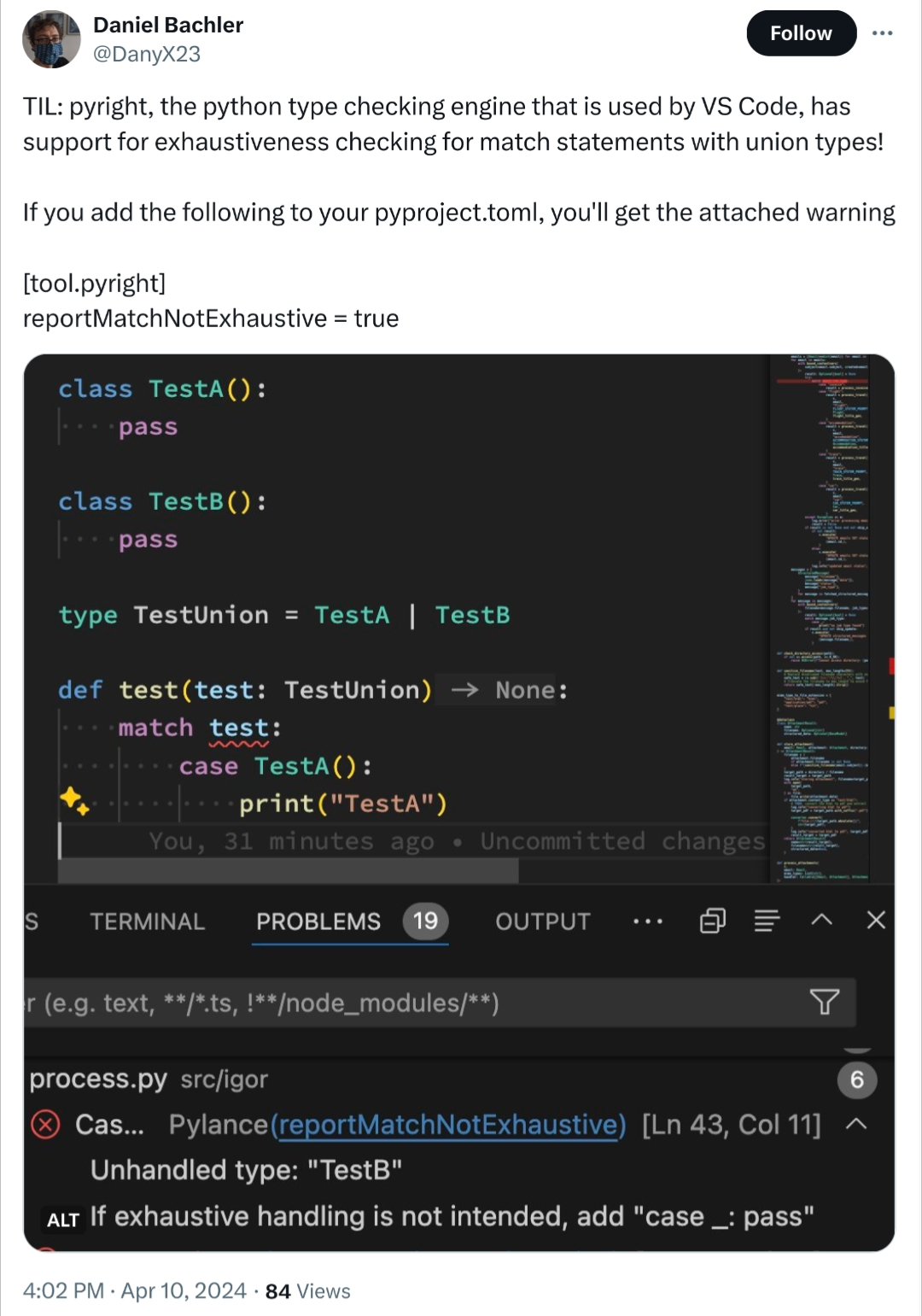
Twitter user @DanyX23:

TIL: pyright, the python type checking engine that is used by VS Code, has support for exhaustiveness checking for match statements with union types!

If you add the following to your pyproject.toml, you'll get the attached warning

[tool.pyright] reportMatchNotExhaustive = true

286


Not sure if this is allowed here, and it's not my playlist, but I thought I'd post these tutorials since I've found them helpful for learning the basics.

287


Hi there 👋, I’m Gerard, founder of Latitude.

I have written an article on how I approached building an open-source data tool. I had doubts about Python vs JavaScript, but I’m happy with the path I chose.

Would love it if you guys give me any feedback!

288
289
2
submitted 2 years ago* (last edited 2 years ago) by rimu@piefed.social to c/python@programming.dev


If you care about performance, you may want to avoid CSV files. But since our data sources are often like our family, we can't make a choice, we'll see in this blog post how to process a CSV file as fast as possible.

290
291
1
submitted 2 years ago* (last edited 2 years ago) by ebits21@lemmy.ca to c/python@programming.dev


Previously LGPL, now re-licensed as closed-source/commercial. Previous code taken down.

Commercial users pay $99/year, free for personal use but each user has to make a free account after a trial period.

292
293
294


I want to write my python code using thonny, but I seem to be getting some error when trying to open a file in thonny (Ctrl + O) and when instantiating a window, for example with TKinter. The exact error can be found here:

17:21:40.785 WARNING thonny.ui_utils: Zenity returned code 255 and stderr 'Diese Option steht nicht zur Verfügung. Bitte verwenden Sie »--help« für alle Anwendungsmöglichkeiten.\n' The text is german and says "This option is not available. lease use --help for viewing all options". For now I'll just use vim instead, but I really wanna go back to thonny. Has anyone ever experienced something like this before?

In case it matters, here is output I get from the terminal when running the program on startup:


17:25:36.099 INFO    thonny: Thonny version: 4.0.1
17:25:36.099 INFO    thonny: cwd: /home/marty
17:25:36.099 INFO    thonny: original argv: ['/usr/bin/python3', '/usr/bin/thonny']
17:25:36.100 INFO    thonny: sys.executable: /usr/bin/python3
17:25:36.100 INFO    thonny: sys.argv: ['/usr/bin/thonny']
17:25:36.100 INFO    thonny: sys.path: ['/usr/bin', '/usr/lib/python311.zip', '/usr/lib/python3.11', '/usr/lib/python3.11/lib-dynload', '/home/marty/.local/lib/python3.11/site-packages', '/usr/local/lib/python3.11/dist-packages', '/usr/lib/python3/dist-packages', '/usr/lib/python3.11/dist-packages']
17:25:36.100 INFO    thonny: sys.flags: sys.flags(debug=0, inspect=0, interactive=0, optimize=0, dont_write_bytecode=0, no_user_site=0, no_site=0, ignore_environment=0, verbose=0, bytes_warning=0, quiet=0, hash_randomization=1, isolated=0, dev_mode=False, utf8_mode=0, warn_default_encoding=0, safe_path=False, int_max_str_digits=-1)
Traceback (most recent call last):
  File "/usr/lib/python3/dist-packages/thonny/__init__.py", line 235, in launch
    _delegate_to_existing_instance(sys.argv[1:])
  File "/usr/lib/python3/dist-packages/thonny/__init__.py", line 322, in _delegate_to_existing_instance
    sock, secret = _create_client_socket()
                   ^^^^^^^^^^^^^^^^^^^^^^^
  File "/usr/lib/python3/dist-packages/thonny/__init__.py", line 365, in _create_client_socket
    client_socket.connect(get_ipc_file_path())
ConnectionRefusedError: [Errno 111] Connection refused
17:25:37.820 INFO    thonny.plugins.cpython_frontend.cp_front: Creating LocalCPythonProxy
17:25:37.820 INFO    thonny.running: Starting the backend: ['/usr/bin/python3', '-u', '-B', '-m', 'thonny.plugins.cpython_backend.cp_launcher', '/home/marty'] /home/marty
295
296


I have developed a project in #python to follow #RSS feeds and send an email with daily news. It is more an excuse to practice python, git and design patterns than a real project, but feel free to use it if you find it useful. Suggestions, opinions and feedback are welcome.

https://github.com/xurxia/newswave

297
298
299
300
view more: ‹ prev next ›