1
PocketKNIFE
1471 readers
1 users here now
This is the place for talking about all things pocket knives, and knife adjacent things. Folders large and small, multi-tools, sharpeners, even fixed blade knives are welcome. Reviews! Advice! Show off your Knives!
Also home of the incredibly loquacious Weird Knife Wednesday feature.
Simple Rules
- Don't be an asshole.
- Post any bigotry or hate speech and we'll cut you.
- No gore or injury posts.
- Keep politics out of here, unless it's knife related.
- Brand/model/maker/etc. elitism is highly frowned upon.
- Shilling your brand or product is OK provided that's not all you do and you make other contributions.
- For sale and trade posts allowed, but site admins and mods are not responsible for the outcome.
founded 2 years ago
MODERATORS
2
As this year draws to a close in just a few short days, now is the time to pour ourselves a drink and spend a wintry evening by the fire reminiscing on what we've done. All while using the opportunity to crank out a low effort clipshow style post retreading ground we've already covered.
Doesn't that sound like fun?
Herewith, then, is a listicle containing an arbitrary number of the Dork's most favored knives of 2025. I declare that this number shall be three, and these are chosen for highly subjective and probably deeply spurious reasons. These are not the top three best knives of 2025, or even knives that came out in 2025, nor is this buying advice of any stripe.
Many other knives are brilliant. But I like these.

#3: The HOKC Finka-C
I must admit, I wasn't completely kind to the Finka-C in my initial assessment of it, and in retrospect I was probably a little unfair to the poor little... er, big thing. But despite its various warts there's something about the Finka keeps drawing me back to it, and I've been finding myself carrying it more and more as time goes on. Yes, the dinky toggling secondary lock is silly and the clip leaves a little bit to be desired, and there I go damning it with faint praise again.
But you can't deny that the Finka is put together way better than it has any right to be and being such a big ol' honking slab of D2 brings a grin to my face every time I pick it up. On more than one occasion this year it's been more than enough to make itself the only folder I bothered to bring as a camp knife, which is saying a lot from somebody who usually veritably clanks as they walk in the woods.
The highly effective pocket hook opening mechanism built in absolutely completes it, and just how much I love all of my Kershaw/Emerson CQCs probably goes a long way towards explaining why I like the Finka so much, too. It's the same effect but even moreso, and the Finka is so confident in your hand it makes you feel like you ought to be able to use it to fight off a moose.
#2: The QSP Penguin Glyde Lock

Let's face it, there's no way a knife named after my spirit bird wasn't going to make it onto this list. Add in the fact that it's an Axis locker with ceramic ball bearing pivots, a deep carry clip with an offside filler, and comes in the correct colorway, the Penguin is a shoo-in.
The Penguin is the perfect form factor for a true everyday carry knife and comes with an inoffensive and nonthreatening blade shape that is nevertheless highly functional, and made out of decent steel to boot. Honestly, it's everything the perennially recommended Benchmade Bugout ought to be but isn't, since it authoritatively trumps the Benchy on rigidity and pivot feel while managing to slide in at a mere quarter of the cost.
#1: The Böker Tactical Balisong 06EX229

Come on. You knew this was coming.
The Böker 06EX229 still probably represents the best value for money in the current arena of butterfly knives. It's very close to being my favorite of all time, in fact, and when that's coming from our platform's Premier Balisong Nerd, that's saying a lot. The 06EX229 is built like a nuclear fallout shelter and it's got a list of premium features as long as your arm, and much unlike the big name options from the big boys these days, it does it all for you without driving you to into bankruptcy.
If there is any such thing as the perfect EDC balisong knife, the 06EX229 is probably it. And if it isn't, its smaller sibling the 06EX227 certainly is, and the only reason the latter isn't here as well is because it's disqualified due to my writeup on it appearing last year.
Mine is seen here wearing its fancy new 3D printed duds, which you can nab for yourself here. In stock trim, it only comes in black. Really, that's the only knock against it I can think of.
The Inevitable Conclusion
And you will rarely read me write these words, but that's all I have to say on the matter.
For the year, in fact. I'll see all you dorks on the flip side.

Those were my favorites from the last 52 weeks. What were yours?

3
Alright, my merry waddlers. How's your Christmas going? Spending some quality time with the family, or maybe having yourself a little R&R? Well, here's how I'm spending mine: By shitposting about knives on the internet, as usual. Because that's just the kind of no-social-life-having predictable son of a bitch that I am.

It occurs to me that I haven't wasted pages and pages blathering about a balisong knife lately. Lest we think these days I do nothing but handle bottom notch quality Chinese bargain subbasement meme knives anymore, here's the Revo Nexus.
Revo is another one of those up and coming startup knife companies that I've been studiously ignoring until these went on some kind of hyper-sale several months ago. This fetching two tone green variant currently lists for the thick end of $350 if Revo's website is to be believed, but you could score these a little while back from all the usual online suspects for around $175. If I were on top of things I could have alerted you all to that fact at the time, but I wasn't. So here we are.
The Nexus tickled my fancy because while it's made by Revo Knives in Colorado, it's purported to be designed by BRS. This explains why it's got a name riffing off of a certain Harrison Ford flick, in case that didn't tip you off. Yes, that'd be the same BRS behind the perennially sought after yet unobtainable Replicant and Alpha Beast balisong models... Or rather they would be if they ever felt like actually manufacturing anything for once, rather than apparently being proud to display an entire website consisting solely of sad little "sold out" tags and nothing else.
So while the true BRS models are suffering from a terminal case of nonexistence at the moment, these Revos have the advantage of being as thick on the ground as Christmas morning's snow.

The Nexus is a product of its time, i.e. right now at this very exact second, and is thus a hyper-modern offering that encapsulates every single shred of what's in fashion with the balisong-slinging youngsters these days. So that means it's both latchless and earless and it's got a sleek cyberpunk silhouette, with full length machined aluminum handles, kickerless Zen pins, and it's even packing ceramic ball bearing pivots. And noodles.
Basically, it's 90% of a BRS Alpha Beast or Barebones, but minus the latch and half the price. And while it may be slightly Vaporwave, it manages to actually exist so it isn't vaporware. A sterling stand-in, then, for anybody who may have missed the boat on the former two.
So, pretty much everyone.

The Nexus is a sandwich design rather than channel milled, so each half of its handles is a separate machining and they're mounted up with these spacers which are, I believe, titanium. Fancy.
Note also the distinct lack of a latch. I knew this this full well going into it, but I still did so with some trepidation since I have to say the latchless thing isn't my usual cup of tea. Despite owning thirty six balisong knives and quite a number of otherwise balisong shaped non-knife objects, I actually only had two* latchless knives before picking up this one.

The primary one being this channel milled "BRS" "Replicant" with a Squiddy-esque pattern machined into the handles which is, I'm very sorry to report, fake as a snake. It's a Chinese knockoff but it's a decent one, and it's not like you can buy a real Replicant right now for love nor money anyway so I'm not too broken up about it. It's of pretty similar proportions to the Nexus, and that's probably no accident.
In the middle there is the larger of the two Böker Tacticals, the 06EX229, my current most oft carried balisong, just for comparison purposes. (Identifiable here by my screaming neon printed handle scales, because I'm just such a dweeb.)
The Nexus is 10-1/8" long open by my measure, and basically exactly 6" long closed. The blade is 4-1/2" long precisely and has just under 4" of usable edge, and it's made of 154CM.

The blade has a weehawk-ish profile and is stone tumbled. I do like a good stone tumbled finish, and I like the looks of this one a lot too, but if you stare at it closely enough you can just barely see some of the machine marks left in it.

The Nexus is allegedly Revo's first knife to be made in the US. They're not going to let you forget about it, either, not only with this massive etching but also that entire deal on the front of the box. That's fair enough, as it goes — It's entirely too easy to buy a cynical Chinese knockoff knife for not much money these days, but depressingly difficult to buy one that's made in America without having to take out a second mortgage.
Because it's very fancy, it's got flush fitting, or at least nearly flush fitting, screws with driverless heads on one side.

The other side accepts a T-10 Torx bit and while Revo imply that the thing is designed to be disassembled via this video embedded in their website, I found all of the screws in mine to be permanently threadlockered. And since today's my day off, I concluded I can't be bothered to crack this thing open right now. Revo have kindly allowed me to outsource that entire endeavor, so if you want to see how it all goes together you can just watch their video instead.
Besides, you all have seen the insides of butterfly knives a couple of times before. You'll live.
The other reason I'm disinclined to mess with it is because I like it just like it is. Mine appears to have been pre-tuned at the factory to be just about perfect. The pivot action is flawless, the bearing assembly means there's no blade tap and vanishingly little wiggle in the handles, and manipulating the Nexus just feels nice. If you need a flipper for confidently showing off, this is it.

Except for some reason the Nexus is quite possibly the loudest knife I've ever had the occasion to wave around. Verily it clangs, it rings, and it jingles. Anyone else in the room with you would be forgiven for thinking you've got spurs on while you're messing with this thing.
It's not especially unpleasant or resonant or anything, but it is just exceptionally noisy. If you are a ninja, the Nexus is absolutely not the knife for you.

I have no idea if this is down to the shape of the machined aluminum handles, or the position of those concealed Zen pins, or what.

Otherwise I can't find much else not to recommend the Nexus over, but you have to be into the kind of thing that it inherently is. Thanks to the complete and utter lack of both a latch and a clip, you're on your own for figuring out how you'd want to carry it, for a start. The Nexus comes bundled in custom wrapping paper inside its box, but that's it — There's no sheath or pouch provided, not even a perfunctory ratty low-denier Nylon and Velcro one. Likewise, there's absolutely no differentiation between the handles whatsoever so there's no tactile indication which side's the bitey one and which side's not. Revo didn't even see fit to provide a 2¢ silicone band or something to stick over the bite handle to mark it, so either provide your own or git gud in a hurry, noob.

You probably should, too. Because the Nexus does indeed come out of its box very sharp from the factory. The edge grind is perfectly passable, however...

For a $350 list price you don't even get a true edge from the factory.
I'm starting to think I might be the only person on Earth who actually notices this sort of thing. Guys, am I the asshole here?
The Inevitable Conclusion
There are probably any amount of hobbies more financially responsible than being into balisongs. Like, maybe methamphetamines.
The thing about the Revo Nexus is that it's a very niche object, which will appeal squarely to a few extremely specific people and practically nobody else. Nobody in their right mind would suggest this as a work knife, or an EDC knife, or a camp knife, or for any purpose other than A) collecting, because you are a nerd, or B) showing off, because you are also a nerd. A distant third option is because none of the people who watch too much Youtube will take you seriously if you haven't got yourself a trendy and highly collectible big name knife.
Here's the thing. Because of all of that, the balisong sphere — at least most entries in it that aren't explicitly junk, anyway — is inherently comprised basically entirely of limited edition stuff. With the best will in the world, no balisong model you can actually name will ever be a volume seller. Just like the latest Nexus 6 replicant, this stuff all has a built in artificial lifespan. And so, if you can't handle a perpetual fear of missing out then this is probably not the type of knife you want to develop the affliction of having an affinity for.

At the moment, the Nexus is obtainable. Not only is it slick and stylish and fully compliant with all of the latest fads, but it's also here. That probably counts for a lot, because so many of its contemporaries aren't.
All those models, all those knives, lost in time. Like tears. In the rain.
Dang.

4
I have an online friend and he
says you can pay one price for three
Just look for Kershaw
At Samuel's Retail Hell

And here we are once more, speedrunning towards irrelevance in the narrow window between right now and that inescapable moment at precisely 12:01 AM on the 25th that these instantly transition from the hot ticket to yesterday's news. Hey, at least you can't say I'm not timely for once.
Allow me to introduce you to this flowchart, which handily sums up the ground state of being in this hobby:

We're always on the lookout for something nice... but not too nice. And preferably readily available in bulk.
Thus, among all the other cut-rate crap on display at Wally World I obviously couldn't pass these up and brought this trio home for some yule tide yuks. It's rare enough to find anything in this vein that purports to be from any real brand, let alone one I actually like. These retail for the same $30 as Wal Mart's other current holiday smorgasbord packs, but notably the Kershaw set has only three knives rather than seven, and notably contains zero pieces of other ancillary pack-in trash that serves no purpose other than diverting some part of a meager manufacturing budget from, you know, the actual knives. Theoretically this ought to mean that there's more quality to go around if it doesn't have to be spread as thin across as many things.
Could these be the value-for-dollar sweet spot for a low cost EDC knockaround knife, and can we use them to finally vanquish Betteridge's Law Of Headlines once and for all?
Threefer
Let's put on our thinking caps for this one. What do you think?

Kershaw's self-titled "2025PROMOX" pack contains three knives that are not just a repackaging of their existing models. Instead, these are bespoke pieces specifically contrived to be shoved into this holiday pack, the likes of which we've never seen before and will never see again. They haven't even bothered to invent faux model names for these. We have only the melodiously titled "6.3 in. Knife," "6.7 in Knife," and "7.25 in. Knife." So will these instantly become highly sought after short run collector's items, or gently fade into obscurity by about sunset on New Years Eve?
Do you know, I have a hunch it's going to be the second one.

Not a single attempt was made to differentiate these things. In addition to not bothering to supply model numbers on the box, they don't even sport them on the knives themselves. Each of them has the same "2025PROMO" marking on the back with no other identifying information other than a Kershaw logo and the obligatory China mark.
You can try matching these up to some other Kershaw model or another to figure out what they've been derived from, but as far as I can tell this is a doomed endeavor. The closest I can come up with is that the smaller two of them kinda-sorta follow the pattern of the Outfield but not really.
All three are, per the back of the box, made out of 3cr13 steel. Needless to say, this is deeply unexciting. So despite everything these are clearly low rent junk tailor made for the types of idiots who buy it, if that reminds you of anyone you know.
But there are a couple of things to recommend these over the mountain of other bullshit cutlery-adjacent options found at your local big box junk purveyor.

For a start, the back of the card purports that these are subject to the same lifetime warranty as Kershaw's other products. This is cruising so many miles above the warranty you'd typically receive on a Wal Mart knife, i.e. none, that I wonder if they put this here by accident.
All three of them are also spring assisted openers. And that's awesome.

Kershaw don't make as much of a fuss over their "SpeedSafe" spring assisted opening methodology as they used to, probably because the patent's expired on it by now and everybody else has ripped it off. But in these dark winter months when I'm sitting here feeling both introspective and retrospective while I languish in my chair in the dark waiting for the damn sun to come back, seeing these brought me right back to that bright summer day all those years ago when I bought one of my very first "real" knives from Walmart with my own money. That was another spring assisted Kershaw, a Whirlwind model 1650. With these gazing up at me all full of hope and sorrowful trepidation, I decided I couldn't just leave them there. Even if they're cheap and janky and obviously mildly cursed, they still needed a home.
Remember: A pocketknife isn't just for Christmas. It's until you break it or it snags on some brambles and you lose it down a crevasse.
Ah, crap. That came out wrong.
The Nickel Tour
I see that what I've actually done here is make my job three times harder for myself by multiplying it triple.
So do you know what? I can't be bothered today. I'm not going to look at each one of these individually in excruciating detail. They're all basically the same so we can deal with them in aggregate.

Except they're not. Despite being made of the same stuff and ostensibly differing only in size, each one has one unique attribute that the others don't share. Two of the three have the same overall blade shape but have different finishes with the smallest being tumbled stonewashed while the medium one is as-machined satin; all three have rear flippers to open them but only the largest one has thumb studs...

...The medium one has a jimped spine on the blade whereas the other two don't...

...All three of them have deep carry pocket clips...

...But for some reason despite otherwise being the most feature complete of the bunch with not only the aforementioned thumb studs but also a backspacer with an integrated lanyard loop, for some reason the biggest knife's clip is the only one that's not reversible.
Somehow like the sisters Phorcides, there's some competence only one of each of these can have and apparently there wasn't enough to share around. It's decidedly strange.

Among the bunch I think I like the littlest one best. I do enjoy a drop pointed knife and I like the tumbled stonewash finish the most out of the available options, and the compactness is appealing.

The big one's coated blade is a big detraction if you ask me, especially for something probably destined to be a beater. It's going to get scruffy in a hurry.

The middle child is, aside from the blade surface finish, probably the best looking of them. The jimping on the spine makes it look complete in a way that the the other two don't manage.

All three of 'em are liner lockers, of course. As usual there's a minor difference: The big one has a textured lock bar, and the other two are smooth.
...This is like one of those spot-the-difference puzzles you used to get in the back of Highlights magazine, only much cooler.

If I had to cast about for a comparison, what I would say these remind me of the most — especially the largest one — is my old Kershaw Brawler. The Brawler is another similarly proportioned SpeedSafe spring opener with a rear flipper, and although the latter is much beefier than these three, there is a distinct sense of design similarity about it with the overall length and the vibe of the injection molded scales.
The Kershaw Holiday knives certainly look nice. But then again, I suppose that's their actual job.
Smashola
In keeping with our theme of laziness, I'm not taking all three of these apart. I don't doubt there are trivial construction differences between them to excite the very select types of hyper-nerds in the audience, and I know what one of them is offhand already. But by and large they all work the same way and go together the same way. We can allow one to speak for all.
Given that I care for it the least out of all of them, I took the big one apart just in case something wound up going hilariously wrong and I broke it.

In retrospect, that might have been a mean thing to say about it.
Yes, they all have flush fit and smooth headed pivot screws just like your big brother's knife.

The clip on this one is recessed, and as usual it's a unique feature to this knife that the other two don't share. In exchange for that it's not reversible. One of its screws also pulls double duty to hold the handle together, which isn't how it works on the others. This probably goes some way towards explaining why you can't flip it over.
The clip and body screws are assembled with real blue Locktite. Not superglue, and not the gritty chalky Chinese stuff.

Instead, you'll find that under the pivot screw. But thankfully not to such an extreme degree as our last subject. I'm pleased to report that to go along with the smoothed head the pivot screw has an anti-rotation flat in it that's the real deal. Only one of the liners is broached for it, though, probably to save a penny.

Here's the springamadoo that drives the assist action.
The "safe" part of Kershaw's SpeedSafe arrangement is that the spring itself is totally relaxed at both ends of the range, when the knife is either fully opened or fully closed. This is much unlike various other spring assisted schemes from back in the early aughts which were much more like unto switchblade mechanisms, just with the switch part defeated. That motley bunch were theoretically capable of getting set off in your pocket if any of their parts were worn or busted, whereas the SpeedSafe arrangement can't.
Partially opening the blade loads up the spring, and once you get it past about 20 degrees or so it goes from being compressed to being allowed to spring back out, which handily flicks the blade open the rest of the way. This means that it does take some effort to get one of the SpeedSafe Kershaws over the hump and into a position where it can fire off. But if you fail to do so, the blade will snap back into its closed position rather than trying to open on you. The original patent actually described a variety of spring shapes and not this zigzag arrangement, but the mechanical action is the same.
This obviates the need for the little safety switches and toggles which festooned early spring assisted knives and are, let's face it, hugely annoying. The world decided that Kershaw's plan was better, so much so that nowadays if you crack open any given Chinese knockoff piece of shit you're sure to find a clone of Kershaw's idea with one of those wiggly springs in there.

One other random observation here is that the scales are screwed to the liners via the inside as well as the outside. I suspect this is to keep the scales in firm contact with the liners and discourage the spring from escaping.
The big knife has white plastic pivot washers that may or may not be some fancy low coefficient of friction material, but probably aren't. Wait for it, wait for it... The other two are different, because of course they are, and self-evidently sport bronze pivot washers instead which are visible from the outside:

There's a semiconcealed endstop pin in here which rides in a little cutout in the back of the blade. Here you can also see the SpeedSafe spring peeking through its hole. Because I like you guys so much, the stray piece of lint I'll throw in for free.

Here's the sum total of what's inside:

The hardware lineup.

The scales are some manner of injection molded fiber reinforced stuff, and the backspacer appears to be the same. The handle is separated with two plain threaded barrels which slide through the backspacer; for $10 each in a three pack, you're certainly not getting fancy machined aluminum spacers. I noticed also that one of the interior scale screws was kind of wonky from the factory, but it still goes in fine without seeming to affect anything so what can you say.
So How Bad Is It, Then?
One thing I've always been able to say for Kershaw is that even their cheap knives are put together very well. These are no exception. The blade centering is very good on the big one...

...The medium one...

...And the little one.

Do you hear that? I could swear there's a noise. What is that?
Oh, yeah. It's the entire readership of this column screaming at their computer monitors, "But they're made of crap steel!!!"
Look, there's no escaping it. Calling 3cr13 a budget steel is probably the nicest thing we can do to it. It does bring a couple of bullet points to the table which Kershaw studiously play up, including a very high degree of rustproofness, resistance to snapping, and, ah, "ease of sharpening."
That's because 3cr's edge retention is a lot less of a bullet point, per se, and more like a ragged bullet hole. The stuff only has 0.3% carbon in it, for fuck's sake, which is a far cry even from boring old 440C's 1.1-1.2%. Its hardenability is so low that you could slip it through the crack under your door. It's looking up at the worms in the dirt. It's limbo dancing in hell.
I chose the medium sized knife out of the lineup for my testing, because I'll be buggered if I'm repeating this for all three. I'm not expecting a Christmas miracle to befall me on this day of days, just on one knife out of the trio above the other two; they're all made out of the same stuff and they're all going to work the same way.
Attacking its edge with my graded set of hardness files reveals... That it only manages to fall in between 45 and 50. If I were you I'd be careful using this on your Christmas cheeseboard; the cheese may actually win.

As it happened to just so shake out, I was vindicated anyway because the medium sized one had the best edge out of the box. Here it is up close.

All three edges also arrived noticeably out of true, and they're also corkscrewed. Here is the medium one.
And the same again for the small one:


And the big one:


The latter actually arrived with a flat spot on its edge out at the tip which is visible to the naked eye. I don't know if it was ground that way or if it got whacked somehow in transit. All three knives had the obligatory and by now familiar polypropylene tip protector thingies on them in the package, so given all we've seen it's most likely the factory just did a crap job in sharpening it.
Shocker.

In our standard Highly Scientific Post-It Note Chop Test, the medium knife scored the best with an average cut pressure of 60.5 g and a peak of 77.7 g. The little one scored a less respectable 103.8 g peak and 85.89 g average and the big one slouched up at a truly abysmal 129.7 g peak and 104.69 g average.
Numbers are boring. We need something a little more exciting, more superlative, more bombastic.
So apropos of nothing, and after our last little incident, I've been trying to cook up a slightly smarter way to repeatably knock down the sharpness of knives without fucking up the surface finish. I don't know if I've succeeded, but I've settled on using this rather clever cutter thingy I found on Printables to process down the frankly prodigious and highly absurd amount of cardboard that accumulates around here into standardized strips. My new and hugely rigorous testing regimen involves taking stacks of these six strips tall and julienning them across the grain into confetti. This highly productive activity has the net effect of throwing the equivalent of nine linear inches of cardboard cutting at the edge with each chop, while theoretically the cut off bits flake away from the blade, so that mostly only it rather than the entire surface gets exposed to the shocking amount of abrasive bullshit that's found in ordinary cardboard.
That's the idea, anyway.

With the sharpness it had right out of the box I took the medium Kershaw and hacked at the stack five times.
You guys want to guess what it scored after I did that?

That's right, with only 45 combined linear inches of cardboard under its belt, the poor little thing was too dull to even complete the Post-It test again. The cutting force went right off the top of the chart until ultimately the thing smashed the Post-It into an accordion without managing to achieve any length of cut in it at all.
Well, crap.
Undeterred, I dutifully ground the blade back into full sharpness at a 17° per side angle, which is no doubt hopelessly optimistic for this steel but still better than the 15° I usually do. This took practically no time at all, so at least the bit about 3cr's ease of sharpenability was the fuckin' honest truth.

This brought matters back in hand, with the cutting performance evened out and restored to within spitting distance of its former, er, glory. For anyone wondering, the reason that the thing appeared to achieve that degree of sharpness at all was because the edge was decidedly sawtoothy and probably heavily burred, which has an advantage for cutting plain paper any time you draw the full length of it through the cut which I do when performing my little assessment. But once that burr snaps off and the little teefies wear away, it's Dullsville for you.
I repeated the cardboard test.

With an actual edge on it, the medium Kershaw's performance was significantly less embarrassing but still not exactly stellar. After 5 cuts, sharpness was reduced to needing 116 g peak and 82.82 g average, and after 10 cuts it leveled off to 123 g peak and 99.77 g average, whereupon at the tail end of the test the edge snagged and once again crushed the remaining little bit of Post-It rather than cutting it.
And that's a wrap. You guys remember all that howling I've been doing for years about how fancy knife steel doesn't really matter for casual everyday use? It turns out there's a definite floor somewhere down near the bottom of the barrel where that doesn't apply anymore. Now we know just about how deep it is.
That's right, kids. I was wrong about something.
The Inevitable Conclusion
Don't think of this as gifting somebody a cheesy knife, or even three cheesy knives. We can do a lot better than that. Instead, give the gift of teaching somebody how to sharpen their knife this Christmas.
Because believe you me, with these fuckers they're going to get good at it. Or else.

But still, I wouldn't be too pissed to get a pack of these in my stocking. It could be worse. It could be a golf tee puller, or yet another novelty tie. And this time I think we really have finally managed to break out of the flowchart. Here's a trio of beater knives that I really won't care about if I destroy them.
To quote the inimitable Tom Lehrer: Just the thing I need.
How nice.

5
So here it is: the BBK
All your nice words about my last experiment gave me the drive to get it done, thank you all for that!
I knew I had a "butterfly comb" laying around somewhere.
I cut off the comb part of it with an angle grinder and then cut the knife blade to the right size.
I did not remove the handles though and that ended up biting me in the ass...
Using a magnet, I positioned the blade against and in line with the stub left from the comb and proceeded to stick weld them together.
I was dreading that moment as I'm not good with welding and even worse when it comes to thin-ish material, but it went pretty smoothly and I'm happy how it turned out!
I then went on to grinding. I tried removing the handles but only one came off, the heat from the welding must have something to do with that...

Anyways, the hard part was behind me and all that was left was to grind, sand and polish it as well as my impatient self was willing to.
And there it was:

In all its splendor

The

Butter

Fly

Butter

Knife

6
I heard we were doing homemades.
Hi, I'm dual_sport_dork. You may know me from such projects as, A Bullshit Plastic Knife, and This Other Bullshit Plastic Knife.
Now that I think back on it, it turns out I've been at this rather a long time.

I no longer own this... object... so I had to dig the pictures out of my digital reliquary. The reason this looks like it was photographed with a potato is because it was. (Actually, it was my wizened and venerable Cannon PowerShot A40.) I had to check the file date — I made this in December of 2002. This son of a bitch is old enough to vote.
I'm pretty sure the impetus for this was in response to people on the internet back then moaning about my locality's recently passed knee-jerk ban on nonmetallic knives. So this is a fully functional, for acceptably small values of "functional," frame locking folder made out of Plexiglass and nylon screws. The edges of it look mildly burned because I hogged most of it out by hand with a Dremel. I planned nothing and measured nothing; I just threw this together by the seat of my pants and it more-or-less worked.

It opened, closed, and locked. It also sported something approaching an edge. I don't know if you've ever tried to sharpen a chunk of 0.100" Plexiglass, but the long and short of it is that it would keep an edge on it just about suitable for use as a letter opener. Hey, it was the principle of the thing.
I'm tickled pink to rediscover that even back then I apparently had a penchant for taking pictures of stuff on a white sheet of paper. It seems old habits die hard.

7
Hello everyone,
I'm new to this community, got a suggestion to cross-post this from !imadethis@lemmy.zip , hope you appreciate my rough looking knife :)


For making sandwiches on the job because I don't like spreading stuff with a sharp pointy knife or a box cutter.
I made the handle with a piece of L shaped aluminum profile crudely bent using clamps.
I then pierced a hole through the blade and the handle and test fitted it. I didn't like how it looked when closed so I decided to drill a new hole after flipping the handle around. (Hence the hole at the end of the handle and the second hole on the blade).
I then riveted everything together twice (one smaller rivet inside a bigger one, no idea if thats a good idea or not but it looks better). Cut the handle to shape with an angle grinder and softened the edges with a file then different grits of sandpaper.
I got the idea for the handle from the Higonokami.
Thanks for reading, let me know if you have adidas for the next version!

8
Just in time for your winter solstice adjacent giving holiday of choice, there's a whole bunch of new crap at Walmart ready to sucker your grandma out of her cash and turn every cutlery nerd's unboxing day into pure disappointment when it turns out you wound up with three of these damn things from various distant relations because everybody heard you're into knives, right?
I was at my local orphan-crushing retail juggernaut the other day and noticed that the full array all of these displays must've finally hit the sales floor between now and the last time I darkened their doorstep in order to buy this. It seems the theme this year is sets, or maybe it is every year but I dunno because I don't check, plus I deliberately ignore the Internet scuttlebutt over this kind of thing like I'm avoiding Silksong spoilers or some shit. Anyway, the play here is to make you think a pile of crappy knives all sold together is somehow a better value than a single crappy knife all sold on its lonesome. Although given the ultimate fate of probably most cheap Walmart knives what with getting busted, lost forever in the fishin' hole, or confiscated by airport security, there might be something to be said about having a whole charcuterie board of the little bastards to begin with so you'll have a ready supply of backups.
I browsed and documented a fair assortment of the available offerings which include this fuckin' thing, and this fuckin' thing, and these fuckin' things, and these fuckin' things. I have to admit that this SOG branded set was almost intriguing enough to get me to cave, and this box cutter set with a pair of Gerber EAB knockoffs in it is also interesting enough to warrant a mention if you're into that kind of thing. Likewise, this Kershaw branded set was coquettishly beckoning in my direction. I almost bought this interchangeable blade dressing knife combo just for the whimsy of it all until I realized that I will never in a thousand years need to dress game for any purpose, and even if I found myself in that situation in the aftermath of some manner of hypothetical zombie attack scenario I of all people would probably not have any trouble laying my hands on a sharpened implement as it is.


The problem with all of this kind of crap is that, just like those Black Friday "doorbusters" these days, all of these kits are purposefully cut-down models commissioned specifically for the purposes of cramming them into bad value-for-dollar bundles like this and you'd pretty much always be better off buying a single boxed copy of some other knife actually from its purported maker. They are not, per se, necessarily actually a deal. All of these were either explicitly constructed of garbo low end steels or didn't bother to specify, and ultimately didn't include much of anything I actually gave a shit about. So I left them alone.
Except.
Except, except, except.

Yeah, I still bought this one. Of course I did; you all saw the headline.
Among various other options, this one in particular is the Swiss Tech "Helden" kit. These things apparently all have international-chic faux Swedish names, sort of like Ikea furniture. And it's precisely an EDC Bro Starter Pack meme shitpost, but in real life.
If you apply a couple of brain cells to this you'll quickly realize the inherent shortcoming in these sorts of kits, vis-a-vis the fact that any presumptive recipient you'd be gifting this to who is into the discipline in question is pretty likely to already have a selection of spiffy knives, pens, keyring doodads, and other trinkets that they've picked out for themselves for various reasons. Thus they're unlikely to be excited by a perfunctory spread of Chinese knockoff stand-ins carelessly curated from the back pages of the vendor catalog where only the absolute lowest bill of materials cost items are found.
Except.
...I already said except.

A couple of things tickled my fancy, here. First is that in addition to a dinky EDC pen and wholly unexciting keyring, the Helden set also includes a little pen shaped interchangeable bit screwdriver kit, which according to the box comes with T6 and T8 Torx bits inside (as well as a 2.5mm slotted driver) which ought to be just about perfect for fiddling with knife screws in the field. It's even got a little pocket clip.

Second is that it includes an only mildly cheapified instance of Swiss Tech's Stämmig knife, which sports a gen-u-wine 12C27 Sandvik steel blade which is a mile or two beyond the 3cr and 420 bladed dreck in the other assortment kits, and in this instance got off mostly unscathed with the only visible downgrade being getting busted down from the full fat models' aluminum and carbon fiber scale options to regular G-10. This is labeled as the "Stämmig M2" version to indicate its yule tide cheapness.
It's worth mentioning that the carbon fiber scale version of this knife is $25 all on its lonesome. This whole kit is $30, like apparently all of the current gift combos, so you're basically allowing Hangzhou GreatStar Industrial Co., Ltd. to save $2 on the scales and you get to spend the change on a screwdriver and a little pen. "Cut, write, maintain, and carry," thus claims the front of the box. We'll see about all of that in due time, I'm sure.
I don't know where the hell "Helden" comes from in all of this. Nothing in the kit itself is named such; apparently it's the name of the entire box set, as whole. It translates to, "the hero." Oh, save us all from the marketing department.

Minus the gift box packaging, here's the full spread of what you get. Concealed inside is also a small baggie with a trio of screws, presumably provided as replacements for some of those in the knife. There's no instructions leaflet or anything, though so you get no explanation of any of it. Just a cardboard tray and some self-adhesive thingummies holding in all the various bits and bobs, and that's your lot.
Nöt För Fïghtïng The Møøsë
Let's start with the Stämmig M2 itself.

The box actually has quite a bit to say about it and for once manages not to miss too many of the important aspects, listing not only the 12C27 blade first and foremost, but also the ceramic ball bearings, G-10 handles, and "updated skeletonized liners for added weight reduction."
The Stämmig is a fat chickadee masquerading as a knife. It's broadly rectangular and not terribly short at only 3-1/2" when closed, but it's 1-7/16" across so the ultimate result is a stubby look and feel. The blade is 1-15/16" long if you measure from the very forwardmost tip of the handle but manages to have a cutting edge that's slightly longer at a full 2", thanks to part of the edge extending past the end of the handles when it's open. The whole thing is 5-11/16" long by my measure. I dunno about adding less weight, however the hell that's supposed to work, but the Stämmig is a pretty chunky (for its length) 103.4 grams in total or 3.65 ounces. The profile puts one in mind of the Gerber EAB and others of that ilk, only minus the whole box cutter thing and with a normal and real knife blade.

I don't know what the hell you call its blade shape. It's a drop point sheepsfoot reverse tanto with an upsweep and a big hole in the middle of it. The edge is curved upwards noticeably from root to tip which genuinely does let you get almost all of it brought to bear on a flat surface. And because the primary taper can't start until after the hole finishes, it's a pretty steep ski slope down to the true edge's grind.

The Stämmig has a big fat and big flat pocket clip that'd be deep carry if it weren't positioned so unfortunately, or if its designers could restrain themselves from taking so much of a flying leap at faux-Nordic fashionability and the tail of the thing weren't so angled. In any event, the back of the box suggests you could use this as a money clip and that's probably an attractive feature for anyone with fat stacks, unlike me who spends all of them on damn silly knives all the time. There's a slot that could serve as a lanyard or keyring attachment point down on that end as well.

The current Swiss Tech logo is punched into the clip here in addition to the head on the pivot screw. It's worth mentioning that Swiss Tech's logo is now this tree and not the cross it used to be. I imagine that's because they got sued, given that the entire point of the brand previously was apparently to exist in the hope that people would get it confused with Victorinox of Swiss Army Knife fame, kind of like those vaguely terrifying DVD knockoffs of Disney movies that used to lurk like so much fungus around supermarket checkout counters. Or, maybe it's because they got told off by the Red Cross organization and it's the same story as why all the medkits in Doom are green now. Or maybe both at once.
Oh, and the clip is also not reversible. For no particular reason, since the clip itself is completely symmetrical. There just aren't any holes for it on the other side.

In place of a thumb stud the Stämmig instead has this disk, which ought to put any Kershaw/Emerson CQC owner right at home. Other than that you don't get any opening gimmicks. There's no spring assist and there's sure as hell no pocket hook. The blurb on the box tremulously suggests that perhaps you could use it as a front flipper, but this is bullshit and it's the kind of mindless trend chasing that really chafes my tailfeathers. Calling the Stämmig any kind of front flipper is a stretch that'd give your yoga instructor trouble. It's basically impossible to open that way not only because the whole knife is too broad, but because anyone with eyes can see that no part of the jimped heel of the thing actually sticks out forward of the handles to begin with. It's a big ask to try to rotate the blade all the way around starting from the top since that's all you have to work with, and it always winds up only getting there about halfway if you try it. I'm sure some turkey simply encountered this buzzword on the Youtubes and then decided they ought to wedge it into the marketing copy on the box.
I'll also point out that the blemish in the screw head there is exactly as mine came out of the box. Maybe they're saving a nickel by allocating their factory seconds to these, or maybe I'm just lucky.

It's an ordinary liner locker. There absolutely was room in here to make this an Axis locker which'd make it pretty much the only non-Benchmade entry in the 2" long blade class if it were. But it ain't, and it'll do you no good at all wishing for things that ain't. If you're a good little bird, maybe Santa Claus will bring you a Full Immunity this year.

Superficially a least, the Stämmig's build quality appears not to be bullshit. There are no telltale hallmarks of phoning in; the lockup is solid and positive, the blade doesn't rattle, and it even stays shut properly when it's not in use.
Instead, the Stämmig's bullshit isn't so much physical as it is conceptual. There's no escaping that it's just a bit too tryhard, with pseudominimalistic design language that only wishes it were hip and Nordic, and packaging doing its best to sell you on a pine scented zeitgeist of something that doesn't quite actually exist. If the Helden Kit's box were a person it'd be somebody who just found out about Eurovision yesterday and now they're going around calling themselves a "citizen of the world."
For instance the Stämmig, through its blurb on the box, makes a lot of noise about lightweight EDC minimalism without — you realize after inspecting it more carefully — actually managing to achieve it. For all its swish skeletonizing both within and without, and the end of the day it's still all steel with no fancy wondermaterials in it anywhere so it's actually pretty heavy. The wide money clip works, sure, but it's still not exactly discreet if you use it to clip the thing to your pants. And while we're at it we could do without the hole in the blade which surely serves only to make the blade itself a trifle weaker and be a place to accumulate pocket lint.
But then, the hole in the blade is also what makes the Stämmig carry any visual interest at all. So without it the entire ensemble would be worse even though removing it would objectively make it better. So roll that up and stick it in your koan, and ponder it for a while.
Where the Stämmig does succeed is in being a short bladed and nonthreatening urban EDC microknife, only just handily excising the "micro" part. Many of its ostensible competitors are with the best will in the world simply too small. Despite its short stature, nothing about the Stämmig feels small at all. It may be little compared to your favorite full sized tactical whatsit but when handling and using it you still feel as if you're holding a real knife rather than some ephemeral fingernail-picker that'll quail at the sight of anything more challenging than opening your next Amazon package. No, you're not going to use this to split kindling or cut down a tree, and you're probably not fighting anybody with it, either. But it's well above the minimum threshold where it graduates from being a keychain bauble to a usable cutting implement. And it's even made out of a decent steel. All this in a 2" folder that's got a short enough blade it ought to be pretty universally legal, at least within the US.
So there's a lot to recommend about the Stämmig.
Except.
Except for one thing. (I'm saying "except" a lot in this column.) We'll get to that. First, let's look at the rest of the package.
Skruvmejsel
The little screwdriver in this kit probably excited me at first more than the knife. Oh, sure, the knife is a fine thing in and of itself. But I have tons of knives, and ever since my CRKT Pocket Driver inexplicably went MIA I haven't had anything to carry around to twiddle and tune knives in the field other than my entire Wiha bit kit.

Like apparently almost everything they offer, Swiss Tech have gone and given this a gratuitous Swedish name and called it the "Basteln." You could translate this from Swedish (and German, for that matter) as "craft."
And is it not written, if I were rolling my eyes any harder I'd flip upside down.
Anyway, the Basteln is fairly self explanatory. The various EDC whatsits included in this package purport to be made of titanium but this doesn't, and as far as I can tell it's made of aluminum. It's quite small, only 3-1/4" long with its little endplug installed, and hexagonal in cross section with almost exactly the same thickness as a typical #2 pencil. It does have a pocket clip although that's mounted very low, which leaves about one third of the thing sticking up above the hem and makes you look like an enormous nerd. If that's not your jam you could dangle it from a keyring instead via the hole in its endplug.

Inside are the three advertised screwdriver tips in T6 and T8 Torx, plus a 2.5mm slotted driver which the package calls "# 2.5" for some reason. These aren't the usual 1/4" hexagonal driver bits but rather the smaller 3/16" size which are typically found in your dinky cell phone repair kits and so forth.

These types of bits are a commodity item, except in this case they've been sawn roughly in half so that all three of them will fit inside the Basteln's handle. You can use it with the normal longer bits as well, but if you're thinking of carrying around a different bit in this thing note that you can only fit one of the full sized ones in it.

There's a magnet in the socket on the business end and the bits work in it exactly as you'd expect. The Basteln's main drawback is that its cross section is hilariously tiny and not a very comfortable shape to grip, so if you ever find yourself needing to really crank on any particular screw you'll probably find that you actually, er, can't.
This will become relevant very soon.

The included T6 and T8 bits appear to be bespoke items, or at least manufactured with some modicum of attention to detail. The slotted bit clearly isn't, and has just been sawn off at the knees. Unlike the other two, its bottom is flat and nobody's bothered to recreate the chamfer around its edges. This doesn't affect anything, it's just one of those little observations.
Brütålïzätïøn
Right there on the back of the box the Helden kit claims the included screwdriver is for maintaining your knife. So what happens if you try?
Boy am I glad you asked.

Getting the clip off is only mildly arduous. The screws are T6 heads which fit one of the bits that come with the driver. They're cranked, though, and also threadlockered with what appears to be the equivalent of permanent (i.e. red) threadlocker. It's theoretically possible that you may be able to undo these with the dinky Basteln driver but unlikely. I'm not exactly hopeless when it comes to swinging tools around but even I couldn't do it without resorting to grabbing the Basteln with pliers or something and thus marring its finish. I didn't, and I gave up and switched to my Wiha driver instead. After some struggle, the clip screws came out. Great! Now what?

Removing the thumb disk is also a hassle. You'd probably want to before attempting to sharpen Stämmig, because even if the blade is broad enough to hit your target angle without it getting in the way (it probably is) you still wouldn't want to mess up that swanky red anodized finish. Its screw is T6 as well, and also glued in with permanent threadlocker. Grand.
But that's only an appetizer. The body and pivot screws are also slathered in permanent threadlocker and some hateful bastard at the factory also apparently cranked them down with about a hundred and six ugga-duggas. Thanks a lot, asshole. So they're not budging. At all.
Thus the notion that you can use the bit driver included with this kit to get into the knife is thoroughly dashed. You're welcome to try, but you'll simply ream the tips off of the drivers. Their quality isn't awful, but they're not exactly premium either. The Stämmig is designed with no user serviceable parts inside, and the means you're likely to find this out involve destroying the very bits your kit came with, which it told you were intended to take apart this selfsame knife. What an absolute steaming crock of lutefisk. So just forget it.
Well, you can forget it. I have a reputation to uphold.

I'm no stranger to getting apart impossible to disassemble knives. I torqued three of my dwindling supply of T6 Torx bits so hard that their tips corkscrewed and then broke off before wising up, and then tried attacking the threadlocker directly. The typical way to go about this sort of thing is to take your soldering iron and use it to cook the heads of the offending screws until the shanks hit 300° F or thereabouts, which is the temperature at which even permanent threadlocker (excepting the specialty high temperature variants) decomposes and lets go. You'll find that some cheapola Chinese knives are assembled with bonna fide superglue instead of Loctite, but not to worry; that also breaks down at around 300 degrees.
During this process I discovered two things:
- The heating element in my soldering iron has apparently partially given up the ghost, so fuck me, and
- The body screws in the Stämmig are not T6 but in fact T7, a bit which does not even come with its bit kit, so fuck you.
It seems they really don't intend you to take this thing apart after all.

Well, bully for them. You can't keep this bird down.
These are without a doubt the singular most crudded up with threadlocker screws I have ever removed from a knife in all my years. The crap is everywhere: On the threads, in the boreholes, in the rebates in the scales, and all over the outsides of the aluminum handle spacers as well.
Inside is at least one interesting construction detail, which is the crescent moon track and endstop peg integrated into the blade which is nearly identical to the one we found in the Ozark Trail Valor from last week. That plus the overall construction similarity lends more credence to the theory that the latter is unmistakably yet another Hangzhou joint.
Note also that this has a functioning anti-rotating pivot screw, and a good thing, too. Because without it the blasted thing would be even more difficult to get apart than it already is.

The Stämmig has very nice ceramic ball bearing assemblies with brass carriers. These are way nicer than the ones found in the aforementioned Valor, and probably represent a significant fraction of the $5 price premium. The detent ball in the liner lock is also ceramic.

The blade is pocketed to accept these but the liners are flat.

The back of the box was telling the truth about the skeletonized liners, at least. The two halves are separated by a pair of aluminum diabolo shaped spacers which are anodized red just like the thumb disk.

Here's the hardware lineup, sans the two body screws on the scale I didn't bother to take apart because I'm tired, boss.
From left to right, here are the clip screws, the pivot, both body screws from one side, the thumb disk, the bearings, and the three extra screws included in the package.
Which... don't... match any of the others. What in the nine circles of Alighierian hell now?

The instructions don't tell you this because there aren't any. But I eventually figured out that these are intended to fill the holes in the scale if you intend to remove the clip. I think.

The clip, you see, is located via three protrusions on its back face which index into the holes drilled in the scale on that side.
So including special screws to fill these is a whole entire layer of extra that's just absolutely uncalled for. Neat that they bothered, I mean, sure, I guess. But it's exasperatingly unlikely that anyone would A) bother to attempt to remove the clip, and B) actually manage to do it with the included tools, let alone C) notice or care about the difference in sizes in the screw heads, versus just putting the original clip screws back in where they came from.
What the actual fuck.
Do you know what I would have liked much better than three unnecessary clip hole filler screws? A T7 bit that actually fits half of the friggin' screws on this knife. Oh, and rounding up whoever is responsible for applying the threadlocker on these and kicking him directly off of the end of the nearest pier.
Tråkig
Here's the included keyring. The incorrigible punters in the marketing department have insisted on naming it "Binden," per the back of the box. I don't know why. This doesn't mean "keyring," it means "bind."
Fair enough, I suppose. But was this trip really necessary?

It's one of those flat profiled jobbies that are all the rage among the EDC cool kids nowadays. At least it's genuinely titanium, just like its description says. I assume so, anyway. A magnet doesn't stick to it and it's clearly neither aluminum nor cast zinc.
There's not much else to say about it, really. If, for some reason, you find yourself in desperate need of specifically a flat titanium keyring, this one can be yours for a mere $30 with a knife and pen and screwdriver thrown in for free.
I think there's probably slightly more efficient ways to go about it in that case, if we're honest.
Scrïbblën
Somehow, the included pen does not have a gratuitous Swedish nametag.

I'm not complaining, but given the pattern so far that's kind of weird. It is, at least, pretty nice for what it is.
For a start, it is also genuinely titanium. Well, the body and its cap are, anyway. The preinstalled little keyring is steel, and so is the pen point and ballpoint ink tube inside. It's only 4.6 grams (0.16 ounces!) including the ring and all. It's also seriously tiny: 3-1/8" long with the cap installed and only 0.197" or 5.14mm in diameter. With the cap removed it's only 2-7/8" long which for me at least is actually too dinky to comfortably write with since it's too short to actually reach the web of my hand. If you're old enough to have ever scribbled something on an old Palm Pilot with its included stylus, well, this'll remind you a lot of that. Welcome back to 1999. You can use this for a quick note readily enough or signing something on the spot, but you certainly won't clear trying to write the great American novel with it even with a long runup and a following wind.

The cap is a screw on arrangement and can't be posted on the tail of the pen. That seems dumb at first, until you remember that the intended methodology here seems to be to dangle this from a zipper tab or something and leave the cap there when you unscrew the pen from it.

This is just a regular old cheapo ballpoint writer and not a gel pen or anything. Inside is a normal-ish ballpoint mechanism. It looks like just a cheap ballpoint, it writes just like a cheap ballpoint. It works; it's nothing special. You can get at it by unscrewing the tiny little endplug on the tail end of the pen.

You get two refills with the kit. By the time you actually get around to needing them these are guaranteed by ancient rite and tradition to have long since vanished. That's no matter, since you could handily replace one of these with probably any old thing stolen from a donor pen. You only have to be willing to hack the ink tube down to be short enough and risk getting gunk all over yourself in the process. Habitual office stationery fiddlers know how this all works.
Astute readers will notice that the refills come with threaded black plastic caps on the ends whereas the original cartridge installed in the pen doesn't.

And lo, these won't screw into the pen body. Thus I strongly suspect that these are actually readily available commodity refills for something else, which Hangzhou GreatStar or whoever have co-opted for use here.

It doesn't seem like this ought to work, but when the time comes you can just rip the black plastic caps off. It turns out they're not held on by anything. It'd be helpful if the instructions mentioned this, but first it'd have to come with instructions.
Any time serious photography equipment is brought in close proximity to a ballpoint pen it is required by law that a high magnification macro shot of the pen's point must be produced. Herewith, I present the following:

There's a silicone O-ring at the base of the threads here which probably doesn't do a great deal to keep water out of this but does serve as a friction aid to prevent the pen from coming unscrewed from its cap of its own accord and disappearing.

Here's the article in question compared to a smattering of mini EDC-ish pens located by casting around those strewn about my desk at the moment: From the bottom up this is an Ohto Tasche, the obligatory Fisher Bullet space pen, a OLight O'Pen Mini, our subject, a crusty old Nite Ize Inka, and whatever the fuck this is. The Swiss Tech pen is probably now the smallest functional pen I own.
Perførmåncë
Look.
I knew I was going to get myself into trouble producing graphs in my last review, because now everyone's going to expect the same level of rigor for every damn fool shard of metal that crosses my desk from now on.
I'm not doing that today. Maybe later for this knife, but not right now. But here's what I can tell you.

As the Stämmig comes out of the box it is heckin' sharp.

Its edge grind is not exceptionally refined or polished, but it's got a wicked apex on it which is probably the keenest I've ever encountered on a production knife this cheap.

I don't know if this is a fluke or what, but mine is also nearly perfectly true. That, combined with the 12C27 steel which I measured at between 55 and 60 HRC, means that the Stämmig ought to be a perfectly satisfactory cutter right from the jump for the purposes of all but the most persnickety knife nerds. And anyone in that camp will probably just resharpen the damn thing themselves anyway.
You want a graph? Here's a graph.

With its stock edge and geometry, the Stämmig scores with an average cutting force pressure of 49.45 grams and a peak pressure of only 49.9 grams via my ISO standard Post-It slice test. It's also suspiciously consistent across the entire length of its edge. I will remind you that in our last test, after mirror polishing the edge on my Ozark Valor it scored 39.94g and 55.5g on the same tests. That's... not far off, all from a knife I haven't fiddled with at all.
Suffice it to say, anybody who finds one of these stuffed in their stocking on Christmas morning probably shouldn't handle it incautiously.
I'm not doing a long-winded cardboard cutting edge retention test on this just yet. I don't have the time, I've only owned this for a day and I don't want to fuck the finish up on it already, and practically no prospective buyer of this thing is going to care.
Thë Inevitable Cønclüsion
The Stämmig and by extension its Helden kit box thing are, amazingly, mostly not crap. I had a hunch, or more accurately a hope, that this would be the case. Which is ultimately exactly why I picked this out of lineup among all of its peers. It's nice to be right sometimes.
Actually, something just occurred to me. If this was supposed to be an EDC starter kit, you guys forgot to include the obligatory crappy 3xAAA flashlight.
...Guys? Ah, well. I guess there's always next year.

Now if you'll excuse me, I've got to go find the guy in charge of the Loctite at the Hangzhou GreatStar factory and dump this load of coal down his chimney.

9
Look, you probably won't believe me when I say I don't really follow much of the internet scuttlebutt that we will hesitantly refer to as The Online Knife Community. I've got a multitude of reasons, not least of which being that during daylight hours I'm actually doing other things with my life. Yes, I know that's just as unbelievable. But the real crux of it is that over a lifetime I've already had my fill of the ol' WWW. That is to say, not the internet as a whole but rather the three overarching themes looming over literally every hobby-sphere where there really isn't enough for everybody to say on a daily basis to keep the algorithm happy, so we wind up with a steady diet of:
- Whining
- Whacked Takes
- and Willful Ignorance
It gets even worse if you scroll into the comments.
Anyhoo, that means I probably miss out on most of the "viral" knives that bubble up through the Intertubes unless I happen to wind up with one independently and then find out about it afterwards. Even when I try for it on purpose it tends not to work out. Take, for instance, the Walmart/Ozark Trail TR2203R1-11 V2, the mid-cycle facelift and successor to the TR2203R1-11 V1, the now apparent OG, a sequence of words I never thought I would write in a million years about a fucking Walmart product of all things.

Yeah, I've totally got one of those. I bought it with the honest intention of writing all about it, but found myself without anything compelling to say on the topic. It's just like its predecessor except the clip's properly reversible now, you can also get it in green, and if you have the orange one the color is a little more vibrant. Woo! I'll bet I can stretch that out into a thousand words. That's another column in the books, boys. Wrap it up and print it.
Well, we're not reviewing that knife because it's been usurped.

This is the Ozark Trail Valor. That's right, they're giving them names now. Not only that, but this is a Walmart private label knife and it doesn't even come on a stupid hang card. It comes in a real box:

I left the stickers on it for reference, and also for posterity. And for the lulz.
The Valor is one of as far as I can tell the trio of new-ish "premium" named boxed knives now available from Sam Walton's Big Rock Candy Mountain. The Valor is probably the best deal of the bunch if you ask me, and I also saw its siblings the "Sonder" and "Nimbus" on display but left them alone. The Sonder is a Civivi-esque button locker with green G10 handles which is probably the second place contender of the bunch in the interesting-enough-to-bother-with stakes. It's 12C27 steel, which is another Sandvik option but one peg lower on the totem pole, but the main reason I left it there is because button lockers aren't really my forté. If anyone says they care I may pick one up later and mess with it.
For what it's worth, Walmart is doing a crap job of marketing these. For instance, their listed names aren't even shown on their own website, which makes them a trifle annoying to track down unless you already know what they look like.
These aren't the only cheapie Ozarks that have suddenly sprouted names. This seems to be a theme this year with several other of the traditional crapola models typically found on the rotating coutnertop rack or tucked away down the camping aisle also sporting nametags, with such examples of the "Vertex" and "Fauna" low-rent liner lockers, "Eagle Rock" and "Forge" fixed blades, and another Axis locker with injection molded scales, the "Glacier." At least this makes identifying the damn things in store somewhat possible for any weirdo who really wants to stuff themselves down this strange and awful rabbit hole. I snapped several quick pics of these, which you can see here, here, and here.


The old orange D2 version is still here, too. It hasn't been given a new name and is still just another nondescript "7.5 Inch Folding Knife." It's also $2 cheaper than when I bought mine, damn it. I suspect my retirement fund strategy of hanging onto my unopened one until it somehow appreciates in value is probably not going to pan out anytime soon.
Look At You, College Boy
I spotted the Valor by pure chance in the glass case at my local Walmart. I always look, of course, because that's the law and you have to. As you can see I also always cruise the cheap peg racks for anything new and interesting, or at least overtly whack and highly suspicious, either of which could be the very leavening from which the dough of content is made. And lo, this stood out to me.
It also marks the first time in my life I've ever gone so far as to bother to buy any non-brand-name knife from the Walmart glass case.
That's really highfalutin'. Did you forget your roots, son? Are you gonna tell me you actually washed yer truck before you took your girl to Dairy Queen in it, too? Combed your mullet before you put on that tux, didja? Get a load of this, Bill, this guy bought his knife from the counter! They made him pay for it right there! Haw haw haw.

And yes, when I got home I checked online and discovered that the Internet already went absolutely berserk all over this knife. Every asshole with a mouth and a Youtube channel apparently had a hot take about it around four months ago and as usual I missed it.
I don't care. The Valor is only $20 and it's actually pretty nice.

Here's how you identify one of these. Apparently there's a hang card version of this as well, but you want a boxed copy. That's because the box fully protects the article in question, whereas the hang card packaging leaves the handle exposed to get all fucked up in transit.

As usual for Walmart's own brand stuff, the bumf on the box doesn't really do a great job of selling you on the product. They blithely list it as a "7.5 Inch Folding Knife" in the headline which serves as no differentiation at all between this and the other crap they sell that's not as good. The back lists a "slide lock" at least (an Axis lock to you and me) as well as a "belt clip," once again continuing the proud tradition of misrepresenting the intended use of the pocket clip on your knife, enticing bozos to dangle it on the outside of their pants where it can get hooked on stuff and break, and then prompt the owners to moan about it.
Stop that.
It also lists the recyclability of the box (cardboard) and interior tray (cardboard) as well as an "insert," (paper) the latter of which was MIA from mine. I have no idea if this was a packaging thing or is intended to be some manner of instructions leaflet, and in the latter case it may have been a deep well of hilarity but now we'll never know. (The thing you see folded up behind it there is actually my receipt.)

Oh, yeah. The blurb on the back also lets slip that the Valor has a 14C28N blade.
After the Axis lock, that's the second thing I spotted on this knife when I was looking at it in that glass case. It's rare enough that Ozark Trail knives even admit what they're made out of at all, let alone turn up being made out of a steel that's actually supposed to be pretty good.
So I'll be damned. There's my twenty bucks down, and into my pocket this went.
The Skinny
It's so irresistibly tempting to call the Valor yet another Benchmade Bugout clone that practically nobody seems to be capable of mentioning the thing without saying it. In terms of being an Axis locking folder with a blade of roughly the same length and thickness, I guess that's accurate in a way.

What's new here isn't just the 14C28N blade but also the anodized aluminum handle scales. The Ozark Trail Axis lockers have historically already been plenty rigid enough thanks to full length steel liners beneath their scales, but this one takes it one step further.
Not to come over all like a cell phone reviewer about it, but this makes the Valor feel a lot more premium due to being denser in the hand than the previous outings. It's 93.6 grams or 3.3 ounces overall, which is up 13 grams and some change from its plastic scaled predecessor. The injection molded scales on the prior editions were certainly functional and by no means bad, but with the best will in the world they always felt a little cheap.
Walmart calls the blade 3-1/4" but it's actually 3-3/16" from the forwardpost point on the handle by my measure. It's a modified tanto point and exactly 0.090" thick. The grind is very subtly hollow, nearly flat, but not quite. The open length is allegedly 7-1/2" but once again they overshot, and I measure mine at 7-3/8".

Some punters on the Internet are trying to call this a Kershaw Iridium clone. I don't see it, personally. It's not too tough to figure out who Walmart is trying to take a swing at here, yet again.

The Valor is a lot thicker than a Bugout, too, but if you ask me it feels nicer to handle. For some baffling reason all of the jimping has been omitted from this other than that on the back of the blade. The older plastic scaled incarnations had a Benchmade-esque strip of it on the back of the handle as well, but this doesn't. That plus the smooth scales superficially ought to make the Valor a metal bar of soap, and maybe if you were using it in the wet or with thick gloves on it would be. For EDC use by hypothetical normal people, whoever the hell those may be, it's just peachy. There's nothing quite like a smooth slab of cold metal in your hand.
The blade is coated with some kind of PVD finish which is variously called bronze or copper depending on who you ask. Me, I'm calling it brown. Look, you can try to fancify it all you want but it doesn't work. Under any lighting, in any condition...
It's brown.
I'm not a fan of that, only because I'm not a fan of coated blades in general. I think this'd be much more boss with a bare steel blade. The previous D2 models were undoubtedly coated for rust resistance, but 14C28N is way more corrosion proof than so that's really unnecessary here. Instead, they've apparently spraypainted the blade on this one specifically to annoy you once it gets scuffed up.
Or me. When I said you I meant me. (Hey, hey.)

There's a deep carry pocket clip that they even managed to pull off right this time. Just like the previous D2 folders it's really stiff, but in this case thanks to the smooth handle scales the draw is very nice. It's the usual through-hole design but this time around the screws actually are flush fitting.

Well, almost. Never mind the one sticking out there. That's how mine came out of the box, but after messing with it myself I was able to get it to go right back in and it stayed there. The clip screws are exactly as long as they need to be to sink into the liners, not one molecule more, and thanks to its bodacious spring tension the base of the clip won't sit flat in its little mounting pocket enough to get the second screw in unless you think to mash the clip down with your thumb before doing up the second screw. Otherwise it looks like it goes in but doesn't actually grab anything.
I choose to take this as a fantastic sign that some factory worker with cojones like cannonballs finally went and invented the concept of the Chinese weekend. Mine must've been made last thing on a Friday.
Either that, or they're all like this. So watch out.

We didn't have to wait for version two to come out in order to get a reversible clip this time. There's a matching pocket in the opposite scale for lefties if you want to swap the clip over. You only get tip up carry, though. This ain't no Spyderco. You also don't get anything to fill the empty divot with.

You can't miss the Axis lock crossbar on this thing. There it is. It looks fine, it feels good, it works. My example has perfect lockup and action. No rattle, no wiggle, no hitches, no kinks.

One thing the back of the box forgot to mention is that this totally is a ball bearing knife. That's not hard to guess given that the last two versions were as well. Once you have a chance to play with it that's unmistakable. But still, they could have bothered to say.
I'm really stoked about this, by the way. Not the Valor in particular, but the apparent fact that everybody's figured out that little thrust bearings aren't premium and they never were, so everything's showing up with them nowadays. I'm sure some Nedermeyer will pop out of the woodwork now with a list of cons to go with the pros, but nobody cares. Er, you shouldn't use them in dusty environments or underwater or in space! Whatever. Ball bearings are a quick and effective path to smooth opening with broadly wiggle-free pivots and that's better than whatever cut rate bullshit the Chinese have been throwing in their crappy knives for decades. So I say bring it on. Ball bearings in everything. Let's fuckin' go already.
There has been much speculation and wild theorizing online about who actually makes this thing. Some extremely hopeful punters are claiming it "must" be of CIVIVI manufacture, or Kershaw, or whoever else. I'm not buying any of it. Hangzhou GreatStar Industrial Co., Ltd has historically been the manufacturer of insofar as we can tell every recent Ozark Trail and Walmart knife, up to an including the myriad Swiss Tech models and so on and so forth. There's no compelling reason to surmise that this isn't as well. If your uncle works in the factory or something and you've got insider information on it, do by all means let us know. But in the absence of that I'm calling it as the same as the previous versions, especially since the fit and finish of this, not to mention the construction methodology, is highly reminiscent of other knives in similar guises from various faceless Chinese manufacturers these days. Just to name one off the top of my head, this thing really puts me in mind of my HUAAO Bugout clone.

You can spot a shitty knife from a mile off if the blade centering is out of whack. This one isn't, which stands to reason since it's not a liner locker and it's got ball bearings. But it's nice to see all the same. So on that note, I can't wait any longer to see what we'll find inside it.
Giblets
Nowhere does Walmart or Ozark Trail or anybody make any mention of whether or not the Valor's got any kind of warranty. Maybe it was on the insert I was supposed to get. Well, either way mine probably doesn't anymore. Bombs away!

There's stuff in here I like. There's stuff in here I don't like, but I'm not too surprised by. But for what it's worth my Valor wasn't difficult to take apart at all. The major screws are threadlockered, but they let go with a minimum of drama.
The aluminum scales are single piece machinings, and they're made pretty well. The anodizing obviously comes after the machining and surface texturing. The outsides are lightly textured, presumably being bead blasted or similar.
The liners are plain steel. Everything is gooped up with corrosion inhibiting oil of some variety and I left these exactly as they were for this photo. But there are already tiny rust spots on mine, which is discouraging. Only the nerds and the obsessive compulsive will probably see this, but still. Would it cost that much more to make these out of cheap stainless? Or chrome plate them?
Actually, forget I said that. It probably would.

If you were paying attention you'll have noticed that the Valor has a driverless head on one side of its pivot screw. If you weren't paying attention, now's your chance to pretend you were.
This caused me some trepidation initially, but I soldiered on anyway. It turns out the pivot screw is an anti-rotating one with a flat on it, and the liners are broached correctly for this and everything (for once), so no tricks are necessary to get the screw off.

Inside is the usual Axis lock arrangement. Omega springs, single piece crossbar, you know how it is by now.
What's more interesting is the Valor's lack of endstop pins. Instead there's a captive pin pressed into the blade itself which runs in a semicircular track in the liners. That's pretty unusual, and I wonder if this is some sort of patent avoidance thing, or what. Truth be told I didn't notice that there's no endstop pin until I took it apart and saw this. Right now is when you'll realize that where that pin would be, in a traditionally designed Axis lock folder, instead they've cheekily cut away that part of the handle and left it as a stylish 45 degree chamfer.
The older D2 Axis folder did have an endstop pin, and it was cheap and horrible and not held in by anything, and liked to fall out as soon as you took the fucker apart. This is better.
The pin in the blade is apparently pressed in. It's not coming out without a fight, probably by whacking it with a pin punch, so I left it alone.
There is also a tiny little burr on the tip of the pivot screw on mine, which made pressing it out about 2% more inconvenient than it needed to be.

The Valor uses incredibly thin thrust bearing assemblies. The balls are steel and the carriers are Nylon, so you're not getting anything super fancy. Still, they do their job well. Presumably because of this, neither the liners nor the blade are pocketed to accept these bearings.

In fact, the bearing assemblies are so thin that they'd probably be thin enough to act as drop in replacements for the ordinary washers found in a non-bearing knife. That is, if only you could figure out where to get your hands on a bunch of these with identical specifications. Now there's an interesting idea.

There's a full aluminum backspacer. The lanyard hole is here as well and this sticks out proud of the aluminum scales when the knife is assembled. This is much unlike the true Bugout clones which only have little diabolo screw spacers here instead. I like this idea better which seems sturdier and less failure prone, plus it looks cool.

Here's most of the ensemble. I didn't take the other scale off because there's no difference between the two sides and I'm lazy.
Per-formance
Oh boy, where the rubber meets the road. Here's where the fuckin' opinions always start.
Written columns like this one and, indeed, every single user written review of every stupid knife in the universe always have the same problem. A knife's sharpness is basically impossible to accurately express in text, and so beyond exceptionally egregiously bad examples it's really not even beneficial to try. "Real sharp," declares every single quasi-literate chump who's managed to figure out how to swipe at his phone's keyboard. We should all hope so, because that's how knives are supposed to work, innit? But these are also the same bozos who on average are likely to use the tip of their Gerber as a screwdriver or chop vegetables on a glass serving tray, so they may or may not know what a sharp knife would be like if you dropped one on them point first from a helicopter, nor be able to gather up enough articulation to cut their way out of a brown paper bag in order to tell you about it even if they did. Unless you have the opportunity to demand that any given keyboard warrior present to you his credentials before you either consider or outright discard his assessment, none of this is likely to be useful.
It gets worse when you start asking people about edge retention rather than just plain old seat-of-the-pants sharpness. Because good lord, everybody suddenly has nine different opinions and hazy half-recollected soundbytes about how this steel is better than that steel is worse than the other steel, most of which is bullshit and all of which smells a lot more like dogma than science.
So. What to do about this.
I am versed in CARTA edge retention testing, at least as far as knowing what it is and broadly how it works. But I'm not making this my job to the extent of actually ponying up the cash to purchase the requisite equipment. I'm also aware of the BESS sharpness testing methodology, which is, ah, certainly something that indeed exists. I'm too skint to get into that either, but it's also clearly a "system" that seems to exist largely to sell proprietary consumables and that just ruffles my feathers the wrong way.
But there may be a kernel of usefulness, there. I considered this for some time, and eventually determined we can surely come up with something achieving 80, maybe 90% of the functionality and silliness of the BESS system with only about 1% of the cost.

So meet this fuckin' thing, which is my own invention.
We're all familiar with that Youtube staple, the standing paper cut test, right? What you do is take a piece of random paper and fold it in half, stand it up on a table or something, and then lop it in two without supporting it in order to show off to everybody how studly your sharpening skills are. And if you want to cheat, just carefully select your paper to be thinner or thicker or more rigid or whatever it is you need to make yourself look good, slap it on Tiktok, and rake in those like'n'subscribes.
This standardizes that somewhat. Instead of random paper it accepts normal square Post-It notes, which I determined by probing sheets from several packs of them with my micrometer are actually of remarkably consistent thickness. They're also always the same size, and you can steal them from work. Perfect!
I've paired this with the cheap digital desktop scale I use to weigh all the various trinkets in my writeups. The BESS scale you can buy for $170 is allegedly much fancier than this, and may just at the periphery have a couple of genuinely handy extra features like locking its readout to the highest read value, which my $10 weed scale can't do. But I'll bet you it's not objectively any more accurate, and we can record our stats simply enough by just pointing any of our myriad cameras and the display and taking a video recording. That ain't too tough.
What you do is crease a Post-It into a V, stick it in the slot standing up, and place it on the scale. Tare the scale so it reads zero with the weight of the holder and Post-it on it, place it on a rigid surface, and chop that sucker in half. Note how much force it takes (I used grams) to make the cut. Just like golf, lower numbers are better.

In my head I've long decried the lack of hard data in our little enterprise, here. Now the flashlight guys don't get to have all the fun.
Here's a chart of how much pressure it takes to cleave a Post-It in twain with the Valor's stock edge. It peaked at 127.7 grams with an average of 80.38 grams of force required. So what the fuck does that mean?

Not a whole hell of a lot, without something to compare it to. So here with the gold line is the same test done with my Benchmade Bugout, which has been personally sharpened by yours truly and not used for much (insofar as I can remember) since. It's profiled at a 30° angle which matters because in the realm of knife sharpness goddamn everything matters. How easily a knife will cut any given thing depends on how the knife's profile is shaped, how acute the edge is, how well it's sharpened, and how much of that edge has been folded or chipped or abraded away in the meantime, i.e. how much dulling has occurred.
I figure this all ought to be self-evident. But you never know. There are a zillion variables to control for, and I'm going to go ahead and account for none of them. Thin skinny knives cut better than fat lumpy ones. That's a fact. In this test, a skinny little knife will score better than a thick one. And so what if it does? That's how it'll work in the real world, too.
Anyhoo, what I'm more interested in as a quality benchmark is edge retention. And if there's one thing knife bros get super hot and bothered about more than anything else in the entire universe, it's edge retention. When we're nattering away about a steel's performance, this is almost invariably what we mean. "Better" steels have more of it, "worse" steels have less, and when is it worth the tradeoff for more or less edge retention for more or less corrosion resistance, or ease of sharpening, or more toughness that'll translate to you being less likely to just snap your blade like a piece of glass? Oy, vey. We never shut up about it. Holy wars and crusades have been started over less. Ask three people about this and you'll inevitably get nine opinions, six of which will actually be wrong because the claimant is parroting some half-remembered factoid or oversimplification of how alloys work. Two of them will just be some idiots bleating "it's all in the heat treatment" on a loop because they're desperately envious of everyone else's high performance knives and trying to stave off buyer's remorse of their own cheap 420HC blades. The ninth opinion may well be something quoting Larrin Thomas and thus actually hold some weight. But then only maybe.
And hey, Mr. Thomas says right here that 14C28N is his top pick for a budget knife steel, so this thing ought to do pretty alright.
Right?
I boldly set off to find out, and along the way I discovered a few things about the Valor and its edge.
First, I don't have one of those fancy Rockwell hardness testing machines, either. But I do have a cheap set of allegedly Japanese graded hardness files, with which I gleefully attacked the Valor's edge before sharpening it. Mine only go in 5 HRC increments, so what I can tell you for sure is that the Valor's steel is between 55 and 60 HRC at the edge — not at the spine or anywhere else, which even if we had more decimal places would not necessarily result in a number producing any kind of useful performance prediction.
55 is kind of on the low end of allegedly optimum hardness for 14C28N, and the high range is 62 which is higher than what my files imply it is. So if one thing is for certain the actual value can't be up there. It's possible that the Valor's heat treatment leaves its steel on the soft side, I suppose, but without more precise equipment it's difficult to be sure. I can tell you that a truly catastrophically bad heat treating job would have been immediately apparent, registering on the next grade down's file (50 HRC) and it seems that's not what we've got on our hands here. So that's hopeful.

While we're at it, here's what the edge looks like as received right out of the box. This is a pretty typical factory edge grind for a not-too-expensive knife. The Valor has no ricasso at the base of the blade, and there's an equivalent of a choil back there even though there's no stop pin or mechanical reason for there to be one. Regardless of the reason, the edge runs all the way from the tip to the base.
Except.

The thumb stud on this puppy is non-removable. Oh, I'm sure it gets mounted at the factory by screwing its two halves together, but the stud hasn't got anywhere to insert any kind of bit driver on either side of it, and even if it is a threaded assembly it's definitely glued together as well. You could attempt to grip this with padded pliers and probably not succeed, or simply clamp either side in a duo of Vise Grips and possibly succeed but definitely mar the finish. I decided against either strategy and left it alone.
But that means with where the thumb studs are positioned relative to the edge, and how tall they stick up, it's going to be quite annoying to sharpen all of the Valor's edge all the way down to the base at a shallow angle without also striking the studs with your stone and scuffing them up. You could do it with some manner of rod sharpener perhaps, or with a bench stone if you held the thing at rather a rakish angle with the stud held out in space. I couldn't be bothered with either.

The tip is acceptably pointy, and as usual for a cheap tanto pointed knife the edge angles between the main grind along the length of the blade and the secondary section of the edge up at the point are not quite the same.

The edge trueness isn't bad, but it's still not the same angle on either side.
To get a known starting point, I dutifully clamped the Valor into my Ruixin sharpener and bullied its edge down to a consistent 30°, 15° per side. I went down to 2000 grit on my diamond stones, and then lightly finished up with some DMT 0.5 micron diamond stuff on a strop. Here's what that wound up looking like:

This is down near the base of the edge, so notice the unsharpened bit all the way on the right hand side. That's the short section of the edge that was blocked by the thumb studs, and is maybe a shade under 1/4" long. I could have messed with this further. I decided against it.

While I was at it I discovered that a short portion of the edge down near the tip, and only on one side, is dished. You can see as it catches the light that the edge isn't straight and there's a small wiggle in it. Not anymore; I ground this out along with everything else.
After sharpening and polishing down to that 30° angle, the Valor's cutting performance increased dramatically. Although, you'd bloody well expect it to.

That's the red line there. The blue one is the data from the factory edge. On the first cut it required only a maximum of 55.5 grams of force to cut a full Post-It, and an average of only 39.94. Yowzer.
Now what? Well, we need to see if it stays that way after cutting a bunch of stuff.
Spoiler: It won't. No knife ever will.

Plain old corrugated cardboard is a cheap and abundant cutting medium, especially at this time of year. It's also shockingly abrasive, as anyone who cuts a lot of boxes in a day can tell you. Using it to dull your knife in a consistent manner is dead simple, just prepare some sheets of it in a consistent width — I settled on 12" — and get to slicing. If you want quicker results, be sure to cut against the grain of the corrugations. Or, if you're a little diaper baby who isn't confident of their sharpening job, you could cut along the grain instead and have this take a lot longer.
I pitted my Valor against the obvious competition, a Benchmade Bugout, in what ought to be superficially at least much more performant S30V. After ten rounds each of hackin' and whackin' in 12" increments, i.e. ten linear feet of cutting, I took a reading at the scale. But because I ran out of cardboard, I only did this twice per knife.
The Valor diminished to needing an average of 70.94 grams to complete its cut test after 10 rounds of cardboard, and 113.09 grams after 20. The Bugout, meanwhile, started off before any cuts at an average 48.21, dulled to needing 56.11 after 10 cardboard cuts, and 83.78 after 20.

The blues are the Valor and the golds are the Bugout, and if you're colorblind I'm very sorry but I can't help you with that. The numbers don't lie, the Bugout started off requiring slightly less peak pressure to complete its cuts and remained sharper longer than the Valor did. Maybe that's to be expected considering the much fancier steel, but the other thing to keep in mind is that a Bugout costs nine times more.
At the end of the day the Valor lost a lot of its peak sharpness but still wound up being about 74% as sharp as the Bugout at the conclusion of the test. Both knives are still objectively sharp at the end, being able to shave off arm hairs with only a little more noticeable effort required with the Valor. If you absolutely need your knife to remain 26% better at cutting cardboard over time, is it worth a 900% premium in price? If I keep going, will the gap widen even more?
I don't fuckin' know, you tell me. I ran out of cardboard in any case.
The Inevitable Conclusion
Oh, and while we're at it, this is what the cardboard cutting test did to that brown finish on my knife:

All this is permanent. I mitigated it somewhat by scrubbing at it, but it'll never go away. However it came out of the box is as pristine as a coated blade will ever be, and if you're the sort of person who likes to keep your stuff looking nice this is going to piss you off forever.
Not that I'd know, or anything.

So here's the thing. Up until now, every Walmart knife has come with the same kind of apology preattached to it. You know how it is. Yeah, well, it's only ten bucks, or seven bucks, or even five bucks. It's not meant to be taken seriously, right? It's not a proper knife, so what can you expect?
This doesn't.
The old advice is evergreen, but to the point that we're all getting sick of saying it: It's great for what it is, but if you're willing to spend just that little bit more you can get something better.
Well, now I don't think you can. Not anymore, anyway. The mic has well and truly been dropped. Gauntlet, flung down. Treatise, nailed to the cathedral door.
For $20 you're going to be hard pressed to get your hands on a blade made of 14C28N, let alone in an Axis locker, and with ball bearing pivots. That makes the Valor a hell of a deal even with its baffling design decisions that piss me the hell off.
So now its in a category where I don't know what the hell to do with it. All I want for Christmas is two things: Sell it with a bare uncoated blade, maybe tumble finished if you can afford it, and put some Torx heads in the thumb studs. I think that's all they're going to have to do to break the whole damn internet.

10
Not intending it to be a theme but, for my second post in a row, I'll be discussing a knife designed by another YouTube knife personality.
In this case Ben "What is Up Guys!" Pettersen. Originally seen in BladeHQ.com videos, Ben left and started his own company KNAFS where he's been slowly and steadily working and improving. You may have seen his "Lander" series of knives, or maybe you know him from the WE/Civivi designs like the Banter series.
The Civivi Sendy is a bit of an odd duck for Ben, and his design language. But it's not an odd knife by any means.

The Sendy is loosly inspired by the classic barlow-shaped folding knife popuplar since the 1600's (and possibly before). It lacks the classic barlow bolster but otherwise does a good stand-in for the pattern.
The Sendy can be had with a, IMHO, fairly nondescript drop-point blade. I don't personally think that blade shape gives it as much character as the other option seen here: the spey blade. Traditionally this is a blade shape used in animal husbandry, in particular the castration of sheep. For that, and other reasons, it's long been one of the 3 blade shapes included in the stockman pattern of slipjoint knives.
While the shape may have had somewhat, uncomfortable, origins, the utility of the shape cannot be overstated. This is a great jack-of-most-trades blade shape.

A flipper-tab only knife, the design keeps the roughly barlow shape true by posistioning the flipper in-line with the handle. You have to get on top of the flipper really, in order to open the blade. One might even argue it's a top flipper at that point.

Unlike a classic barlow, this is a locking knife. The liner lock is easy to access through a right-side cutout.
The Sendy in particular also has a nifty feature: in the handle it hides tweezers and a metal toothpick bring the utility factor even higher!
The tweezers are particularly excellent. Way better than the Victorinox ones you find in the Swiss Army Knife for sure.


You may have noticed as well that the scales are rather textured. In fact they mimic the wood grain pattern of cedar (the designer referencing cedar siding and shingles in particular). Originally the knife was to be called the Cedar but something about a copyright concern on the part of Civivi forced a last minute change.
Regardless of what it's called this is a great knife. After carrying the Maximal all summer I've been carrying the Sendy ever since. It's been used quite a bit and sharpened twice. The Nitro-V blade steel can take a very fine edge and it's quite stainless. Blade thickness of 2.3mm is very efficent with the full flat grind.
This is not a knife for heavy duty tasks and I wouldn't want to use it for hours on end. That's not its job. It's a single-blade multi-tool that (IMHO) looks good in most any setting and performs well to boot.
11
49
Send In The Clones! NoEnName_Null's Snake Knife or: "I Can't Believe It's Not A Craighill Sidewinder!"
(lemmy.world)
A-badger, badger, badger, badger, badger, badger, badger, badger, badger, badger, badger, mushroom, mushroom...
Yes, the jokes about this one positively really write themselves.
This is, verbatim, the "Snake Knife." By, er, NoEnName_Null. But don't just take my word for it.

It's like a Chinese knockoff of PlayerUnknown. (Okay, actually I'm positive it's a placeholder that gets put there instead of an error when an Aliexpress seller somehow doesn't have a "brand" name defined. Not that that their brand names mean much anyway.)
It's literally called the "Snake Knife." Iroquois Pliskin, eat your heart out.

So it says in the product image, anyway. It's certainly a lot snappier than, "Folding Pocket Tactical Survival Knife Multi-purpose Hunting Camping Military Tool with EDC Mini Self Defense Utility Fishing."
I love it when I score a knife with EDC-Mini-Self-Defense-Utility-Fishing. It's the best kind.

Anyway, they're playing up its snakiness because this is trying, albeit not trying very hard, to be like unto the Craighill Sidewinder.
As luck would have it, I've got one of those. We've dissected it previously, and for that reason I'm not going to include the entire buttload of comparison photographs with it because we've already seen it to the usual maniacal level of detail. Instead I'll only include a perfunctory half buttload.
If I didn't already have one of those it's doubtful I would have bothered to click on this, nor spend $15.66 on it. But I do, so I did. And here we are.

The Snake is 44.8 grams (1.58 ounces) of pure sinusoidal Sino-silliness. At the very least, it's successfully nicked the Sidewinder's clever and artistic, albeit rather impractical, double pivoted interlocking handle mechanism. You might not know this just by looking at it online, though, because the seller really doesn't do a great job of communicating this. Since I've already got a Sidewinder I already had a pretty good expectation of how it ought to work, and I'm pleased to be able to report that how it does its thing is in exactly the manner you'd hope.
Well, more or less.

The Snake makes the appearance of being a flipper opener, just like the OG. It's got two pivots in the heel of the blade instead of one, so when you swing it out it separates the two toothed handle halves and they swap places by one notch before they interlock again.
The Snake, however, has the disadvantage of being significantly smaller and lighter than the original Sidewinder. It's not an outright counterfeit, not even close. It's just very heavily inspired by its, um, inspiration.

Its handle halves are also machined out of solid titanium. None of that sounds much like a drawback, and in any other circumstances I'd be just chuffed to bits that it really is titanium and not just ratty old potmetal. But in this specific case, it means that the Snake's blade and handles are too light and it can't carry enough inertia to carry itself all the way through to the open position with one flick of the kicker on the rear. The original Sidewinder, meanwhile, can. With a bit of practice, anyway.

The Snake stops in the middle every time, and that by necessity makes it a two-handed knife. You can just about close it with one hand if you're clever about it, but opening it with one hand in a single motion is impossible. It doesn't matter how hard you flick it or snap your wrist. Truly, we're pioneering new ergonomic frontiers, here.

Otherwise, the Snake looks pretty slick. The titanium handles feel way more premium than they have any right to be, and the grey parts have a stonewashy finish over them. The blue parts are blue because they're anodized rather than painted or coated in any way, which means the finish ought to be durable enough for pocket duty. But since titanium anodizing imparts its color on surfaces via refraction off of the nanoscopic features on its surface, if any gunk gets on it that changes the color until it's wiped off. In the Snake's case that makes the surface turn a duller purpleish-grey anywhere it's dirty, and since the surfaces are also matte finished that also makes every spot and smudge singularly difficult to clean off. Which is why it so often looks like that in these photos.
I must have cleaned this thing about 946 times during this, and it still did me no good.

In my musings on the Sidewinder I proposed that it really doesn't need a lock, despite being a liner locking knife. Whoever made this must have arrived at the same conclusion, because it hasn't got one. Instead there's just a prong machined into it to serve as a detent. This ought to make it legal in places where locking knives aren't.

There's a steel detent ball on the underside of that prong which falls into a pair of holes on the blade, one each for the open and closed positions. And it's true, the Snake doesn't need anything other than that. As long as you're clamping its handle halves together it can't fold up, since they're mechanically connected to the blade and by necessity they must separate and switch positions in order for it to move.

The detent bar is pressing on the blade all the time, though, as evidenced here. It's probably one of the contributors to the Snake's slothful mechanism — all that which adds together to prevent you from opening it with one hand.
There's another problem, too.

There's a conspicuous keyring hole in on the end of the blade heel. You've probably already spotted what the issue with it is.

Yep, a whole fat lot of good that'll do you.
The hole has to pass between the handle halves, so this is yet another rinky-dink Chinese knife with a keyring mount design that actively prevents you from opening it. It's just as well in the end, I suppose, because the original Sidewinder doesn't have any carrying provision at all. So it's not like we've lost anything there.

Mine even included a little split keyring in its aforementioned black gift box, which I've surely still got around here someplace. This is conspicuously absent in every single product photo, and it's no wonder why.
The rest of the specs seem to be accurate, other than the pictures consistently depicting the Snake being a lighter blue than it is in reality. I suspect that heavy photo editing was involved in all of its pictures, as per usual. If we're counting, the color is apparently supposed to be "Mini Folding Knife." Believe me that I tried, but I can't find that one anywhere on my Pantone charts.

They really don't say much about the blade. Especially not its composition, which is only listed as "stainless steel." It's about 2-1/4" long by my measure with 2-1/16" of usable edge. It's got a real choil on it which is surprising, and against all expectation for a crummy Chinese novelty knife mine actually arrived from the factory quite sharp. It's also got a fabulously useless fingernail slot in it, which is totally inaccessible between the handles when the knife is closed so I have no idea why it's there.

Its primary grind is of course ratty and laden with unpolished machine marks. But the edge itself is not actually bad.

Somehow, it's also accurate and close to true.
I took both of these photos with my new L-Series 100mm macro lens, by the way. The one above is focus stacked, and obliquely illuminated with one of my many random EDC flashlights. The background is the sheet of ordinary paper I take most of my photos on, because the process process inevitably gets grease and crumbs of gods-know-what all over everything when I do my disassemblies and I'd prefer the surface to be disposable. And just look at that texture on it. I briefly considered dropping the exposures showing this off of the stack, but in the end I just couldn't not show them off.
As it turns out, the Snake has a couple of other surprises ~~up its sleeves~~ hidden inside.

For a start, what I was positive at first were just plain brass washers around the pivots turned out to actually be the weensiest little thrust ball bearing assemblies I've ever seen.

Look at the tiny bearing, it's so cute. The inner diameter is just 3mm. I really shouldn't be surprised that these are available as a commodity. RC nerds, most likely, will put a thrust bearing on any damn fool thing, and the smaller and more fiddly it is the better. Now four of 'em have found a home here.
The original Sidewinder has ball bearing pivots, too. Significantly larger ones. This undoubtedly contributes to its openability, and I'm sure the makers of this were trying to follow suit.

But in an apparent cost-cutting move, the Snake's other end is forlorn and bearingless. Its tail linkage is just a plain flat surface riding on the inner faces of the handles. There's a bunch of drag created here which probably doesn't do the thing any favors in the trying-to-open-it department. I did mess with the screw tension here and also lubricated the faces thoroughly, which improved matters slightly but I still can't get the bastard to open in a single action. Oh well.

Here's the detent bar and its ball. If I were going to machine a detent out of a single slab of material this is exactly how I'd do it. I don't know if that makes me smart or these guys dumb.

The total bill of materials. Despite being a bearing knife I'm kind of surprised to see that neither the blade nor the handles are pocketed for the bearings. The handle slabs remain in parallel because the linkage at the end is the same thickness, at least more or less, as the blade plus a pair of the bearings.

Here's all the hardware. The screws are all T6 heads, and they were threadlockered to hell and back. This thing is extremely sensitive to the screw tension, so that's probably on purpose. None of the screws have anti-rotation flats so you have to stick a driver in both sides if you want to get them out.
The tail linkage is also totally symmetrical, and thus not as elegant on the one in the OG Sidewinder which is concave in order to never stick out past the tips of the handles. The one in the Snake visibly does, albeit just a touch, when it's in its open position.
The Inevitable Conclusion
If you absolutely need to have a poor man's Craighill Sidewinder in your life for some reason, I think this thing is just about in a class of one. If nothing else it's about 80% as practical, but only 8.79% of the price.

The Snake is somehow both over- and under-built, with some premium(ish) materials and components which still somehow don't quite manage to add up to a totally competent final product. There's probably some social commentary to be found in there somewhere, but on that note there's still nothing new under the sun.
And yes, I read the reviews.

I still bought the damn thing, though, because I'm stupid and I've got a brand to maintain. Maybe I ought to buy a brown table and work on my Scottish accent while I'm at it.

12

If you spend any time on YouTube watching knife content, you'll probably come across the KnifeCenter.com channel and David C. Andersen. Not only is he the host of their YouTube videos he's also a knife designer.
And he's always been a proponent of user-friendly, practical, no-nonsense, and affordable pocket knives for everyday use.
His first design is certainly that. You might say, much like the Civivi Elementum, it's almost too "generic" but I disagree. This is a knife that is an easy entry into carrying a knife daily for those who've never done it before.

The Maximal has a 2.95 inch (74.9 mm) blade and an overall length of 6.89 inches (175 mm). A practical drop-point blade shape with, surprisingly a small amount of recurve towards the back. I couldn't get any good photos of the recurve on my typical stump-as-photo-table as it is too bumpy, but here's a close approximation.

It's so subtle that I thought it was a bad grind from the factory, but that doesn't seem to be the case. It will probably be removed naturally after the first two re-sharpenings.
Because CJRB is making it, they're using (with the base models) their proprietary AR-RPM9 steel. This is derived from another word salad steel: 9CR18MoV but with better properties. The knife pictured here, however, has a newer steel. Called AR-SFII, it's also proprietary to CJRB but an upgrade from their RPM9. Supposedly equivalent to 154CM (a rather famous knife steel, used extensively by Bob Loveless who popularized the drop-point blade shape back in the day), it's an improvement over their AR-RPM9 in edge retention while retaining toughness.

And while all of this may be true, I do not have the skill set to verify these claims. What I do know is that, based on my use, AR-SFII will hold an edge for a very long time.
Now I've not been abusing the knife, but I've not been babying it either. It was my main carry all summer and has cut food, paracord, zip ties, made wood shavings for fire building, and yes, broken down a box or two or a bunch, and it's still relatively sharp.
In-hand it's comfortable for me but not something I would use for hours on end. (What pocket knife /does/ meet that criteria?). The drop-point blade, 2.5mm thick, is a very capable slicer but I do wish it was hollow-ground instead for easier food prep. The crossbar lock is well tuned and the pivot houses ceramic ball bearing washers.
The clip is deep carry but not obnoxiously so like many knives today. This version has full carbon fiber scales (no overlays). This is my first carbon fiber handled knife and I have to say, it's quite nice. Smooth and lightweight like aluminum but not cold to the touch and won't show its wear as easily.

Here it is next to some similarly sized knives that I had close at hand. The Kizer Drop Bear and the Benchmade Mini Griptilian. The mini Grip is a bit smaller than the other two but I think it lives in the same basic space.
The Kizer has 154CM steel and micarta scales. Had I purchased the Griptilian just a few weeks before I did, it too would have a 154CM blade, but when I was finally ready to buy one they had switched over to S30V (where they've remained for almost 7 years).
Anyway, as you can see the Maximal lives in a happy middle ground of knife shapes and features. The blade is not as utilitarian as the Drop Bear and not as aggressive as the Griptilian. The taller scales fit my hand well and the overall length is not too long (bigger hands might have a different experience). And the crossbar lock gives it the fidget factor that's very satisfying.
This is definitely a knife that I would recommend to basically anyone. (Not a lawyer, check local knife laws, etc). It won't dull quickly and it should be easy to re-sharpen. It doesn't sit obtrusively in the pocket nor does it get lost, and it offers a great shape for a large variety of tasks.
I paid $70 for mine but the base model can be had for $50 and sometimes less. For some that may seem like a lot of money for a knife but with the fit and finish offered, you're certainly Maximalizing your money with this one. (I'll show myself out.)
13
Hey kids!
Do you ever think to yourself, "Golly gee willikers, it'd be swell if my knife were infeasible to carry and totally impossible to open with one hand?!?!"
Boy, let me tell you what.

Just when you think you've gotten the Chinese and their search terms all figured out, here's this. It's the Gragi Knives "Interesting Utility Pocket Knife,2.4" All Metal Construction Stainless Steel Blade,Quick Change Retractable Box Cutter,Tool EDC," model G512-A.
I thought I'd seen it all. I've seen the mechanical, the novelty, the elegant, and even the cool-knives-for-men. But now. Now the gauntlet has really been thrown. Interesting. Once again, I feel like somebody's calling me out. I couldn't not click on this.
I assure you I am not making this up.

This sort of thing might give a bird a reputation. Now I know what Dave Barry was on about all the time.
You could probably think of the Gragi Interesting as being broadly related to those "pantographic" knives you see all the time. You know, the ones that are for some inexplicable reason always shaped like the Freemasons' logo? Uh-huh. So here's how it do:


Just fabulous. Three out of ten, with rice. No notes whatsoever.

The Interesting or the G5120A or whatever has exactly the mechanical design that would result if somebody described how a balisong or butterfly knife works in Latin, wrote it on a piece of parchment and stuffed it in a bottle, threw it into the ocean, and it washed up in Quanzhou. It's a double handle, gear driven, half pivoting, out-the-front opener.
I'm also making it look much slicker than it is in that .gif, because I'm now very practiced with it via the expedient of fiddling around with it incessantly at my desk for the past week.
If you grab both halves of the Interesting's handles and pull them apart, a pair of armatures swing out and carry the blade to its halfway position. The tips of them end in little gears that genuinely do mesh with each other, and believe it or not they functionally serve to keep the blade in alignment.

But then it just stops there. If you're deft you can get it to balance in that middle position like I did here. But usually, if you let go it just snaps back into its retracted state and stares at you sulkily from between the handles. In order to actually get the thing to deploy you have to work it into that halfway position and then give either the blade or one of its arms a little nudge forward. Then it'll go over-square far enough that when you let go it'll spring out into its extended position.
Note that this is categorically impossible to do with one hand.

The motive is provided by a little clothespin spring on the hinged end.

The tips of the handles are separated by these diabolo spacers, which are screwed into place. The entire rest of the thing is riveted together other than that, though, so I couldn't take it apart. That's of no consequence; we can see what's going on in there easily enough. It's got brass washers on all the pivots and, believe it or not, none of them wiggle very much.

It's also surprisingly small. Here it is next to my little Böker. You can tell it's the little one because its handle scales are now Flat Dark Earth and Olive Drab. It's pretty much exactly 6" long when open, with a 2-5/16" blade that's sharpened for about 2-3/16" of its length. Closed it's 3-5/8" long and it's 0.361" thick not including the rivets. Being all steel it weighs 63.2 grams or 2.23 ounces overall.

The astute among you will have noticed that the Interesting doesn't have a pocket clip or even a perfunctory hole through which to put a keyring. In fact, it sports no carrying provision at all.

Instead, you get this fittingly dinky nylon belt sheath with a button snap on it. It's 2% better than most, because this one goes so far as to include a plastic stiffener insert in it to help it keep its shape and resist being mashed flat instantly.

Everything you see here is as it comes. That row of spots on the spine, for instance, isn't a consequence of the lights in my photo box. You can just barely feel the divots there with your finger, and I don't know where they came from. I have no idea what the slot in the blade is for, either, since it's not accessible to grip when the Interesting is closed. Its edge is... there, certainly. Capable of slicing open an envelope at least. It's pretty toothy, and not very even. I've seen better. Believe it or not, I've also seen much worse. I still haven't found the "quick change" part alluded to in the product description. If you manage to spot it, do let me know.
I don't know what the blade is made out of. "Stainless steel" is all the specifications will tell you. The rest is useless, e.g. only claiming as usual that its blade angle is "≤60°," which is something specific that crops up so frequently it's got to be some code word, a nudge and a wink allusion to something, but I'll be damned if I know what. Its DIY Type is also Woodworking, as we've seen before. Oh, and the specs also state that its origin is mainland China as if you couldn't have guessed.

That is because the Gragi Interesting may just the single most Chinese thing I have ever seen in my life. Just look at that box. Look at that excuse for a logo. Look at that font.
That font right there tickles my penguin senses in some way that I can't quite put my flipper on. Something about it is just ineffably Chinese, and of the knockoff variety. It instantly screams, "The contents of this container is painted with lead and dusted with asbestos, is covered in grinder marks, and will smell like a communist petroleum refinery. You will be ripped off for purchasing it, but you'll do it anyway because it's 30% of the cost of a brand name one."
On the carton of a cheap Harbor Freight bench vise. The quality control sticker on your $30 pair of fake Jordans. The embossed legend on the back of your flea market LCD game, which reads "NOT DO LNSERT IN EAR."
This is one of those universally understood warnings from nature, like the rattling noise coming from the other end of that snake. We've all seen it and we all know what it means, but what is it?
This drove me to figure it out.

Every bit of the Gragi's pack-ins come festooned with it, like so many stripes on an amazonian poison dart frog. Even its gaudy and shoddily made microfiber cleaning cloth. The name of this font is "Sim Sun," or perhaps "SimSun," and it was the default for simplified Chinese in Windows for decades, from Windows 95 all the way through XP.

(A small selection of very specific people are now triggered. In which way, I couldn't tell you.)
And I'm sure its selection of various Chinese glyphs is perfectly cromulent for native consumption. But precisely like how us gweilo have no comprehension of how ridiculous our generic oriental tattoos look to people who can actually read them, its Latin alphabet rendition looks to Westerners totally out of proportion, shonky, and just slightly uncanny. But since it's been the default everywhere for so long, nobody seems to bother to change it. It's all just the perfunctory minimum — purest "that'll do."

The perfect metaphor, really.

14
You know how we like the Boker "tactical" balisongs 06EX227 and 06EX229, right? 'Course you do.
Well, the only thing that's ever really bothered me about these is that they only come in black.

Because I am crazy in the coconut, I have authoritatively rectified this situation. No more humorless Germanic aesthetics for you and your knife; just print these off in any damn fool color you can imagine and bask in the deep and abiding satisfaction that you're deliberately tweaking the noses of a bunch of Very Serious Knife Designers.

These are just print and install. All dimensions and features are accounted for, including the pocket in the back which accepts the head of the pivot screws and all of the front side screw holes being countersunk so the heads remain flush fitting.

One other minor point of order: If these look to be slightly wider than the OG scales, that's because they are. The originals are actually not a full overlay, and leave a noticeable perimeter of metal sticking out around all of the edges. Which I guess theoretically breaks up the silhouette of these so they don't just stand as featureless entirely black obelisks as they come from the factory. Or something. I mean, I'm sure there's some reason for it.

If you take a look at this photo I cribbed from my prior writeup, you'll see what I mean.

These, though, I did design to be a full overlay and they run right up to the edge of the liners. I think this looks and feels a little nicer, and when you're slathering your knife in a harlequin's raiments anyway all of that kind of gets lost in the noise.

All of this allows you to, as any right minded individual should, take into consideration the "tactical" moniker on these knives and then proceed to flagrantly miss the point.
Printables link: here.

15
It's the hip new show where I buy every knife again, but worse. So cerebral, because i r smert!
I've got a bit of a history with these two. Well, we have a history with the CRKT Provoke Zap, in any case. That's because it's the very second weird knife I ever posted here. That was two years, one month, and seven days ago. I know this because Lemmy tells me so.
The good times, don't they just roll.
All of that was back when I was just taking happy snaps of stuff at my desk on my mousepad. That didn't last long, but at least the upshot is that I didn't have to creatively name the folder for all the photography for this one, since I didn't bother to save the originals. Swings and roundabouts, and little silver linings.

The Provoke is a Joe Caswell design and not the H. R. Giger nightmare you may have expected at first glance. It and its inevitable myriad knockoffs are mostly folding karambits, although there's now an "EDC" version with a more normal blade on it. And of course how they fold is deeply weird, because I wouldn't have it any other way. CRKT and indeed probably Mr. Caswell himself describe the Provoke as having a "Kinematic(R) morphing" action, and the long and short of it is that the blade doesn't pivot on an axis, per se, but rather slews up, forward, then down on a pair of swinging arms.

Like this.
They bill it as staying "neatly tucked away in transit and comes to life when there’s trouble afoot." As a karambit the blade is distinctly hawkbilled and you're presumably meant to hold it in a reverse grip like this. It's a Special Purpose Operator's Tactical Device, and therefore more or less designed with doing unto fools in mind, thus probably not the best choice in the world for a general purpose utility knife. This particular Grivory/FRN version is the budget model so it's the cheapest. Apparently its color is literally named "Zap," or maybe the model itself is, depending on who you ask. The current aluminum bodied incarnations can get excitingly expensive these days, but I think I paid around $80 for this way back when. Obviously the neon yellow flavor is indeed the correct choice, as was rightly observed at the time, because no one can see this and later claim you were trying to sneak around with it.

But its clone and I also have quite a history, because I've tried and failed to order one of these three times. This time it finally took.
I actually tried to buy one of these from Wish many years ago, long before I ever got my genuine Zap, and it never arrived. I ordered it again and I got something else in its stead which wasn't even a knife, plus a refund. I tried again on Alibaba some years later and my order was inexplicably cancelled. And not one of those fun inexplicable cancellations where your thing shows up in the mail anyhow months later and for free. This was probably the universe giving me every chance there is to doge a bullet, but as usual I wouldn't listen.
So I gave up, held my nose, and ordered this one from Amazon since they seem to have finally turned up for sale there. It showed up in two days. Go figure.

This is the "Promithi Folding Morphing Knife, Retractable Pocket Outdoor Jungle Hunting Camping Survival Working Knife, EDC Multi-Function Tool, with Bottle Opener and Glass Breaker." Verily, it is possibly several of those things. What it's not, unlike our last outing, is an outright counterfeit of the Provoke.
This has actually been sloshing around my knife drawer for several months while I slept on writing this. The Provoke and its "Promithi" twin are satisfactorily mechanically absurd, but I'm sorry that I must report to you that the clone version is crap. One of these will only run you about $18 at the time of writing, but don't bother. I think one of the fancier combo meals from Taco Bell would be a better value, and would probably last you longer in the bargain. If you want one of these, there's no substitute. Dig deep in those couch cushions, muster the extra dough to buy the real thing, and that's our job done.
Except it isn't, because we still need to look at both of these. One of them in a manner quite askance. And the former of which because we've been handed a golden opportunity to do so again.

It's no wonder all of the marketing literature and website product shots invariably depict the Provoke in its open position. When it's folded it's just a hunchbacked little goblin, grinning at you licentiously. Your guess is as good as mine as to how you're supposed to measure it, but I peg it at about 2-5/8" wide when it's closed, which proportionally is a bit like having an entire flattened lemon in your pocket.

The hawkbill blade is about 3-7/8" long in total if you measure the entire slug of metal it's made out of, but once you lock it out the effective portion is only 2-11/16" and the sharpened part is 2-5/8" if you measure it all in a straight line. The Provoke Zap version has a fiber reinforced Nylon handle and the armature widgets are the same, but there are metal reinforcement plates hidden on the back sides here presumably to add rigidity and prevent the whole thing from being a wet noodle.
There's a small but noticeable amount of rattle present in the armatures when you have the blade only partially deployed, but somehow once it's locked out it's as resolute as Gibraltar. Don't ask me how; it just is.

How it locks is nearly as bizarre as how it opens. It's via this sliding thingy towards the rear, which clicks towards the spine of the handle and takes a rather heroic effort to get to move. It makes it near as I can figure impossible to close this with one hand, even though opening it is so easy.
Apparently this version is made of 4116 stainless like a kitchen knife or an old Swiss Army. The others are made of D2. I like D2 better, but I like the price of this one more.

Even though it's altogether too clever, I really like the Provoke's clip. Despite how it may appear there totally is one, which is flush fitting and concealed on the back of the handle. When you press the textured part of it down, the whole thing flexes and the tip pops up. The back of it is utterly flat and thus snag free, and the Provoke draws effortlessly off of pretty much any fabric as far as I can tell, with your index finger falling naturally into the thumb hole.
So you actually could EDC the Provoke and occasionally I do, just for the perversity of it all. Never mind the slick draw and satisfying deployment, because all that winds up with you holding a reverse-grip karambit in a posture that leaves you no choice but to attempt to open boxes and mail by lashing out at them like an emu kicking a dingo in the face. To soften it up first, you should probably screech like a casuariiform at it, too.
Nobody's going to say anything about it. You're the one holding the knife.
Anyway, some part of the Provoke's lock also serves as a strong and clicky detent that keeps the blade from worming itself open in your pocket.

Let's start right there with the Promithi clone, because it hasn't got one of those. At all. Just put your finger in and your elbow out, and it falls right open if you wave it all about.

This is despite the lockup action being what amounts to an ordinary liner lock, with what appears to be a detent ball in the end and everything. Just, forget about it. It doesn't work. So never mind the clone's horrid and completely pedestrian clip, if you carry this and do anything other than sit stock still at a desk you'd better also make sure you're wearing your chainmail underpants.

The Promithi's clip is neither flush fitting nor clever, nor is it positioned very well. It leaves a lot of the knife including the entirety of the finger ring sticking up above the hem of your trousers, whereas the real deal discreetly rides almost completely concealed. True to its specs, though, there is indeed what's ostensibly a glass breaker point down at the end which also doubles as a lanyard hole.
I have no idea what would happen if you actually tried to use it as such. It's just possible that the glass may win.

There's a bottle opener hook down below the nose, too. That bullet point wasn't a lie, either.

Unlike the genuine article, the Promithi version is all steel. The handle, the armatures, and presumably even the blade. All of it. So it's heavier than the real thing: 152.8 grams (5.4 ounces) vs. 135.8 (4.79 ounces). It feels denser because it's quite a bit thinner, but otherwise the proportions are all pretty similar.
What the blade is made out of is anyone's guess. "Stainless steel," it says, and is otherwise silent on the matter. The online listing is just as nonsensical as ever, listing the blade profile as "clip point," the height as "0.01 inches," and claiming that it's "reusable." Okay, the last one I may begrudgingly grant them. But only just.
It has this gearsy vibe going on (no, definitely not her) which does it no good at all, sonny me lad, because it's all fake. The gear "teeth," such as they are, are simply inexpertly carved into the surfaces of the armature and don't turn or engage with anything.
It gets worse.

Once you add up the lash in all four pivots, there's more than enough rattle to allow the edge of the blade to clash with the handle if you're not careful when you're closing it. It's actually more easy to do so than not, since the liner lock is constantly pressing up on the rear arm all the time and making the blade want to obstinately cant in that direction.

There's a frankly disgusting amount of wiggle allowed in the blade. Hey, maybe that's another feature! It's not just a knife and a glass breaker and a bottle opener, but in a pinch you can use it as a pair of castanets.
Nevertheless, the action does work in a broad sort of sense.

If you were wishing this were some appreciable fraction of the quality of a real Provoke just to try it out, though, forget it.

As you've already guessed what with it being a cheap knife with a single sided handle and all, the Promithi's edge is chisel ground. It's cheap, it's nasty, it's 'orrible. It's likely to be dulled significantly towards its root as well, thanks to being routinely bashed into its own handle. It's not even remotely straight. Just look at it.

The real Provoke's blade actually isn't chisel ground, surprisingly enough, as evidenced with this back side shot showing off the rest of the markings. It, too, isn't really genuinely sharp from right out of the box but it's at least able to fairly reliably chop a Post-it in half whereas you'd have better luck whacking your stationery with a spoon than trying it with the Promithi.

One other point of order I should mention is that the genuine Provoke can't do the thing where its blade hits the handle. There's a small but unerringly enforced gap between the blade and the inner surface of the handle at all times, and no amount of twisting or cajoling seems to be able to cause the blade to crash into it regardless. Even if it did the blade is steel and the handle is just fancy plastic, so it's unlikely you'd deal any damage to the edge.
Let's rip this stupid clone to shreds the rest of the way.

Getting the Promithi apart wouldn't be an especially onerous task except the screw heads are All Weird (a technical knifemaking term) with some of them coming filled with paint, some accepting a T9 Torx bit, and others a T8 with no apparent rhyme or reason to it.

Inside are bar none the cheapest, flimsiest, most bullshit plastic pivot washers I've seen in my life. I'll bet they'd wish you think they're Teflon, but I'm positive they're not.

The Promithi's thickness is created by building it out of three distinct slabs of steel, shown here in their full and unctuous as-delivered glory with the gaps in between soaked in some manner of slimy lubricant. I threw caution to the wind and cleaned this off prior to the rest of the photography and didn't replace it with anything. Perhaps my Promithi will rust from within over the coming years as a result, but just see if I care if it does.
One of 'em has got the lock finger thingy on it. Calling it a "liner" seems wrong, since all that does is discredit the rest of the liner lockers in the world by association.

Here's the sum total of the mechanical components. Note the detent ball on the end of the lock finger which accomplishes nothing, and the fake gears engraved into the ends of the armatures.

The full kit and caboodle. Getting the Promithi apart in its entirety revealed at least one cause of its wonkiness: The lower pivot hole in the rear armature is drilled crooked, and causes the screw to kick off at an angle when it's installed. The pivots are all plain Chicago screws with those plastic washers as the only bearing surfaces. The ones in the upper pivots (in the blade, rather than the handle) are thinner than the other two for some reason.

The screws have no anti-rotation flats (although I'm not quite sure how it would work if they did) and the upper and lower ones are different lengths from each other.
The Inevitable Conclusion
Over the years there have been myriad attempts at compacting a karambit into some manner of folder, some more clever than others. The CRKT Provoke is one of the clever options.
Promithi... Isn't. For once I'm at a loss for words. Me, of all people. I know, right?

It's awful. All the nicks and gouges you see in it are exactly as it was delivered to me. I certainly didn't do anything with this knife to get it all banged up like this and it's uncertain if anyone else in history actually has. It takes everything pleasant about the Provoke and twists it until it's incomprehensible. The action is terrible. It's self-dulling. It's probably more dangerous to carry than it is to use.
I think the most interesting thing I can come up with to say about it at this point is that it won't sit flat on its rear surface, so in several of these photos I propped it up using this tiny knife as a kickstand, and even it is infinitely more competent and certainly more usable than the Promithi clone. So to this I award zero points, condemn it to straight back to whatever hell from whence it came, and may the gods have mercy on the soul of each and every asshole who assisted in its manufacture.
If you want a Provoke, buy a Provoke. There's no cheating it this time.

16
17
Spooky scary balisongs are flipping through the air
Because they bought the newsroom hype they're outlawed everywhere
Imaginary urban toughs lurk only in your minds
But in your reelection bid, you make up fake new crimes

Oogly boogly!
This is the Cold Steel FGX series Tanto Balisong. This is a very scary and very naughty knife because it's not only a balisong, but as part of Cold Steel's FGX line it's also completely nonmetallic.
...I was waiting for the crash of thunder and the howling of the wolves. In the old country, whenever you said something super ominous and spooky, you could reliably count on dramatic convention to ensue.
No? Nothing?

Well, anyway, the core conceit of the FGX Tanto is easy to guess. It's made through-and-through of injection molded fiberglass reinforced Nylon. Which, according traditions both ancient and incessant, Cold Steel has made up a frilly name for. They call it "Griv-Ex." The blurb also claims that "other strategic non-metal materials" are also used, most likely ABS or something similarly mouldable in order to pull off the rivets and latch. But no matter how you slice it (har), there's no metal in here whatsoever.
It's also black, from stem to stern. I understand that makes it extra scary. So stop the presses, duck and cover. Phone the President, call up the National Guard. Quick, ban it! Ban everything!

Indeed, with any luck the very existence of this knife and others like it are keeping our harebrained legislators from getting a good night's sleep any night of the year. Cold Steel's product page also goes on to mention that this knife "may" not be legal in all jurisdictions, and I imagine that's probably so. It may in fact be shorter to list the locales where it is legal than print a veritable telephone book of all the places where it isn't. When your ivory tower is so tall that the sum total of your tenuous grasp of reality is apparently informed only by cartoons and schlock 1980s ninja movies, it's easy to miss the clear and simple fact that there's nothing inherently any more dangerous about a balisong knife than any other kind except, perhaps, to its own wielder. And not a single person hoping to smuggle a shiv through a metal detector with malice in their heart is going to deliberately pick a style of knife that's specifically and notoriously difficult to use, are they?
They're going to use, er, a shiv. Like I said. Probably made of glass or wood.
But that's not going to stop people living in fantasyland from getting extremely hot and bothered about this thing. And then we wind up with silly laws.

Even outside of all of the above, the FGX balisong is awesome simply because it is monumentally absurd. It is a mustachio-twirling, damsel-to-tracks-tying, cartoon caricature of villainy. And for that I adore it.
Monstrosity
The one thing that becomes immediately apparent as soon as you have an opportunity to hold the FGX balisong is that it is absolutely humongous.
It's 6-1/2" long closed and a full 11-1/8" when open, with a 5-1/8" blade. The numbers don't do it justice. It is, bar none and without peer, now the largest balisong knife I own... And by a significant margin. Every proportion is exaggerated. It's 0.719" thick, nearly three quarters. Counting just the handles, it's 1.336" wide. That's without the latch! Across the ears at the heel of the blade it's 1.626" wide, near as makes no difference to 1-5/8".

It's bigger even than a Kershaw Moonsault. It towers over a Benchmade 87 and outright dwarfs the Model 51. It completely eclipses a Mantis Mothra. It's gargantuan. It's a B movie monster, ripped straight from the posters.

But due to being made entirely out of plastic composites, it only weighs 90.9 grams or 3.21 ounces. So despite having probably around double the displacement of a Model 51 if you dropped both of them into a bucket of water, it weighs about the same — and is only 70% of the weight of my titanium scaled BM51 clone, pictured above. And thanks to being made of the same material all the way through the point of balance is somehow still right.
That makes the FGX balisong, contrary to all logic and expectation, a fully mechanically functional balisong knife.

But needless to say, if some ne'er-do-well is hiding one of these about his person, it's so huge that you'd be likely to notice the attendant bulge.

Otherwise, there is a full compliment of familiar features. The FGX balisong has a real working latch, which even has a primitive detent built into it. The detent's just a pair of nubbins cast into the shank on the latch, which out of the box gripped ridiculously hard. They wore in pretty quickly, though, which makes me wonder if at some point soon they'll just plain old wear out and cease to function. The latch isn't spring loaded and doesn't have any anti-rattle or clash prevention features, but you can't have everything in plastic. Well, actually, you can, but who's counting? There's also a curious extra endstop pin built into the latch itself, which rests between the handles. This is probably an anti-squeeze device, which helps conceal the inherent noodliness of the handles when the knife is latched.

It's even got a real live pair of kicker pins, although perhaps "pins" aren't the right description, because these are moulded directly into the blade. They can't be dismounted. Nor, apparently, can the plastic rivets that act as pivot pins. These too are of course thoroughly nonmetallic, and appear to have had their heads shaped in place with the application of heat. I thought at first glance it might be possible to press them out again for disassembly, but they didn't budge even after applying a generous shove with a punch, and after that I gave up.
The upshot of this is that the FGX balisong has a small but manageable amount of lash in the pivots that results in a free end handle play of maybe just under a quarter of an inch. That's actually not bad, considering not only the length of this thing's handles but also that it's, you know, made out of friggin' plastic.
There are some visible mould release marks on the various components, including this prominent one on the blade. A couple of seam lines are also apparent, all of which make it clear that every part of this is injection moulded.
Teeth, Gnashing In the Dark
Note that I called the FGX balisong a "knife" earlier and not a "Balisong Shaped Object." Cold Steel go out of their way to point out that this is not a toy, and that's the truth. That's because — are you sitting down? This thing actually has an edge on it from the factory.

Okay, it's not much of one. And that may be for the best, because with the best will in the world consumer grade thermoplastics are not renowned for their edge retention characteristics. But the FGX balisong is at minimum the level of sharpness required to serve as, say, a letter opener. As you can see it can't cleanly deal with a Post it, and it's not enough to draw blood by just running your thumb down the edge. But there is a distinct sawtoothed sharpness you can readily feel, and which is several ranks above butter knife grade.

The blade is very thick, 0.270" all the way down its length, distally tapered to its edge with no secondary bevel. Yes, that's more than a quarter inch. It's a single flying wedge, with a flat... er, grind isn't the right word, but it's the equivalent shape. Except for its very point:

The latter of which is reinforced with a convex profile. Thus it's clear that Cold Steel's intended method of employ is probably thrusting rather than cutting. Fiber reinforced nylon is only rigid in a relative sense, compared to other readily available plastics. It's not a patch on even cheap steel, but it is extremely resistant to shattering or snapping which means this is likely to be quite brutally effective if you ever found yourself in a situation where you needed to insert it into an assailant. It'd surely work at least once. Maybe don't go around telling everybody, though.
It's also strangely soothing to pinch the tip of the thing and feel the point where it gently transitions from flat to curved. I couldn't tell you why.
If this isn't mean enough for you, Cold Steel also do a dagger profiled version with serrated edges. That one looks even more menacing than this one, and I may just have to pick it up for the perversity value as well as the sake of completeness. If nothing else, these things are cheap: Cold Steel list the serrated ones at thirty bucks a piece, but the simpler tanto version is only seventeen.

It's got pretty much exactly a 135° tanto point on it, like a kid's drawing of a samurai sword. And what looks like it might be chromatic aberration around the point actually isn't, by the way.

It's a bit of mould flashing, through which we can deduce that the edge is not ground or milled on in any way, but is in fact moulded right in.

While we're at it, here's what the edge looks like right at the point, up close good and proper. It's not exactly precision work, this, but for a thing that's made out of plastic for only a couple of bucks it'll do.
The Inevitable Conclusion
I've heard it whispered in the dark corners of the Internet that when manufacturers make nonmetallic knives like these, The Man forces them to surreptitiously insert bits of metal into them someplace so they'll still trigger a metal detector. Well, I'm pretty sure this is bullshit. I took one of my imposing collection of unwisely powerful magnets and waved it all over the FGX balisong and came up with nothing. If Cold Steel did something like this, they must have used something nonferrous. Personally, I'd doubt it.
So the FGX balisong it exactly what it appears to be: A plastic bogeyman, a stab in the dark, seventeen bucks worth of pure annoyance aimed squarely at the types of people we'd like to annoy. Fuck 'em.

Needless to say, carrying this anywhere is certain to get somebody's panties in a twist, some way, some how. I should also point out that nonmetallic or not, this absolutely will not sail through one of the fancy X-ray backscatter machines the TSA is using these days. And, in fact, things just like this are precisely why they use those now. So don't try it.
But in the realm of security theater, I think it's fitting that we get to be dramatic right back at these bozos. If they fear monsters lurking under their beds, well. I say let them be spooked. Wield your FGX proudly and let it flicker as a tiny candle flame of common sense in a world of idiotic darkness.
Plus, it's cool. How can you argue with that?

18
Every once in a while I feel like somebody's calling me out. For instance, with this: QSP make a knife called the "Penguin." Could anything else have me written all over it in bigger letters?
Well, okay, it could have been a balisong. But it's not, so it seems thus far if you want a Spheniscidae-adjacent bali then mine is still your only option. But still, I think it was my most solemn duty to buy one of these so I can squawk all about it. You know how it is.

QSP seem to be a newish player on the market and up until now, to be honest, I'd never looked at them that hard. They're another quasi-faceless Chinese manufacturer attempting to cast off their homeland's reputation for low-rent flea market grade cutlery, perhaps so much so that they posit "QSP" stands for "Quality, Service, Price." Well, actually their "about us" blurb is rather long-winded but still short on actual useful details, and repeats the phrase "Better Knife, Better Life" instead, suspiciously frequently. The word on the street is that they might be trying to position themselves as the next CJRB or Civivi. That remains to be seen.
For some reason it seems that almost all of their models are named after animals. For its part, the Penguin comes in a frankly absurd number of combinations of action types, handle scale materials, and blade finishes. I got the "Glyde Lock" variant in green and with a bare steel rather than coated blade, which is naturally the objectively correct choice for anyone who wants to spend no more than $49 on it. It must be said that it's one of the less excitingly expensive options while managing not to be yet another boring liner lock. The Penguin as a whole is available in both frame and liner lock incarnations, plus a button lock version, and with large and small variants of some types. It's all a bit much to keep track of, if we're honest.

The Penguin comes in a nice lift-off presentation box that's not much bigger than the knife itself.

These guys sure know how to make a good first impression, though. This thing comes with not one but two penguin stickers inside the box. I'll happily accept a bribe like that any day of the week. Alas, the stickers are the only freebies I got because I paid for this one with my own money.
For some reason they also include a card with the specifications of the knife you now already own, as if that's going to help your purchasing decision any. I notice the various options checkboxes on mine are resolutely unchecked. I don't know what's up with that. The rear briefly outlines QSP's alleged limited lifetime warranty, which as usual seems to disclaim pretty much everything and explicitly also only covers the first owner. It also calls out being "taken apart or reassembled" as invalidating it, which as we all know means my personal example will remain fully covered only as long as nobody at QSP manages to read this column. No mention of reassembling it incorrectly, mind you; presumably just taking it apart and putting it back together at all is enough to do it.
What a load of krill.

The Penguin is a mid size, EDC oriented folder that's 4-1/16" long closed and 7" precisely when it's open. It's got a 3" long blade if we stick with our usual method of measuring from the forwardmost point on the handle, with a sheepsfoot profile and about 2-13/16" of usable edge. There's no ricasso so the sharpened part goes all the way from tip to root, ending in what amounts to a choil at the base which interfaces with the stop pin inside the knife. The blade's 14C28N, i.e. the current king of non-crucible steels, so it ought to be a halfway decent performer as well. The ambidextrous thumb stud is close in, and either it's forward enough or the base of the sharpened edge is rearward enough that removing it is necessary for sharpening. A pair of T8 drivers with one stuck in either side dismounts it easily enough.
The Penguin weighs 83.5 grams or 2.94 ounces in this incarnation, including its injection molded fiber reinforced nylon scales. You can get these with aluminum or carbon fiber or with copper plating, or the gods alone know what all else, and undoubtedly those all have slightly different weights. No word on a black one with a white blade. What a combination to overlook, really.
The handles are 0.478" thick not including the protruding lock toggles, or 0.564" with. Including the clip the whole thing is 0.650", so it's not exactly wafer thin.
It's got has a decent heft in the hand, and the center of gravity is pretty much right around where the lock is, which is nice. It's neither front nor tail heavy, and has a pleasingly grippy texture that manages to not be sharp or annoyingly raspy in the process. I can confidently report that no part of it is made out of rubber, nor soft-touch anything. If nothing else at least it won't ever disintegrate into goo in storage and you'll never find it unexpectedly glued to your pants.

The Penguin's Glyde Lock is yet another take on the crossbar/Axis lock, with its major contribution being the elongated slider thingy in place of the usual round button jutting out. The lock's pretty easy to find and works the usual way, sliding to the rear to release the blade.
It's also got this groovy laser engraved flush fitting pivot screw head, which is an absolute must if you're going to show off to your friends that you're a top-shelf EDC bro and not just some uncultured chump who buys all his pocketknives from Walmart. Not that I'd know, or anything.

The other perk you get for going with the Glyde trim level is ceramic ball bearing pivots, so this Penguin's got a nice solid pivot with low-friction feel. The blade is 0.120" thick at the spine and thus has a fair amount of heft to it compared to, just for purest sake of argument, something like a Benchmade Bugout. So the Penguin is a champion at doing the Axis Flick trick, if that's what you're into — and you'd better believe that I am. What with the elongated easy to grab lock button and effortless pivot action, it's like it was made for it.
If, for some damn silly reason, you would prefer that your Penguin not have ball bearing pivots, you can purchase an aftermarket kit of Teflon and bronze washers to replace these. QSP themselves remain silent on the matter but the wisdom of the Intertubes indicates that this is supposed to be favorable for people who work in exceptionally gritty environments. I propose that in that case, rather than sandblasting your nice knife on a regular basis, you might just want to invest in a cheaper boxcutter instead. But what do I know? Also, since taking your knife apart allegedly voids the warranty I don't see how they expect you to install these in the first place.

The Penguin only looks like another one of those damned all-composite wunderkinds from the outside. It does indeed have full length steel liners concealed and encapsulated within its scales, if that helps you sleep better at night. That makes it a damn sight more rigid than the current crop of all-plastic EDC darlings, calling out the aforementioned Bugout especially. It's also just a shade over a quarter of the price of the latter, as well, which helps. There's some jimping in the liners which sticks out behind the pivot area, and also some on the back of the blade. There isn't a finger notch in the handle per se, but there is a shallow depression in the scales that serves a similar function as well as a short forward finger guard on the front edge only. There's a section of jimping hidden down there as well.

I really like the Penguin's clip.
Actually, no. Back up a bit. I really like that QSP have done with the Penguin's clip, which is a different story. The clip itself is just about average, and as is apparently all the range these days comes too tight as it is out of the box. It grabs just a shade too hard for a clean draw off of most fabrics, which to be fair can be fixed in a jiffy by anyone with moderate cojones and a willingness to tweak it slightly with a pair of pliers.

What I really like about the clip is how it's inset to be flush with the scales where it's mounted. And QSP didn't do a halfassed job with this, either. The screw heads themselves are also countersunk into the clip, so there's nothing poking out to snag. Other manufacturers could learn a lot from this. Other manufacturers who shall remain nameless, and charge a lot more for their knives.

The clip is reversible, albeit with only tip up carry provided, but these absolute Chads have also gone on and installed a shiny steel filler in the pocket where the clip would go on the opposite side, so you don't wind up with a stupid divot in the scale on whichever side it's not installed on. I know, I know, that's like three cents worth of metal getting me all excited like this, but now that I've seen it I can't fathom why other makers who have inset clips don't seem to bother to do this.
And it makes it look cool. Something to balance out that big shiny pivot screw, but on the other end of the handle. You have to look cool if you're a penguin. There's no other way.
You also get a lanyard hole down there if you're the type of person who cares about that sort of thing.

I like the Penguin's size. The sheepsfoot blade is not everyone's cup of tea, and if we're putting our cards on the table I'll admit that I usually prefer something with more of a drop point, myself. But the Penguin's blade profile does at least do one thing, which is make it look a lot more like a peaceful utility tool and not a tactical combat implement. It's also right at the 3" blade length limit which is in force in most locales, which means you ought to be able to carry this pretty much anywhere. So that's nice, and also not something you can say about the OG sized Bugout, technically.
(So naturally it's shown here with a Tactical Combat Implement, just because. Neener, neener, neener, et. cetera.)

The Penguin is quite acceptably sharp out of the box. I still don't have a rigorous way of assessing this yet, but it cleanly deals with a standard Post-It with no trouble.

I'm thus a little disappointed to see that its edge grind is noticeably off true from the factory. It seems like this is still largely inescapable in sub-$100 knives, even here in the future. QSP make a lot of noise about craftsmanship and precision and so on and so forth, but it looks like they missed this particular little bit right here.
Oh well. I have an imposing array of diamond stones and I'm not afraid to use them.

Otherwise, the grind is pretty good. It's nice and fine, and they didn't have to employ any stupid microbeveling tricks to ensure it actually wound up with a functional edge on it.

I'm quite fond of the stonewash tumbled finish on the Penguin's flats, but it's a shame this was done before rather than after the taper grind. The taper itself has a satin as-machined finish which is curiously slightly curved and also swept towards the rear, even though the taper itself seems to be flat. It's not unattractive, but having the tumbled finish only on the dinky spine section of the blade makes it look a bit cheap. Which, to be fair, I guess it kind of is.

Unlike a lot of cheap knives, though, the Penguin's blade centering is just about perfect. No doubt that's because it's both an Axis and a ball bearing knife, so it's starting out with two major handicaps not present. The pivot is extremely solid and doesn't wiggle one tiny bit, and the lockup is likewise just as solid as any Benchmade I've owned. You can't fault it there.

So, here's the part where I void my warranty.
The lock toggles are made out of the same fiber reinforced stuff as the scales, and they press fit onto the ends of the crossbar in the lock. The undersides are not as pretty as the parts that show, but you won't be looking at them all day anyway. Underneath are the usual Omega style hair springs, which remain captive under the toggles and the scales, but are otherwise easy enough to remove.
It occurs to me that somebody with a 3D printer and a huge predilection for cutlery related nerdery could probably make custom replacement lock toggles for these pretty easily. Now there's something to think about.

Anyhoo, whether you love them or think they're a dumb plasticky idea, the Penguin is a damn sight easier to take apart than most Axis/crossbar knives thanks to those separate toggle pieces. It means there's no need to try to maneuver the crossbar out of some damn silly slot like you're playing Operation. With the plastic toggle and spring removed, the inner steel liner just lifts off with no further gymnastics required. Inside you'll see the bearings — ceramic ones, no less.
I will say that the interface between endstop pin, both diabolo shaped handle spacers, and their attendant holes in the liners are ridiculously tight. On the bright side, that means no tiny parts will fall out the moment you take the bastard apart. But conversely, getting them to let go of each other the first time is a harrowing affair, and getting them lined up again to put the thing back together requires getting everything lined up perfectly.

The pivot screw has an anti-rotation flat on it and that means your swanky QSP logo always winds up the right way up, no matter how badly you put the thing back together again. All of the screws are threadlockered with the blue stuff, but all of them came out easily and I didn't have to declare war on a single one of them to get 'em to let go. The pivot screw takes a T8 Torx head and the others are all T6. A word to the wise: The scale/spacer screws and the clip screws are slightly different from each other, with the latter being slightly longer and with fatter heads. So don't mix them up.

All of this makes the Penguin the easiest to dismantle Axis locker I've ever had the pleasure of messing with, and that's still including the tricky lineup job for the pins and spacers. This makes it supremely approachable to clean and de-lintify as necessary... If only it didn't apparently instantly invalidate your warranty to do so.
The Inevitable Conclusion
I really like what QSP's come up with, here. It's fitting that it's namesake is the most intelligent, the most elegant, indeed, the greatest of all birds.

What with the sheepsfoot blade, the bearings, and the Axis lock and all, what this really puts me in mind of is a non-humongous rendition of the CJRB Crag. Maybe QSP can make themselves the next CJRB after all.
That's A-OK with me, Q.E.D.
Keep on waddlin', my friends.

19

There is something very compelling (to me) about the sodbuster pattern slipjoint. It is old (some say back to the Romans but that seems very suspect) and very utilitarian. A good working knife. It was compelling enough to Case Knives they got a trademark for "Sod Buster" and built a whole line of knives around it.
If you're interested in one telling of the history of the sodbuster pattern, this video is informative. (I have no way of verifying accuracy however.)
I'm pretty sure Case also popularized the yellow synthetic handle. At least enough that others copied from them. Imperial/Schrade* certainly did.

The Imperial Sodbuster, or as it's affectionately called "IMP22Y", is an inexpensive knife to be sure. I purchased it a year and a half ago during a brief "how close can I get to $10 and still get a good knife" phase. (See previously reviewed Watchman and Duratech.)
In terms of matching the sodbuster pattern and the classic yellow handle it gets high marks. It claims to be 7CR17MoV steel and it cost $7.99 at the time. After that everything goes down hill.

Out of the box a few things were noticeable:
- the brass pivot and pins came pre-tarnished, with obvious green rings around each one, staining the handle.
- the grind was pretty far off
- very stiff opening with a pronounced gritty/grinding feel. There is no need for a half-stop with this knife because every part of the movement could be considered a stop. This is not a knife that will accidentally close on your fingers. This is a knife that will barely close at all.


It's this last part that gets us back to the title of this post. For you see, that gritty/grinding feel was not left-over debris from manufacturing, but indeed, is the rounded tang of the knife blade and the back spring slowly but surely grinding itself to death.

As best as I could do with the macro function on my phone (and some cropping) you can see the pivot end of the knife. You can clean the knife to perfection and within a few times of opening and closing it, you're left with a mass of metal shavings and a shiny knife tang. I have no idea if they are wearing equally or if one is going to "win" but in the end we all lose with this knife.
Ouroboros, the snake eating its own tail, is meant to represent infinity and the cycle of life.
This is not Ourorboros. This is more Pizza the Hut.
The knife sits on my desk as a reminder of the fact that no matter how bad something can be, there's always a way it can be worse.
- (The muddy history of Schrade and Imperial knives is probably best left to Wikipedia.)
As an aside, I've moved accounts from lemmy.world to piefed.world. I have no idea how this is going to post to the community. sorry in advance for any weirdness.
20
Here, as you can see, I have a Spyderco Para 3.

"Clearly that's two of them," you say. "We all knew you were an idiot, but surely you can count to two."
Ah, but you see, it isn't. That's because one of them's a fake.
A forgery, a fraud, a simulacrum, a sham, a fraud, a phony, and a knockoff.
The truly astute among you — or the sufficiently learned geeks of the correct stripe — will probably already be able to spot which one it is. But any unordained member of the unwashed masses would probably be unable to tell, and that's one hell of a thing.
Thus, I present to you my first entry in what I plan to make a new and recurring if sporadic feature...
Send In The Clones!
This all started innocently enough.
I was noodling around on Aliexpress looking for more dumb shit to waste my money on. I'm sure you know exactly how it is. I chanced to scroll by this very image, and immediately it caught my eye:

Your really have to be an advanced nerd for this kind of thing to excite you, but I damn well know a Spyderco compression lock when I see one. Even if it's only fifteen pixels' worth of a grainy thumbnail image. I was therefore pathologically obligated to score this thing from the "Fire-Heat Knife Maker Store," specifically because they were being extremely coy with the product images. All of them were deliberately vague. They very carefully refused to depict the signature Spyderco thumb hole, the top end of the pocket clip, or anything even resembling a full frontal shot of the knife. But they mentioned a particular Spyderco model numer, C223, about a zillion times in the product description. Not, notably, the word "Spyderco." Not even once.
So you know what's up. When you see that, you know you're in for one of either two things: An absolute flaming piece of shit which is nevertheless bound to be a deep well of hilarity, which we can milk for content; or what I was really hoping for, a top flight counterfeit the seller really doesn't want to get busted for listing. Which we can also milk for content. So I put down precisely $20.81, crossed my fingers, and waited for that slow boat from China.
I've got no affiliation with the aforementioned chumps other than deliberately letting them sucker me out of twenty one bucks, but if you're into this sort of thing they may be worth a look. As these things go, the listing for my particular knife has vanished without a trace you can't buy the same one anymore, or at least not from the same people. But they've got oodles of other fascinating dreck in their listings which are all to the very last item absolute counterfeits of other knives. At the time of writing their "C240" listing is still up, for instance, which is presumably a clone of the Spyderco Smock. Since one good theft deserves another, I've stolen the entirety of the product images for that listing (all four of them) and reposted them here, here, here, and here. But you can see what I mean. I say presumably because they're very keen not to show you what this thing actually looks like. But they're certainly ready to refer to its model number an awful lot. They know you know. A nod's as good as a wink, am I right? Say no more, say no more.


They've also got a counterfeit of the Mantis Gearhead, which is currently low-grade unobtanium but generated a lot of buzz when I posted about it back when. If you've ever fancied getting your hands on one of those but now can't, I can tell you at the very least that the original knife is basically built to the level of a middling Chinese knockoff to begin with, so a clone of it is unlikely to be much of a downgrade if it's even any at all. (Archived image here, in case that listing also evaporates at some point in the future. Which it probably will, about nine seconds after I posted this.)


I'll finally spoil the suspense. In these photos, and (almost) consistently throughout this column, the genuine article is the one on the left and the fake is the one on the right.
The tell, of course, is that Spyderco never did a carbon fiber handle version of the Para 3 like this. "Nerr, but you forgot about the Para 3 Sprint Run, didn't you?" No, but that one has textured carbon fiber scales, not smooth woven pattern ones. And it was S90V whereas this one claims to be S30V (but more on that in a moment, for sure). Flytanium made a set of aftermarket scales that look pretty similar to these, but not quite the same, and insofar as I'm aware no knife ever left Spyderco's factory looking quite like this one.
Other options were available that may have looked even closer to the real deal. But let's face it, the carbon fiber is cool.

But what's not cool is this entire concept. Or rather, the looming possibility that any knife you might buy from a random online storefront expecting it to be a genuine Spyderco could very well wind up being one of these, and without something to compare it to or a thorough familiarity with the genuine article it's pretty much guaranteed that your average buyer would be totally fooled.
I've touched on this sort of thing somewhat obliquely before, and don't get me wrong — I enjoy a good Chinese knockoff myself. Probably moreso than most, or maybe just moreso than is healthy for a normal person. But I'm bent enough that this kind of thing amuses me to no end, so I seek them out on purpose just for the thrill of the chase.
The "C223" is the absolute spitting image of the Para 3. Not just the shape and the design, nor even the cross-compatibility of many of the parts. But the markings, the trademarks, all of it.

These chumps even copied the packaging. It's uncanny. If a bloke down the pub handed you this in exchange for $50 you might think you got a deal if you didn't know any better, especially given that right now a genuine Para 3 is every bit of $250. But this isn't worth $250. It's worth about $20, even new in the box. There are minute differences here and there if you know where to look, but that's the thing. You'd already have to know. Subtle inaccuracies creep up here and there, like small differences in sizes of text and terminology. The real box reads "USA MADE," for instance, whereas the counterfeit says "MADE IN USA." The UPC is the same, though, as is the alleged model number.

The presentation inside is much the same. Oh, except that the real thing comes with a Spyderco sticker inside the box but the counterfeiters were too cheap to include one of those, despite the fact that it couldn't possibly have been much of a tall order. Oh well.
But, whoever made this did have the chutzpah to fully copy the manual. That's good for a laugh, because not only does it reproduce the text from the real thing nearly verbatim, but it even includes the contact and warranty claim information for the actual Spyderco company. Yeah, no problem, mate! If you have a problem with your fake knockoff knife, just send it to Spyderco and we're sure they'll cover it.
Come to think of it, I wonder if anyone's ever tried. (Somebody over there probably has a whole desk drawer full of broken counterfeit knives people have sent them, and if they don't I'll bet you someone at Benchmade certainly does by now.)
The coloration is slightly different from one to the other as if they made this by making a color photocopy of it.

But I know they didn't, because I did notice one odd difference between the real and fake manuals. The genuine one is as usual on the left, and the fake on the right. For some reason they've mixed up the trademark and (R) symbols, nearly but also not quite completely reversing them relative to the real manual. I have no idea why this should be. Maybe the fakesters feel pathologically compelled to intentionally insert subtle telltale errors in their materials while they snicker at us behind our backs.

Here's what I can say about the clone, though. It doesn't just look like the business, it's actually extremely well built. If this weren't a cynical counterfeit it could stand on its own and be one heck of a deal.
For a start, I really like the carbon fiber scales.
Well, I say carbon fiber. I'm not convinced that they're not just "carbon fiber look," because they look like G-10 underneath. But the effect is well done, and catches the light correctly and everything. So despite that, or perhaps because of it, the clone is actually marginally heavier than the real knife. It's 97.8 grams or 3.45 ounces, versus 95.7 grams or 3.37 ounces. That difference may very well be down to the mass of the blade itself or some of the other componentry as well. I'm not obsessive enough to go around weighing all of the parts separately.

The real Spydero is laser engraved whereas the clone is just laser marked. This may be a cost-cutting thing. If you examine it closely you can see that the genuine knife has thinner and more defined markings that have some depth to them. And the more you stare at the alleged Spyderco logo on the clone the more wrong it looks. It also purports to be made of S30V which is not only deeply suspect but also out of date. Current retail Para 3's like mine are made out of S45VN, although Spyderco has made oodles of versions of the damn thing over the years out of all kinds of different steels. I'm sure this is much appreciated by the rest of sane society, because it keeps the true Spyderco fanatics off of the streets and out of trouble by way of giving them something to do in cataloging them all.

The back sides of the blades are much the same story. The clone still claims to be made in Golden, Colorado which is of course categorically false.
The "C223" clone has a fine satin machined finish on the blade surface and is genuinely fully flat ground, but its finish is visibly coarser than the real thing. It's not too dissimilar from the finish found on older Spyderco knives, which is to say it's not bad. But it's not as nice as its inspiration, and it might be one way to identify a fake if you're holding one.
There's not much sense in comparing the rest of the measures because they're literally exactly the same, nearly down to the molecule. Blade length, 2-7/8", with 2-5/8" of usable edge. Overall length, 7-1/8" open, 4-3/16" closed. Thickness without clips, 0.445" on one and 0.446" on the other. The Para 3 is kind of the compact version of the Spyderco Paramilitary 2 (or sometimes rendered"Para Military 2," with a space). This is in keeping with the usual tradition of complete inconsistency with knife makers not being able to decide if models with higher numbers should be bigger or smaller than their lower numbered brethren. I picked the "C223" deliberately, because I do own a Para 3 to compare with but I don't have a Paramilitary 2. I don't have the 2 because I already own yet another knockoff of it, which is the previously mentioned Ganzo G729. I'm perfectly happy with the Ganzo for what it is and don't need another $265 hole in my pocket, but thanks all the same.

Spyderco must be very proud of their Compression Lock given how they like to rattle on about it in all of their literature. It amounts to basically just a liner lock, but positioned on the spine of the knife rather than the inner edge of the handle. Much noise is made about how this is safer than a traditional lock which has a grain of truth to it, since no part of your fingers needs to be between the edge and the handle at any point while you're manipulating it.
It's faithfully reproduced here, of course, and works very well. Externally, at least, our fake knife seems mechanically impeccable with a precise and positive lockup without any rattle or wiggle in the blade.
Because of where it's positioned, the Compression Lock also lets you perform a silly trick wherein you can hold it open and flick the blade in and out without having to touch it, rather like doing the Axis Flick thing with a Benchmade.

You can use this to open the knife without putting your fingers on the blade if that's an important feature for you for whatever reason, but more prosaically you can use it to convert your knife into a fidget toy and drive your colleagues bats with it whenever they're within earshot. Anyway, you would theoretically be able to do this with a normal liner locker, too, if it weren't for the pesky fact that the blade is in the way.
The jimping on the back of the blade is even 100% faithfully reproduced, with an indistinguishable level of sharpness and precision from the real thing including the number of spines. 13 in all. And yes, I counted them. And now you're counting them too, to see if I'm right. I know you are. (The jimping in the liners, though, has one extra spine. But that makes it superior, right? More is more than less. Obviously.)

Among the various parts on these that are mechanically interchangeable, we can include the clips. The hole spacing is the same and you can swap these back and forth if you feel like it, which maybe is no big surprise since the Chinese have been cranking out compatible aftermarket clips for various Spydercos and Benchmades forever. It's even engraved — really engraved, this time — with a logo. I didn't say "the" logo, though, because just as before it's still slightly wrong.

The blade centering is great, too. That's usually one of the places where cheap knives fall down. The one above is the clone. For comparison, here's the real one:

It turns out there's a good reason for that, and now that I've said so you may have already guessed what it is.
The Gubbins
You know full well I can't just leave it at that without taking this thing apart. So I did, and while I was at it I disassembled my Para 3 for comparison. That's part of why it took me so damn long to produce this, and the other part you'll see below. Both of these knives are of course incredibly similar on the outside, so since we're here let's see if they're similar on the inside, too.

Ostensibly it doesn't take much to get the Para 3 to give up the goods. This here is the real Spyderco, which uses their increasingly familiar (now that I've taken a total of two of them apart and documented them here) shouldered barrel pivot with captive bronze washers. Precision machine work is kind of Spyderco's stock and trade, and this layout is very reminiscent of the ones in the Smallfly 2 we looked at many, many, many moons ago.
Note also the semicircular track for the lock detent ball which is actually already machined in from the factory.
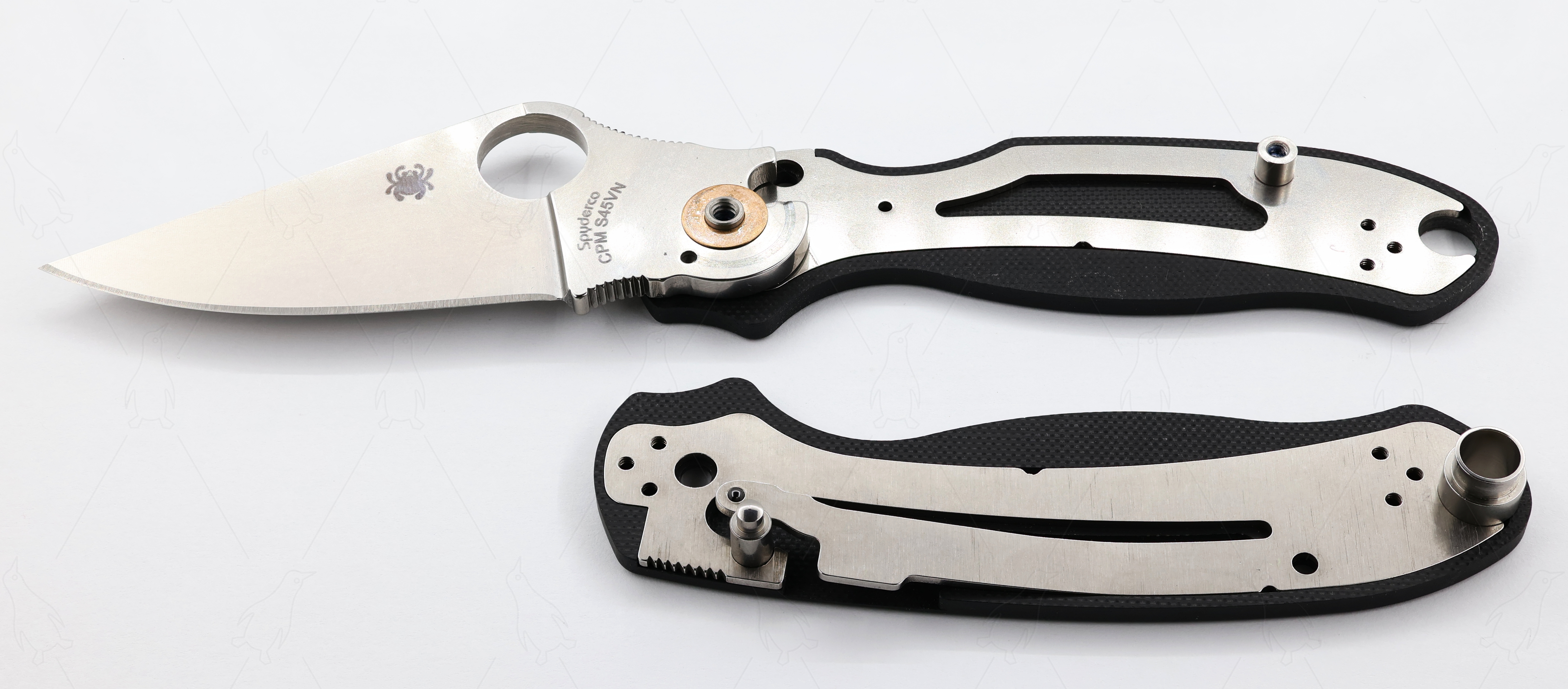
A superficial assumption might be that the Para 3 is one of those jobbies that's mostly made up of its scales, and that it doesn't have full length liners. It actually does, but they're concealed by being inset into the scales.

Despite Spyderco's insistence on the matter, the Compression Lock really is just a liner lock but backwards. It works the same way with the same types of components, in this case including a normal endstop pin which passes through both liners and is also visible peeking out of holes drilled in the scales. Because it's a Very Nice Knife, and bloody well should be for its price, the Para 3 includes a ceramic rather than steel detent ball in the lock.

All of the press fit components in the Para 3 have very close tolerances, and lock together firmly enough that you may think at first blush there's more than just the two screws holding it together. The pivot barrel press fits into the liners, for instance, and holds the washer on whichever side you didn't dismantle captive.

That theme continues with the lanyard hole backspacer tube thingy on the tail of the knife which is an extremely tight fit in not only the liners but also the scales, and takes quite a bit of wiggling and rocking back and forth to coax it out. It sits flush with the outer surface of the scales which, if you were paying attention a couple of dozen paragraphs ago, the one in the clone knife actually doesn't.

Oh, and for some damn fool reason the pivot screws require a T9 Torx bit but the spacer screw heads are T8. I have no idea why this should be.
Apparently the clone makers had no idea why this should be, either, since in the case of the knockoff "C223" it isn't. All of the screws on that one are T8 heads.

It also has ball bearing pivots. I'll be damned.
And they're ceramic ones, no less.

To make up for this, the detent ball in its lock is plain steel. It also includes one spacer washer only on that side, I assume to take up the extra thickness from the detent ball itself. I'm pretty sure it only has one, anyway. I didn't find a second one on the carpet, and after carefully ensuring that the washer ended up back on the side it came from my example went right back together perfectly. So your guess is as good as mine on that one.

The pivot screw design between this and the genuine Para 3 are completely different. They look the same on the outside, but that's where the similarities end. The Para 3 uses that threaded barrel that actually has as screw driven into each end; which end comes out is probably pretty much random whenever you try to take it apart. The "C223" doesn't, and uses a traditional Chicago screw. It does have an anti-rotation flat on it, though, and for once in a knockoff knife the liners are correctly broached to take advantage of this.

The blade heel is different. It's pocketed to accept the ball bearings, and it lacks the zooty pre-machined track for the detent ball. That probably explains the need for the spacer washer, come to think of it. It's obviously be hand tuned for lock engagement with a grinder, because a burr and a small burn mark have been left on it. This is pretty normal for cheap Chinese cutlery.

Otherwise, it comes apart just like the genuine article. The press fit components aren't as tight and are easier to remove. I don't think that has much functional bearing on anything; all of that is just Spyderco showing off.

The full set of hardware.
It occurs to me that I forgot to take a similar picture of the Para 3's hardware, and I'll be blown if I'm taking it apart again just for that. You'll just have to deal with it, I suppose.
You can interchange the clips, spacers, and scales between both knives freely. The blades won't go, not because they're shaped especially differently from each other on the outside, but the pivot hole setups are totally different.
The Edges
I was keenly interested to see what the actual cutting performance of this clone would be.
You see, you see, that was a pun. I don't know if you noticed.
Anyway, I usually don't get too far into rambling on about the edge performance of whatever random novelty bullshit I'm showing off, because in a lot of cases the actual knife aspect of it is secondary. But this purports to be "A Spyderco," and since it hasn't got any major gimmicks up its sleeve a prospective buyer of it (whether they know it is a fake or, more likely, not) would probably actually expect to be able to cut stuff with it. Merely being glow in the dark and with a trick spring loaded ballistic corkscrew on it won't be enough to carry it through, here.
I'm pretty ill-equipped to quantify this sort of thing, to be honest with you. I keep all of my working knives very, very sharp with the aid of a variety of sharpening gadgets — some of which we may some day explore — but outside of superlatively bad examples it's hard to convey a knife's performance in text.

Therefore I got very scientific with this.

Here's the usual lousy micrograph of the clone's edge. I was not too surprised to see that it's got a secondary or, if you prefer, "micro" bevel on it. That sort of thing is often a shortcut to ensuring that any given hastily hand-ground budget knife actually manages to achieve an edge — rather than its two sides embarrassingly failing to meet in the middle, as sometimes happens — and can cover up a blade made of shitty steel or with a shitty heat treat from becoming obviously dull after minimal use. A steeper edge angle is more durable and will remain sharp longer than a shallow one, all other things being equal, at the expense of lesser cutting performance. And the whole point of fancy high edge retention steels is to be able to keep a shallower and thus more performant angle for longer. Or, indeed, at all.

The point's kind of a mess. The grind doesn't quite go out to the end of it, so the very tip is actually just barely noticeably blunt.

The edge grind is of course also noticeably out of true. That will have to be ground out the first time you sharpen it for real, unless you plan on doing as off-kilter of a job as the factory did.
All of this is completely to be expected and well within acceptable tolerances for a $20 knockoff knife. Regardless of all of the above, the "C223" is still objectively quite functionally sharp right from the very moment you remove it from its fake-as-a-snake box, and will effortlessly cleave a Post-It note in two, or open your mail, or cut rope, or flatten a cardboard box. I predict this is in no small part because even if the edge geometry has not been accurately cloned from its Spyderco inspiration, the blade geometry itself with its full flat grind has been, and this is one of the signature aspects that makes Spydercos if nothing else very consistent cutting performers.
Meanwhile, here's how the real deal does it:

Needless to say the genuine Para 3's edge grind is noticeably finer than its clone under magnification. I was surprised to see a micro bevel from the factory on here as well, but maybe I shouldn't be given how Spyderco apparently expect you to sharpen your knives this way as a matter of course, e.g. if you follow the unintentionally hilarious instructional video that comes with (on DVD!) their Tri-Angle Sharpmaker sharpener.
Note also the difference in surface finish between the two. Much more finishing work has been done on the flat of the Spyderco versus the competition.

Check out the difference in the grind out to the point, too. I don't know if this is the full $230 extra's worth of precision, but there it is nevertheless.

Needless to say the edge on the real Spyderco is also within true from the factory. For $250, they'd have a riot on their hands if it weren't.
(The above trueness shots were made on the red part of the glossy box lid from the clone knife's packaging, by the way. That's because for some reason my shitty digital microscope decided to absolutely freak the fuck out at that angle on both of these knives when viewed against a black background, for reasons I cannot begin to guess at because it's obviously never had a problem taking a picture from exactly the same angle on many other knives before. My little microscope cost even less than the clone "C223," so maybe there's a lesson in there somewhere. One that I will surely steadfastly refuse to learn.)
Anyway, we need some kind of head-to-head. Real world cutting performance, the guesstimation thereof, two knives enter, one knife leaves. Which one performs better?
I'll let you take a fuckin' guess.

I used a massively ~~rigorous~~ testing methodology to determine which of these knives performed the best. In fact, in the interest of laziness I deliberately structured it thusly: If your average Joe took either one of these knives right out of its box and put it straight to use, what could he expect? I know a fairer and possibly more scientific test would have started by grinding out both knives to the same level of edge at the same angle, which to be fair I absolutely did do after my initial tests. But to make an assessment from that point, I think I may need to find or devise some more precise equipment.
In the meantime, since both knives would cleanly and effortlessly cut paper with their factory edges, I hacked at some strips of cardboard until periodic checking revealed that each knife started to snag on paper rather than cutting it cleanly. So, neither knife was actually dull at the end of my test but had reached approximately the same level of lack of initial sharpness.
Getting the time and materials together for this is indeed part of what contributed to my sitting on this writeup for so long. The other major factor is that I've been doing other stuff with my time lately, and pissing away my money on other projects that are not knife related. Notably, on massive lenses and aiming the same at birds. Sacrilege, I know. Sorry about that. But I made it all come full circle anyway, because the source of cardboard for this was the very same giant box my shiny new lens shipped in.

So, that's the clone "C223's" pile of cardboard in the picture above. It made it through 46 cuts of a 9" wide slab of cardboard before losing its luster, for a combined total of 414 linear inches of cutting.
Look, we knew full well from the outset that the "S30V" mark on its blade was a bold-faced lie. Obviously its seller didn't actually specify what it's made out of even if its original listing hasn't by now inevitably vanished into the black hole of fly-by-night malarkey. And it has. It may be 7cr, or 440C, or maybe even D2. I can't tell you.

I can tell you that my real Para 3, which still had its factory edge up until I did this, easily hacked through 210 strips of the same cardboard for a total of 1890 linear inches before reaching approximately the same reduction in functional cutting power. So who can say what the "C223" is made out of, but I can damn well tell you that for 12.5 times more money, the Para 3 is at least four and a half times better.
That's not to say that the "C223" is trash in an objective sense; only by comparison. For one thing, it's only $21. Even after 34 and a half feet of cardboard it was still well within the bounds of working knife sharpness, and would probably be perfectly acceptable for any garden variety oik who only uses his knife for work and not for gibbering on all over the internet for imaginary knife bro cred. It could still continue to cut cardboard perfectly well after that point, it just wasn't capable of shaving paper just by breathing on it anymore.
And then I put it on my Ruixin Pro RX-009. Hey, more Chinese knockoffitude — I'm sensing a pattern, here. Within just a handful of minutes I lashed it into this:

At 15° per side, or a combined edge angle of 30°, the "C223" cleaned right up. Whatever kind of steel it's made out of sharpened easily, certainly more easily than when I did the same to my Para 3. The Ruixin is capable of making just about anything supernaturally sharp, but the real test will be to see if this thing stays that way.
Finding a good way to fairly test and articulate that will take some planning and cogitation on my part. So stay tuned; given what we do around here, cooking up some kind of consistent testing regimen will probably come in handy and we'll have a use for it more than once. (Yes, I am aware of schemes like the BESS testing methodology. I'm angling for something cheaper, less proprietary and, let's face it, hopefully less silly.)
In the meantime...
The Inevitable Conclusion
When we were young, our mothers all said to us, "If you just put half as much effort into your schoolwork as you put into that damn Nintendo/computer/football/card game/whatever, you could graduate with straight A's and go on to be a doctor!!!"
And I know I keep harping on this point, too, but I think it's kind of the same thing with the Chinese and these knockoff knives of theirs. Many of them, not least of which this one, are so damn well made that if they could just see their way clear to give up the friggin' chicanery and just invent something bespoke for a change they could really have a hit on their hands. But it seems that some people are just averse to making an honest buck, even if it'd be easier than the dishonest one.
Hell, I wouldn't even care if they just stole the Compression Lock mechanism — which, let's be honest, even the independent reinvention of wouldn't be that much of a leap. I think we'd all be 100% be down with that, if the resulting product didn't wind up slathered with fakes of someone else's trademarks.
But as it stands there's just no world in which I can recommend this "C223" the way that it is. It's incredible just how convincing of a fake it is, but that's the very problem. Any possibility, no matter how remote, that one of these might worm its way into the supply chain and somebody winds up paying a single penny more than the $20.81 I did for it or worse, possibly believing that it's worth any more than that, is nothing less than unconscionable.
But.
If this weren't an unabashed forgery there's no chance I would have even bothered to pick it up, because without anything else novel to offer I would have scrolled right past it. And again, that's the whole point of this exercise to begin with: Find a fake, and marvel at just how it stacks up against the original.
Maybe that's the rock and the hard place the makers of this knife find themselves between, then. Maybe you can't win after all, on either side of that checkout page. This knife is a knockoff, but it has to be or else probably nobody would buy it. And you can't make a living selling your product if nobody buys it, no matter what it is. The Chinese have been turning out so much trash for so long that now they've got a trust problem. How ironic, then, that one way around that is to just be even less trustworthy.
There's another aspect to this, as well, which probably not a lot of people will think of but I'm positive some members of this very community have confided to me that they employ. Let's just say for the sake of argument that you were thinking of picking up a Spyderco Para 3 (or maybe a Benchmade or a Microtech, or whatever else) but you're not sure you're actually going to like it. $250 is a big risk, especially if you're going to encounter a hassle returning it. But $21 isn't. It's probably less than the loss you'd take buying a brand new one and then reselling it in a month on some knife forum after it turns out you hate it.
Most importantly, this is a mechanical carbon copy underneath all the fake logos and counterfeit box and all. It looks the same as the real thing, yes. But it also carries the same, opens the same, functions the same, feels the same, weighs about the same... Maybe it won't hold up as well, but who cares? Carry it for a couple of weeks, a couple of months, whatever. If you like it, then you can buy a real one. And if you don't, or if you break it, well. It wasn't much of a gamble. I'm sure we've all spent $20 on less, at some point in our lives.

21
22
You know, sometimes I think I might just know exactly how knife designers feel. Like, the pressure to complete something that not only has to be novel and entertaining, but also functional and appealing. Where I have the advantage, of course, is that whatever bullshit I come up with doesn't exactly have to be marketable. And as the designer of not one but four whole knives, I also get to come over all smug about it as if I'm not just talking out my ass all the time. (Well, okay, maybe more like three and a half.)
Do knife designers ever get the equivalent of writer's block? I'll bet you Tom Hitchcock doesn't.
No, not the footballer. The guy who designed this:
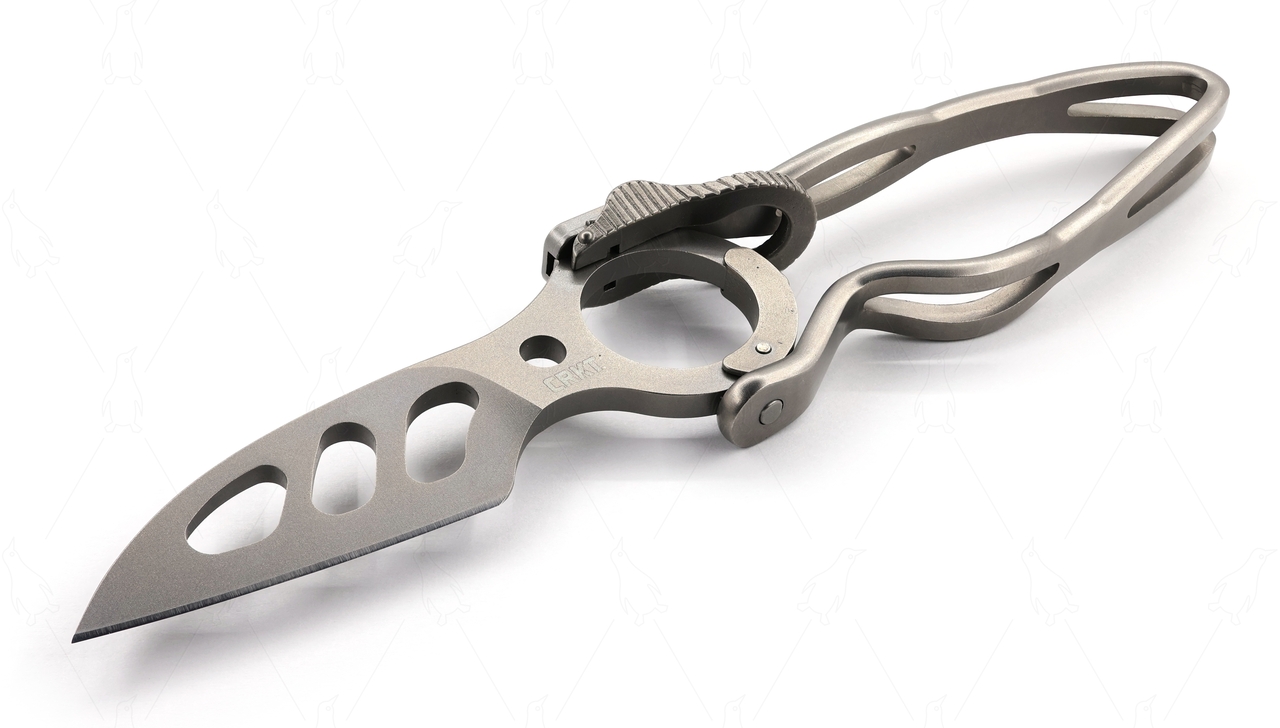
This here is the CRKT Daktyl and it is, without a doubt, slightly bonkers.
I imagine that's because with the best will in the world, by now pocket knives are kind of a solved problem. Just like wristwatches and handguns, we've achieved kind of a core competency in figuring out how such a thing ought to work. Thus in order to do anything novel in the field a designer's major recourse is often to fall back on, well, doing it slightly wrong.

Uh, yeah. Kind of like that.
The Daktyl is therefore another entry in the series of transverse folders that pivot the wrong way. I'm not sure what it says about the field as a whole that this is apparently a genre that exists now, nor what it says about me that I've now amassed three of the fucking things in various flavors.
At first I was prepared to dismiss the Daktyl as just another piece of hipster bohème nonsense that exists only for the sake of novelty, write something hyperbolic and sardonic about it, and move on. But in this case we really shouldn't do that, not least because Mr. Hitchcock maintains a sparse but fascinating website, and through it we can catch a glimpse of the design process of this knife which is a unique opportunity we don't have the luxury to enjoy with your typical faceless piece of off-the-wall novelty garbage.
Because garbage is exactly what this isn't.
It turns out, for instance, that one prototype of this design incorporated a fully formed iteration of its mechanism in a frame that holds a standard utility knife blade. I've casually stolen a picture of this from Tom's web site and rehosted it here, just in case some day this jewel is lost from the internet forever. So it turns out that great minds think alike; damn if it doesn't feel good to vindicated sometimes. And Tom's a real professional designer of stuff with a career and everything. Much unlike myself, who's just some jackass on the internet. If we're not careful, I'll rub some of his credibility off.
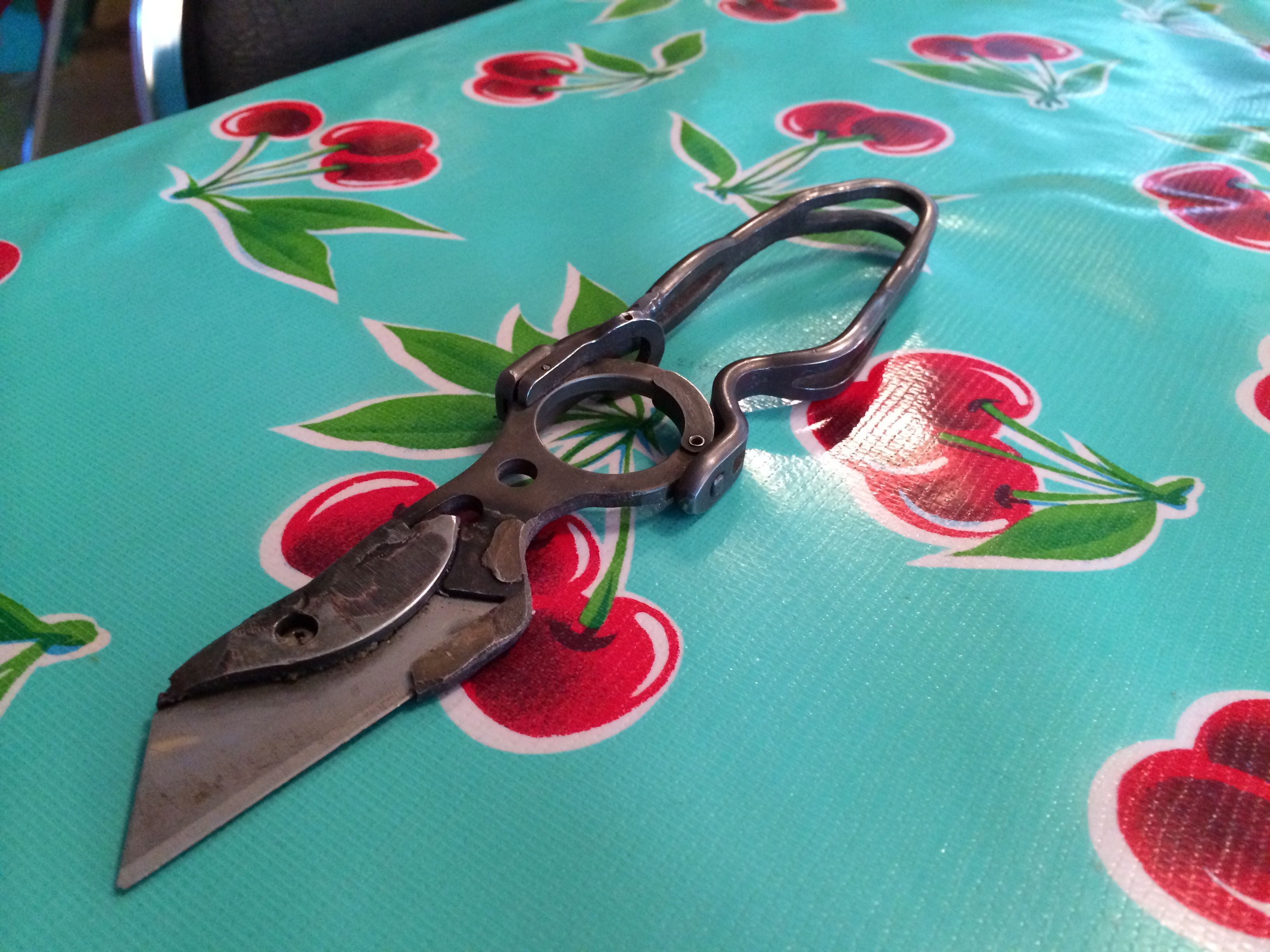
This design seems to have progressed into the Hole In One which got built by CRKT and is now discontinued, thus mocking me forever and becoming yet another of my saved eBay searches, languishing in the vain hope of ever scoring a non-fucked example to complete my perpetual quest to amass a pile of all the damn silly knives I'm never going to use.
The Daktyl is more recent and, importantly, readily available. And cheap, too: Just $45 right now. So for not much outlay you too can be a proud owner of a funky knife with a big ninja finger hole in it and...
Design with a Capital "D"
CRKT's blurb about the Daktyl specifically calls out the "Slide Lock" mechanism, which if you ask me rather buries the lede on how this thing works.

Undoubtedly they're referring to this prominent crenelated dingus on the heel of it which, yes, does indeed slide back and forth. This comprises the sum total of the controls on this knife, and until you slide it outwards it locks the knife totally solid and no amount of mashing it up or down will release the blade. You'll have the devil of a time figuring this out, too, because the cursory instructions leaflet packaged with the thing doesn't explain the slightest bit about how the hell this is supposed to work.

It's not until you work it into this position that the Daktyl will give up the goods. With the thingamadoo correctly positioned, you can press down on it which cams against the springy loop of steel that forms the Daktyl's handle and spreads it apart just enough to release the blade and allow it to swing out sideways. Left or right, it's your choice; if nothing else the Daktyl is thoroughly ambidextrous.

This whole thing puts one rather in mind of the CRKT Van Hoy Snap-Lock, which we very briefly inspected going on for two years ago and holds the distinction of being only the fifth knife I've ever showcased in column. In fact, at a time when I hadn't even made this a column yet and was still taking janky photographs of things on my grubby mousepad with my phone. For fuck's sake, have I been doing this for that long? (Maybe some day we'll revisit that one in some better light.)
Anyway, the Daktyl is a little more confidence inspiring in the hand probably thanks to its generous index finger rest, plus that big old hole right around the pivot. It's also possible with a bit of practice, and if you hold the thing precisely right, to snap it open one handed in such a way that your index finger naturally falls into the ring.

This is immensely satisfying to get right.
And all this works. The Daktyl is impeccably machined such that the blade locks home in both positions perfectly, with nary a wiggle or rattle. Despite a key aspect of its operation relying wholly on the noodle quotient of its handle, it feels remarkably solid. Your grip on it naturally puts one finger through the hole, and the sideways action means that even if you manage to make this fold up on you somehow it won't be the sharp edge you wind up in contact with. If you need even more piece of mind — a concept that every brand loves to sell but nobody can quite seem to point to on the parts diagram — you can slide the lever into its locked position when the knife is open as well as closed, rendering the blade totally immobile.

Unlike the Snap-Lock, the Daktyl's svelte profile completely lacks any kind of clip and there isn't really even anywhere on it to put a lanyard. So you'd think the Daktyl doesn't give you any assistance towards actually carrying it.

But you see, that's where you're wrong. Because there's a carbiner gate built into the finger hole. Its spring motive is also provided by the handles and thus it can eschew the need for any type of tiny fiddly spring. This is clever, but in accordance with the ancient rites of inevitability there is also a notch in the nose of it designed to allow you to use it as a bottle opener, which serves to make it altogether too clever by half.
You can also use this to dangle the knife off of stuff. CRKT suggest that you ought to do this with a belt loop, where it will be plainly visible to all passers by and ought to be a sure fire panty-dropper in any social situation. Virtually guaranteed to not make you look like a colossal nerd in any capacity whatsoever.

The Daktyl has a highly ventilated design. If we were arteurs we would claim it has "a minimalistic aesthetic providing positive reinforcement of form via the exploration of negative spaces, with an implication of a unified whole in silhouette." But we aren't, so we won't.
But there was a time when getting your hands on a skeletonized Spyderco or CRKT was the height of cutlery chic, so here is at least your golden opportunity to reclaim those glory days. Or, more likely, actually get around to achieving them in the first place if you're anything like me.
All This Whiffling And I Still Haven't Talked About The Specs
The Daktyl is precisely 6-11/16" long open, and 4-3/8" closed provided you slide the manipulatory hoojadinger into its locked position. The blade is 3-1/4" long if you measure from the tip to the pivot axis, but the sharp part of it is only 2" long thanks to a significant portion of it being forward of the wasplike narrow waist. Thus it's a matter of interpretation as to whether or not this counts as above or below the mystical 3" figure. Either way, just looking at the thing it's unlikely the law will be able to label you a domestic terrorist for owning one of these and still be taken seriously afterwards.

The blade is a Wharncliffe profile, fully flat ground, and has three jelly bean voids machined into it. There's also a perfunctory round hole which appears to be a holdover from the Hole In One Design. The shape of the cutouts in the blade are the primary differentiators, but there may be other differences. Hell if I know, due to not owning one of the latter.

Despite being constructed entirely of steel of one flavor or another, the Daktyl isn't too heavy owing to a lot of it being just air. Just 67.4 grams or 2.38 ounces, which would make it a much more appealing EDC candidate if only its carry method weren't so damn silly. Even so it's a nice size, and if you can figure out a way to work it into your wardrobe without looking like a dweeb or, preferably, if nobody in your workplace cares this could make a nice light duty EDC piece.
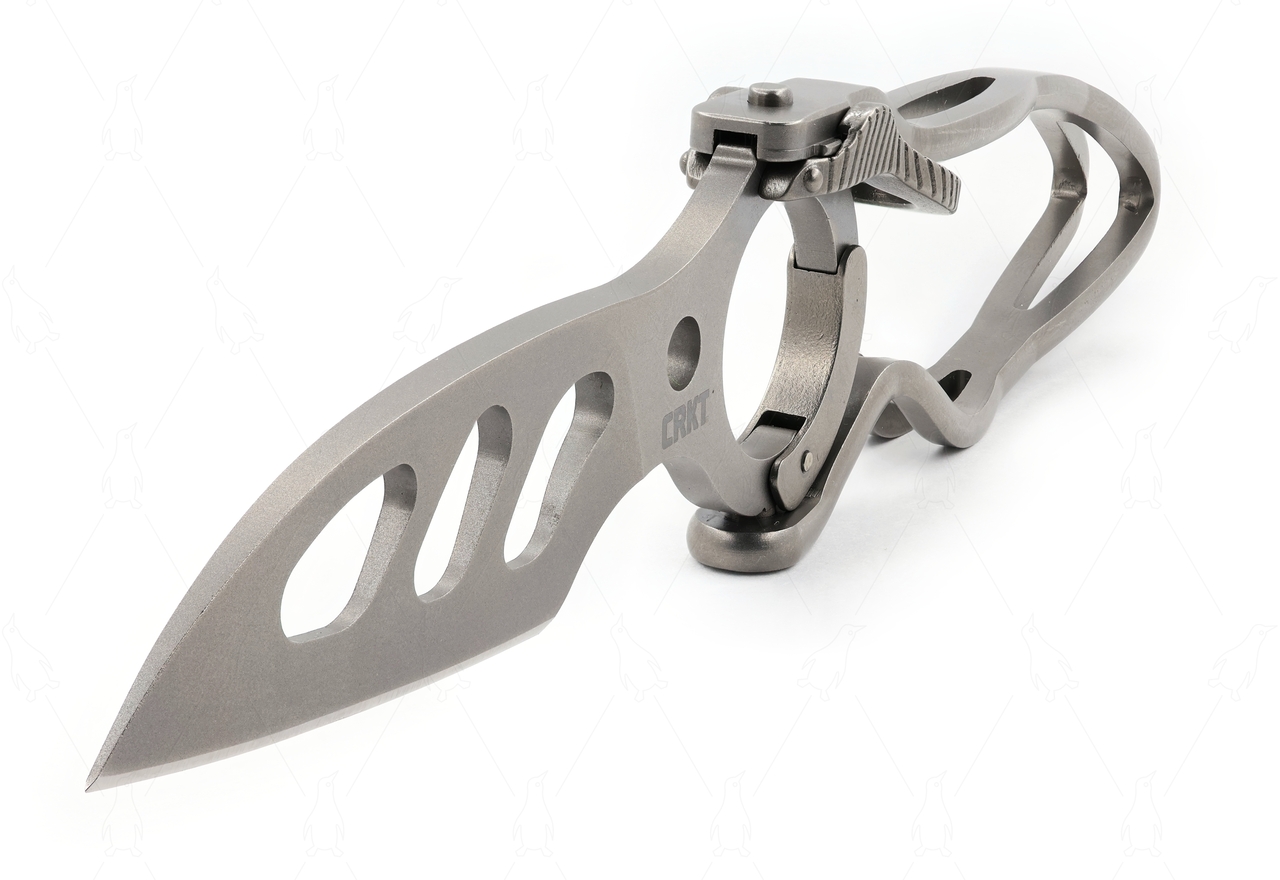
The blade is made of 420J2 which has, let's just say, a high degree of sharpenability. Hey, they make surgical implements out of the stuff, right?
Edge retention notwithstanding, light duty is what the Daktyl is likely to see. What with those holes in the blade it's not bound to do anything but slowly drive you insane if you tried to use it for camp food prep. And thanks to the same it's probably unwise to apply much twisting, prying, or impact force to the blade. Which is a shame because it has an excellent factory grind and a slight upsweep to the edge with a gentle curve that'd otherwise make it highly usable.
The finish is bead blasted all over with a pleasing satiny vibe. This extends to the expertly machined and jimped lock lever, the carbiner gate, and even the cross pins.
The Daktyl's all riveted together and contains no screws, so I didn't brave taking it apart. It seems to consist of a sum total of only four parts, though, not including the pins. So it's not too tough to imagine how it goes together, nor grok how it works just by looking at it from the outside. It's elegant, I'll give it that.

Tom Hitchcock's designer's mark is laser engraved in one side, lest you forget that in your hands you hold an objet d'art from none other than the inventor of Bottle Blocks.

On the reverse is CRKT's logo, an ever-present reminder that sometimes your pure vision runs into the mundane tedium of having to enlist somebody to actually make it. And so it goes.
The Inevitable Conclusion
Did not Nietzsche say, "We have art in order not to die of the truth?"
Do I not say, if I got any more pretentious or used any more gratuitous French in this column I'd have to disembowel myself with a spoon?
The truth is, regardless of whatever else we should celebrate the path the Daktyl took from one designer's vision to a physical thing we can hold and appreciate. While we're quoting, I love the frank assessment on the mechanical design on Tom Hitchcock's web site, which is thus: "I began looking at the trend to knives with finger holes, and I also saw an interesting side-opener. I thought that I could integrate the two ideas, and make a much safer, friendlier utility knife in the process. But it wasn’t as simple or easy as I first thought."
I've been there, Tom.
So I can already hear it:
"Production Rockhopper when, Dorkus?"

23
I have a couple old pocket knives that belonged to my grandfather. I've looked at a lot of information about removing rust, polishing, etc. I used a gun cleaning solvent with wet/dry sandpaper to take off the heavy rust and brass wire brushes. I have polishing cloths and metal polish. I got them looking a lot better, but there is some damage to the metal itself on the oldest knife. It looks dimpled. Is there anything that can be done to help with the damage short of machinery to refinish the blade or something? I'm pretty new/inexperienced so I'm open to suggestions as long as it doesn't require buying expensive tools. The knife that is the worst was from my grandfather's tackle box so it was used hard.

24
You know, sometimes I almost miss the pre-Internet days. Or at least the early Internet era. Back then, the junk purveyors were all on late night television instead. In those pre-dawn hours, if you wanted to get your hands on the truly godawful and macabre you had to call the 1-800 number now, where operators were standing by, ready for your credit card and one easy payment. All of that took effort. Dedication, even. You had to be up at that hour, for a start, and even then you'd have to peel yourself out of your chair.
Nowadays it's just too easy. And some of us have a reputation to uphold and a show to keep going. So you scroll, and scroll, and scroll, and then you wind up with crap like this.

This is the NSOUR "Stainless Steel."
I'm serious. Its model designation is literally "Stainless Steel."

Or be precise, it's the "NSOUR New Stainless Steel Sharp Outdoor Camping Handle, Portable Meat Handle, Unboxing Fruit Knife for Self-defense."
I will let the record state that I am leaving the Portable Meat Handle completely unaddressed. At least this time they managed to get all the letters into "self-defense," and even in the right order. And NSOUR sounds like it ought to be the name of a Chinese knockoff boy band.
If a cigar cutter got drunk and fucked an out-the-front switchblade, the resulting crack baby would undoubtedly be this.

It's tough to miss the NSOUR's most prominent feature, which in fact isn't its silly name, but rather is this tantalizing trigger mechanism behind the big hole in the blade. At first blush it appears that sticking your finger in here ought to be an express ticket to amputation, but no part of the circular cutout is sharp nor contacts the edge in any way. This is a slide opening knife — not a side opening knife — and here's what that looks like:

The action is slightly gritty and drags noticeably. But it is not spring loaded and thus very emphatically, definitely and clearly, and by all legal precedent is absolutely not a switchblade. It just wishes it were.
The NSOUR weighs 57.8 grams or 2.04 ounces and is constructed entirely of steel of some description, most likely stainless per its blurb but with these things you can never really take anything at its face value. And it's not quite as compact as you'd think. It's nearly exactly 4" long when closed, call it 3-15/16". But thanks to a good chunk of its length being taken up by the finger hole the blade itself is actually a comically stubby 1-7/8". Open, then, it's 5-5/8" long overall. The heel of the blade ends in a short ricasso and somehow this knife manages to be the only one I think I've ever handled that actually has more length of sharpened edge than is actually presented to the user. Even with the blade fully extended there's about 1/8" of edge that doesn't come out far enough to ever actually make any contact with the outside world, instead preferring to hide in between the handle plates.
I guess that bit will never get dull, at least.

Because this sort of thing is contractually obligated to contain one on it somewhere, the front of it also serves as a bottle opener. Let it not be said that every part of this is useless, then. (And at this rate my collection of dumb bottle openers is nearly as large as my collection of dumb knives. Many of them are, in fact, one and the same.)
The NSOUR is nearly completely flat, made up of just two shiny polished handle plates made of sheet steel (also presumably stainless, or at least one would hope) separated by a springy backspacer. Only the screw heads protrude past this. Without them it's 0.217" thick. The designers probably could have countersunk the screw heads and made this much slicker, but they didn't. So with them, the total thickness is 0.304". That's still not much.
There's no clip. However, you do get a triangular lanyard/keyring cutout in the tail and a cheap split ring was included in the baggie with mine. For the paltry $10.25 this costs, perish the thought of actually getting a box. That's not how it works.
What It Do
Rather, here's how it works.
Opening this with one hand isn't quite impossible, but it's harder than you'd think. The blade doesn't lock in the retracted position, thankfully, because with only that trigger to work with unlocking it would probably take three hands. It simply detents there, but it does so just exactly too firmly to be convenient. The track the blade slides in isn't polished in the slightest, and despite the typical Chinese predilection to douse everything in petrochemical-smelling grease my example showed up entirely unlubricated. Matters improved a little bit once I dripped some machine oil in the track, but not much. Fidgeting with the thing a whole bunch helped, too. Even so, the amount you have to scooch the blade forward to get it locked open is too far to do in a single operation with one hand. You have to play this little game of push, scoot, push, scoot, regrip, and repeat which is not only inelegant but also makes to feel kind of like a twerp. Like you're doing it wrong. Every time you think if you choke up on it a little further, really reach for it, and contort your fingers like a sleight-of-hand magician, this time you'll get it in one smooth movement. And you can't. Not now, not ever. That's just how it is.
I think perhaps it would be best to ignore the purported self-defense application of this knife. I don't know about the fruit or the meat handling, either.
It might be better if there were some manner of grip greebles on the edges of it. But there aren't, and every face is polished smooth.

On the bright side, I thought for sure this would also be a self dulling knife with the edge raking across the bottom of the track every time you opened it. Surprisingly, it isn't and it doesn't, at least if you open it the usual way. Trust me, I'm just as shocked as you are. You can knock the edge into the bottom track if you deploy it halfway and deliberately push it down, but thanks to the spring action built into it, it won't want to stay there and it helpfully cams itself back up into a position where it won't damage itself. If you value what little edge this has from the factory, don't do that.
As a consolation prize, the frame totally does scratch up the mirror polished faces on the flat of the blade every time you open and close it. What, you didn't think we'd manage to skate by so easily without some crucial aspect of the mechanism being fucked up in such a way to perfectly annoy you, did you?
The trigger does indeed lock the blade in the open position. The lockup's not very solid and there's a great deal of rattle left in the blade in every direction you can think of even when it's ostensibly locked. But it won't close up on you until you deliberately pull the trigger back, which both unlocks it and retracts the blade back into the handle as you'd hope and expect. This brings your index finger with it so it's actually damn difficult to cut yourself with this even if you do accidentally cause it to fold up unexpectedly. So that's nice.
Obviously there's no real forward finger guard, but if you hold this the way it appears you're supposed to you'll have your index finger through the hole, which ought to do a good job of preventing your grip from sliding up onto the edge no matter how much of a muppet you are.
Since there's no externally visible mechanism on this thing whatsoever you're probably wondering, as was I, just how the hell it works. Well...
One. Moment. Please.
The NSOUR's external construction is superficially very simple, with just four Chicago screws in the corners holding it together. They're threadlockered and obviously they don't contain any anti-rotation flats, so getting the plates apart requires sticking a T6 driver in both sides and giving a hearty twist. Preferably without slipping out and stripping the screw heads, or stabbing yourself with your own screwdrivers.
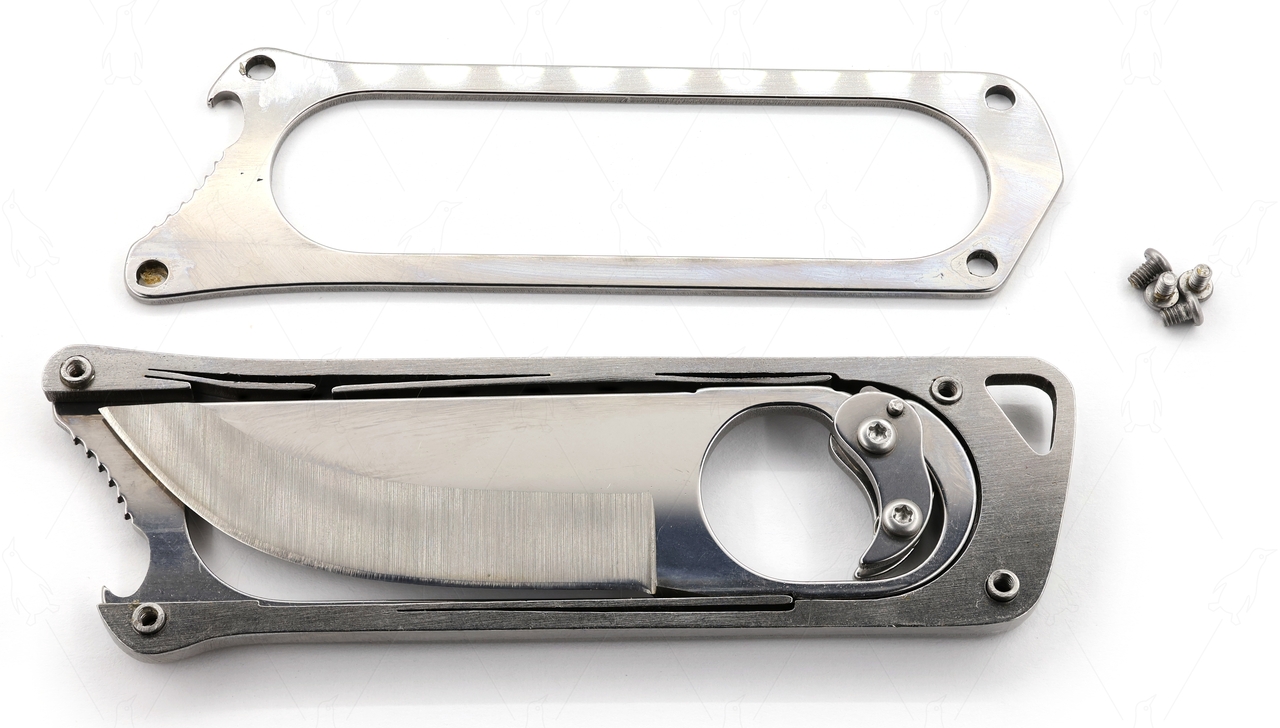
Inside you can see the NSOUR's secrets, which are simultaneously brutally crude and ingeniously clever. It's just all dichotomous like that.
Which side you get off doesn't matter. Most of its mechanism is not only contained in, but also comprised of the backspacer. A selection of prongs carved into the spacer serve as both the detent and lock-open springs. A tiny ramp and notch carved into the top of the blade engage with these.

When the blade is retracted there's a pair of prongs that are just mashed against it and prevents the thing from just falling open in your pocket. It's not great but it works, in a broad sense. It's certainly better than nothing, and all this is what prevents the NSOUR from just being a gravity knife. I believe the lower one is also meant to assist in preventing the edge from riding against the lower surface of the spacer. There's a notch on the lower heel of the blade that I think is supposed to make the closed lockup a little more positive and less squidgy, but it doesn't quite accomplish that. Just by looking at it I have to figure that the assembly of one of these requires a fair amount of hand finishing and tuning with a file or more likely a tiny grinder. Expecting whoever-it-is to nail it perfectly every time is probably a reach. In my case they certainly didn't.

Out on the business end, another prong serves as an endstop and one more just barely falls into the notch on the back of the blade once you push it to its fully extended position, acting as a one way gate and preventing it from backing up. The trigger is very lightly spring loaded and pivots on its top screw, camming upwards when you pull it back to minutely push the locking prong out of the way so you can retract the blade.

The trigger itself is the most complicated part of the entire assembly. It's made of two plates held together with yet more Chicago screws, with a pin pressed into one of them. There's a hair-thin torsion spring around the lower screw which pokes into the little hole you see there and goes off "ping!" as soon as you take it apart. I couldn't get it to stay in place without putting the top plate back on, so I left it out for this shot. The interface with the prongs is a tiny lobe made out of what I presume is hardened steel, which is clearly the only precision machined part in the whole damn knife and rests in a dovetail notch on top of the blade.
Here are all the trigger components separated out, including the spring:

Reassembling the stupid tiny spring is exactly as annoying as you'd expect. The long arm of it doesn't go anywhere in particular and just rests against the back of the hole in the blade. Keen readers will have already spotted it in some of the other photos, but in the exceedingly unlikely event that you also own an NSOUR knife and have also unwisely it apart for some reason, here is where the other end of the spring is supposed to go when you finagle it back together:

And, the full spread of parts:

The left and right handle plates are identical, and you can swap them from one side to the other if you like. They're even polished on both sides.
All the internal bits, such as they are, in action:

It's always deeply satisfying once you get one of these weird knives apart and understand how its screwball action works. In some small part it represents a triumph over whichever dickhead designed it. It's even better when you can get the fucking thing back together without losing any parts, and it even still works. I'm happy to say I won this round, for whatever it's worth.
This knife's action is novel, but also really a stupid way to go about it. It's inevitable, though. The longer any mechanism exists, the closer the probability of some turkey trying to use it in a knife gets to 1:1.
And speaking of inevitable...
The Inevitable Conclusion
I have a friend who is an engineer. No, really. I do. For many years, he's told me he's kicked around the idea of writing a book. He wants to call it, "Why We Don't Do It This Way." I think I might have just found him a new chapter.
History is littered with dumb ideas that never caught on. How fortunate we are, perhaps, to have this opportunity to witness one of them unfolding right in front of us in real time. But the truth is, if nobody actually gave it a shot we would never discover what the next big thing might turn out to be.

Whatever that is, though, it probably isn't this.
It's easy to declare it's all been said already, everything's been done before, and there's nothing new under the sun. I don't think that's so, myself. But that doesn't mean that the next radical idea won't be a bloody stupid one.

25
With a name like "Chong Ming," you just know you're in for a good time.

We've touched on this sort of thing before, at this rate over a year ago. Yes, we've been at it with this nonsense for that long.
Anyway, as Darth Vader once said: Spinning's a good trick.

This is the Chong Ming CM78, and with it welcome to the current state of the art of the Chinese knockoff fidget spinner knife. I've scrolled by and passed up many of these over the last several months, but there was something about this one that I couldn't resist. I mean, just look at it.
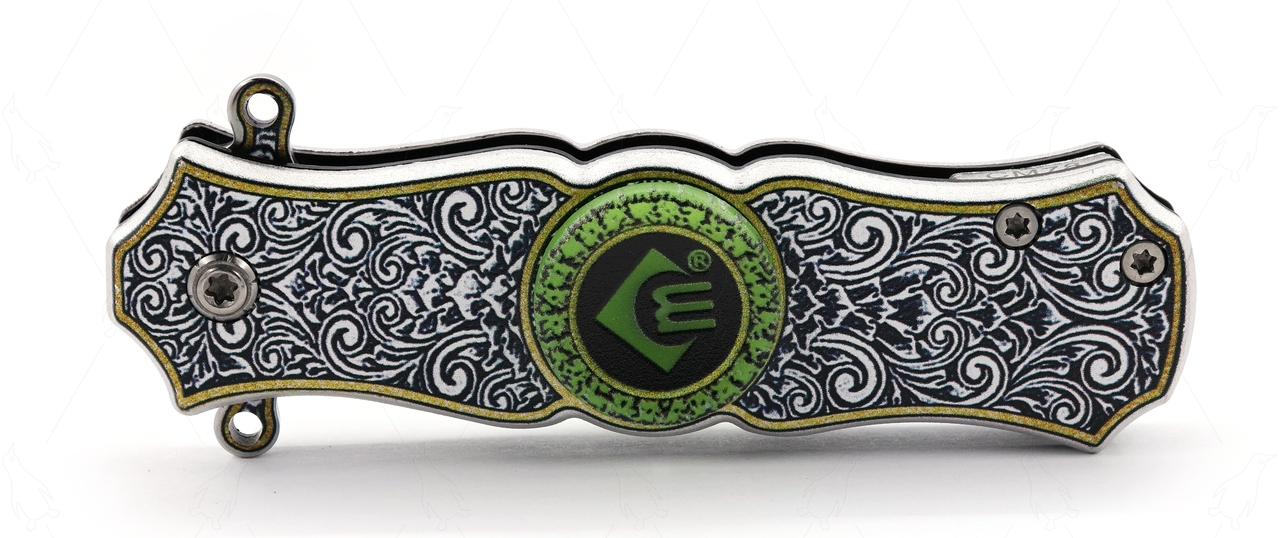
That is some serious filigree. The CM78's vibe could probably best be described as, "overwrought." The fleur-de-lis styling even extends all the way down the blade.

For $13, you get 6-1/8" of ~~top quality~~ Chinese spring assisted stiletto-ish liner locking folding knife with a blade made of, er. Some manner of metal, surely.
Its product description goes on to propose that its intended purpose is "hunting," and describes its theme as... "sport?" But then, it also claims that it includes a pocket clip. Which it categorically does not. You really just can't believe everything you read these days.

As you can see, it's also sold as the "Ziekeer ZD00" and probably a myriad of other ridiculous and inscrutable monikers. If you see any of these anywhere you can rest assured that they're all probably the same.

But this one even bears an honest to goodness model descriptor, laser etched into its little aluminum backspacer. That's miles beyond how far we usually get with this sort of thing.
It's also singularly irritating to take a clean picture of when it's lying on a flat surface, because, well...

Yeah. That.
(If you'd like an infinitely looped version of the above, by the way, see here. You're welcome.)

The CM78 actually works as a fidget spinner, but not as well as you'd hope. It does have one thing going for it there, though: It's only 3-1/2" long closed, about half an inch shorter than our old spinner knife, which makes it significantly easier to use as such without whacking it against the web of your hand all the time. That means you don't need to have hands like a catcher's mitt to use it. With only thin steel liners and handle scales made of aluminum it's quite a bit less hefty, though. 73.5 grams by my scale, or 2.6 ounces. So it doesn't carry as much momentum as perhaps it could, which puts it in the curious position of being possibly the only object on Earth that could have been made better if more of it were constructed of some kind of potmetal. Its mass is also pretty evenly distributed throughout its length which is fine for a normal knife but not so much for something that's meant to be a fidget spinner. So the net result of all this is that it doesn't carry on spinning as easily or as long as you might like.
For comparison, my bog standard metal fidgeter I bought at the mall gods only know how long ago is 86.2 grams or 3.04 ounces, despite having a footprint of only around 2/3 of the size, and is correctly designed with the majority of its mass concentrated out at the tips of its arms. Despite both that and this being equipped with ball bearings, the former can easily remain spinning upwards of two minutes at a stretch while exhibiting a pleasing gyroscopic effect, whereas the CM78 runs out of steam after around eight seconds, even if you give it an unwisely vigorous flick to start it going.
Bummer.
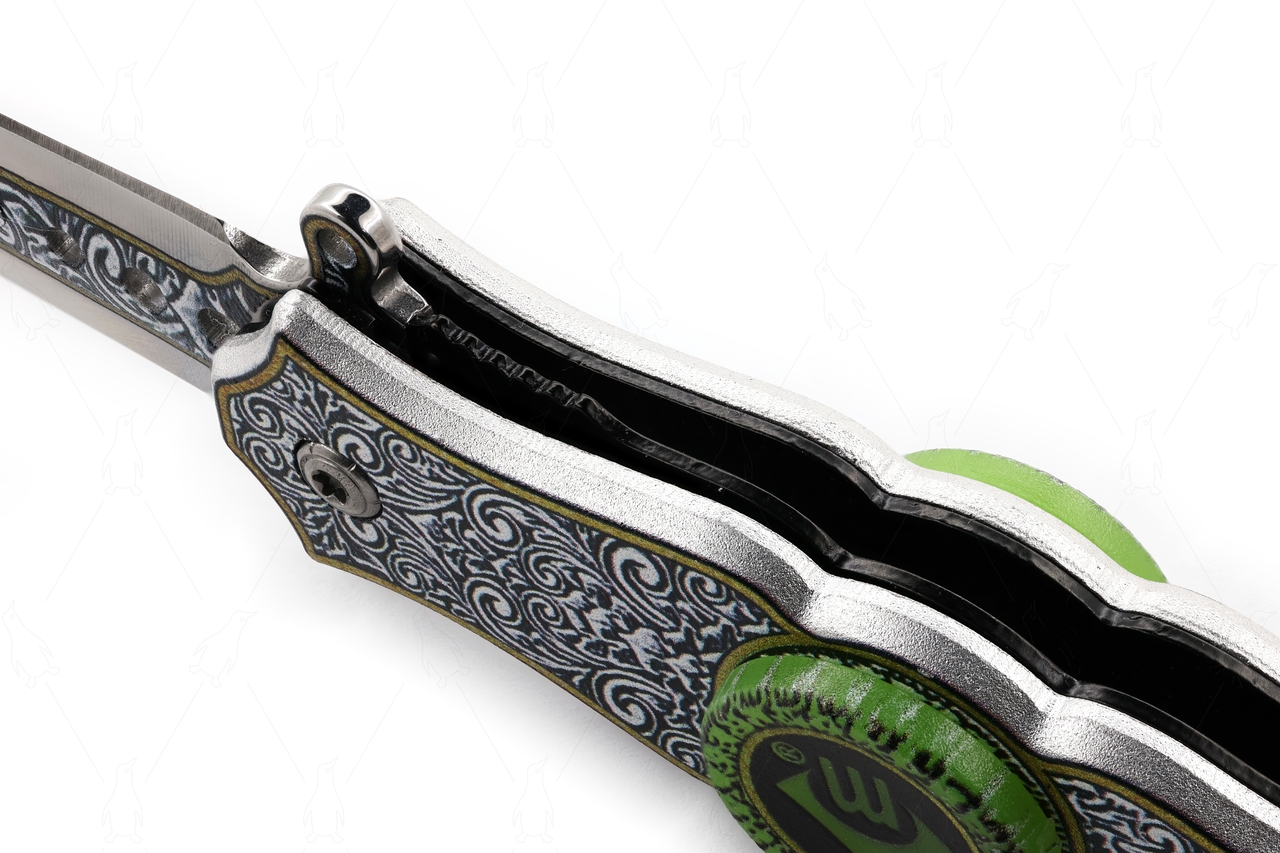
The knife part is a downgrade from previous incarnations, as well. It has a good lockup, but a noticeable amount of wiggle in the pivot when it's open. The pivot washers are just plastic, not brass and alas not ball bearings, either. So it loses out there compared to our last foray, as well.
The blade triangular, ventillated, and short. Just 2-5/8" long and trying hard to look double edged, even though it isn't. I do like that it's spring assisted, though, because the assist mechanism also serves to hold the blade shut when it's at rest. It takes a concerted effort to get it over the hump and fire it off, which also serves to provide you a little peace of mind that the blade won't just spontaneously fling itself out when you've got the thing spinning away just half an inch from the palm of your hand.
...Probably.
It's totally symmetrical with one of the crossguard nubs serving as a kicker to push the blade open, whereas the other one resolutely doesn't. There's no real tactile indicator as to which side is which, and the spine of the blade doesn't even protrude past one side of the handle to give you a hint. Thus, opening this without looking at it carefully requires some trial and error, or an element of luck. A self-defense tool it is not.

The vaguely crucifix shaped profile is generally reminiscent of several other less ridiculous knives I can think of off the top of my head. Or, at least, ones that are ridiculous for different reasons. It's very Knights Templar, and the eagle-and-shaved-head crowd also tend to get all excited about things shaped like this for some reason. As you'd expect, it's not too tough to find a "Masonic" rendition of these, either. For "ceremonial" purposes, per the blurb.

The Chong Ming Branded version has this rather more tasteful logo on its injection molded neon green pair of center buttons instead, with an (R) registered trademark symbol and everything. I was certain at first that this had to be fake, just one of those nod's-as-good-as-a-wink japes we've come to expect from the Chinese to add a layer of superficial yet fictitious legitimacy to the proceedings. But blow me down, I was able to find a bonna fide US trademark registration for the "Yangjiang Guanfeng Industry and Trade Co., Ltd," who are the apparent force behind this thing. There's the C and sideways M marking listed right there, bold as brass, exactly as it appears (incessantly...) on the CM78's box. Go figure.
These guys have zero presence on the web other than their trademark registration, which makes you wonder if they're a front for somebody else. There's also the tantalizingly hilarious prospect that some other anonymous joker in China counterfeited the trademark of this shitty knife company and slapped it on a different shitty knife, for purposes completely unknown. There are a myriad of "Chong Ming" branded low end knives of various flavors all over the usual Chinese storefronts, so either these guys are a shadowy OEM of cheap novelty cutlery, or somebody's rebranding and reselling white box goods from elsewhere on the mainland under this name. We'll probably never find out for sure.
Anyway, you're probably just chomping at the bit to see me smash this to pieces and see what all's inside, so here you go.

First up, the fidget spinner portion of this totally does ride on ball bearings. They're press fit into the scales and recalcitrant to come out, so lest I break the thing I left them alone. One side also houses the zigzaggy spring that powers the assist mechanism, which rests in a pocket hogged out in one of the scales and seems to be a common way to go about it. It is, of course, absolutely slathered in Chinese axle grease.

Inside is nothing much surprising. The only odd thing is the driver sizes for the various screws. The pivot is a T8 screw head but for some reason the rest of the assembly screws are T7, which you almost never see. Otherwise there are no fancy construction tricks. There's no anti-rotation flat on the pivot screw, for instance, so you have to stick a driver in both sides simultaneously. Nothing I found was threadlockered, but at least nothing was stripped, either. Bor-ing.
The fidget spinner buttons are held on with little wood screws that are just reamed into the plastic. The back faces of the buttons aren't flat so they don't quite sit on there straight, which gives the net effect of making the knife exhibit a noticeable wiggle when you're spinning it. I cured this by giving both of them a short lash on one of my diamond sharpening stones. This may be putting pearls before swine but it did at least straighten the damn thing out.

Here's your shocker of the day. The edge actually isn't completely terrible out of the box. The grind out to the point is pretty good and it's acceptably sharp for a dime store novelty. This'd make a serviceable letter opener or, more realistically, bong bowl scraper. I've seen worse.

It's out of true, though. Imagine how disappointed we'd be in the state of the world if it weren't.
While we've got the microscope out, here's something interesting. Despite ostensibly being just black and white, the pattern printed on the handles and blade is actually in color. Check it out:

The red and blue dots are not an optical illusion, as superfluous as they may be. I imagine whatever they're using to print these is also capable of producing full color output and whenever they're not cranking out these is probably used to make containerloads of all those other horrid Joker/Trump/Skullybones/Pot Leaf/Camo/Anime Tiddies/etc. patterned knives you'll find festooning the plexiglass case in your local truck stop. And I'll bet you whoever is in charge of the graphic design is not paid enough to apply a lot of care or attention to what they're doing, so we wound up with these little color fringes. They're only really visible under magnification.
The gold bits are even printed with some kind of metallized ink. The overall effect is pretty damn swanky, but I'll bet you it won't hold up to wear very well.
The texture appears to be a bitmap graphic that's been stretched in a manner that included some kind of fuzzy interpolation, probably because the Chinese tend to treat image aspect ratios as a bourgeoisie Western plot, so when viewed very up close it appears a bit blurry and indistinct.
The Inevitable Conclusion
From arm's length, at least, the CM78 is a slick looking little number for sure.

It's just too bad for it these days that it's so far behind the times. 10 years ago, sure, it'd probably be a sterling recommendation for $13. Instead with this we seem to be regressing rather than progressing; the Wish fidget spinner knife I showed off previously was built better than this, and it was cheaper to boot. Nowadays $13 (or less!) can buy you a lot of knife if you're careful with your choices and don't just jump on the first shiny novelty you see.
But that's not how we do things around here.
Good is boring. Sometimes you can have more fun being dumb.

view more: next ›