Linux

10605 readers
426 users here now

A community for everything relating to the GNU/Linux operating system (except the memes!)

Also, check out:

Original icon base courtesy of lewing@isc.tamu.edu and The GIMP

founded 2 years ago
MODERATORS
101


Edit: I'm now enlightened and use mpv, I really like the ModernZ OSC (on-screen controls), and uses config files.

IINA is only on macOS. I looked up linux alternatives but none of them seem to have similar looking UIs, at least out of the box. I want the player UI to float on top of the video + with a blurred background, it as shown in the image; or at least the ability to theme it like so.

102


Catch up on the latest Linux news: Kernel 6.18, Alpine 3.23, NVIDIA Display Driver v590 Beta, VLC 3.0.22, When Linus met Linus, Linux Mint 22.3 nears release, Jolla Linux phone, and more.

Welcome to the 49th week of Linuxiac’s 2025 Weekly Roundup — your go-to source for all things Linux & Open Source. Here’s a look at the biggest Linux and FOSS highlights from the past week (Dec 1 – 7).

103
251
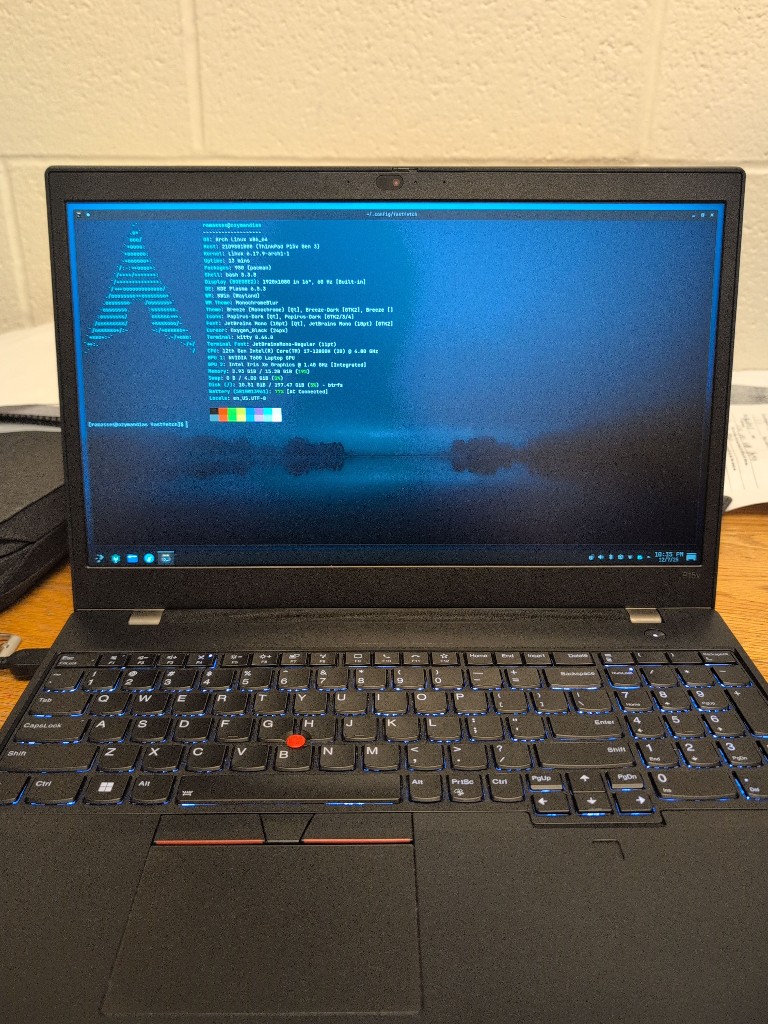
Joined the club! (media.piefed.social)
submitted 1 week ago* (last edited 1 week ago) by a_person@piefed.social to c/linux@programming.dev


Thinkpad P15v gen 3 running arch. I played around with fedora a bit but it was boring. I got a working gentoo install running but that was too complicated, so I settled on arch.

104


The set of six branches containing SoC and platform updates/additions for the Linux 6.19 kernel have been merged for enabling a lot of new RISC-V and ARM 64-bit hardware as well as enhancing some existing SoCs/platforms.

Arnd Bergmann sent out all of the SoC updates/additions on Friday for the ongoing Linux 6.19 merge window. There is some exciting new hardware, Device Trees for some new ARM machines, and more

105


Merged to the mainline Linux kernel last year was GPIB drivers in the kernel's "staging" area. GPIB is the General Purpose Interface Bus launched by HP back in 1972 for lab equipment and more. After a year of cleaning up the code in the kernel's staging area, for Linux 6.19 the GPIB drivers have been promoted out of the staging area and into the Linux kernel proper. The Linux kernel now has stable driver support for this 8 Mbyte/s parallel bus that was introduced 53 years ago.

Since being accepted into the kernel's staging area last year, the GPIB code for supporting vintage lab instruments and other hardware has continued to be cleaned up in newer kernel versions and was nearing the point of graduating staging. That's thanks to passionate hardware folks with the standard itself being long obsolete thanks to the likes of USB, Firewire, and Ethernet. The Linux kernel's staging area as a reminder for any new users is effectively a proving grounds / portion of the kernel where code can reside until it's cleaned-up and in better shape for being formally maintained within the Linux kernel source tree.

106


I tried downloading a video using yt-dlp but got the following errors :
ERROR: [requests] Unexpected error: FileNotFoundError: [Errno 2] No such file or directory: '~/.ssl-log.key'; please report this issue on https://github.com/yt-dlp/yt-dlp/issues?q , filling out the appropriate issue template. Confirm you are on the latest version using yt-dlp -U

ERROR: [urllib] Unexpected error: FileNotFoundError: [Errno 2] No such file or directory: '~/.ssl-log.key'; please report this issue on https://github.com/yt-dlp/yt-dlp/issues?q , filling out the appropriate issue template. Confirm you are on the latest version using yt-dlp -U

ERROR: Unable to handle request: Unsupported url scheme: "https" (websockets) + 2 unexpected error(s)

After some troubleshooting, I found that I get a similar error when trying to download a package via pip FileNotFoundError: [Errno 2] No such file or directory: '~/.ssl-log.key'

I tried searching to see if I could regenerate ~/.ssl-log.key but couldn't find anything. Does someone know what caused this issue and how to fix it?

Solved: for some reason SSLKEYLOGFILE was being set in my shell config, deleting and unsetting it fixed it

107
108


One of the most exciting merges this weekend to the Linux 6.19 kernel is establishing the infrastructure for supporting PCI Express link encryption and device authentication. Multiple vendors are working on PCIe link encryption for their hardware while this initial pull begins laying the foundation of AMD SEV-TIO Trusted I/O support for the mainline kernel.

Dan Williams of Intel sent out the pull request for laying out the new PCI infrastructure for PCIe link encryption and device authentication. The first implementation of that new code is the AMD SEV-TIO for Trusted I/O support.

109


Merged last night for the Linux 6.19 kernel merge window were all of the USB and Thunderbolt driver changes. Standing out this cycle is Apple Silicon devices like the M1 Macs now having working USB3 support on the mainline Linux kernel.

There has been USB3 support in the downstream Asahi Linux project for a while but only now with the mainline Linux 6.19 kernel are the necessary patches in place for enabling USB3 support on these modern Apple Silicon devices... Sans the M3 and M4 Macs that are still being reverse engineered and worked on by the remaining Asahi Linux developers.

110
29
submitted 1 week ago* (last edited 1 week ago) by Lojcs@piefed.social to c/linux@programming.dev


This first happened earlier this week (after updating the system last weekend), and for the second time now. Looking it up the general consensus seems to be that any random reboots are a hardware issue, but I've been running this rig (7950x) without issues for years and there are no errors in the journal so I'm skeptical.

I'm not sure if calling what's happening a reboot is correct neither, one second it shows the os, next second the bootloader without the usual indicators that it turned off and on again.

Last time the journal was very clean with a clear separation between the new boot and the old boot but this time it happened when opening a game from steam so the messages from the two boots are printed interleaved (although the timestamps aren't). There's exactly 0.99 seconds between the last message from old boot and the first message from new boot. What's stranger is that my systemd-boot waits for 3 seconds before booting..

I'm asking here to see if anyone else had the same issue and knows what's causing it. I updated the system just now to see if it will help.

Edit: Fuck me, after the update random ui elements (like the Proton version selector on Steam) started spasming. It feels like 2023 wayland+nvidia again

Edit 2: Lsi steam works

111


Flowblade 2.24 released today as the newest version of this open-source, non-linear video editing application. Flowblade 2.24 brings a number of refinements while also interesting is their commentary concerning the future with Wayland and GTK4 porting.

With today's Flowblade 2.24 release there are many UI/UX updates like new ways for creating compound clips and dual trim for sync-relation clips. Plus some enhancements to themes and other user interface / visual changes.

112


KDE developers continue preparing Plasma 6.6, and although there are still over two months to go before the final stable release (scheduled for February 17, 2026), the team posts weekly updates on the KDE Blogs about what changes to expect from this version. After covering some of them last week, we now have a new batch to look at.

This time, several UI improvements stand out. Desktop items now support Alt-click and Alt-double-click to open their properties, matching the behavior already familiar from Dolphin. Notifications also become less intrusive: when multiple printer cartridges run low on ink simultaneously, Plasma will present a single consolidated alert instead of several separate ones.

113


Sent in for the Linux 6.19 merge window when it comes to the frame-buffer device "FBDEV" subsystem are just a set of "fixes" for FBDEV drivers and code clean-ups. But it does also include a new console font option for better supporting modern laptops with high density displays.

The FBDEV fixes pull request was already sent out today and subsequently merged by Linus Torvalds in short order. The only notable highlight is the introduction of a Terminus 10x18 console font option.

114


GParted Live 1.7.0-12 arrives as a new stable update of the popular Debian-based live environment for disk partitioning, delivering GParted 1.7 alongside refreshed system components.

The release marks a significant change in architecture support, as images are now provided exclusively for amd64 systems following Debian’s discontinuation of i386 kernel packages in Sid. As a result, the long-standing i686 and i686-pae editions of GParted Live are no longer available.

115


I switched to Kubuntu 25.10 on my desktop from Windows 10 and every since, I've noticed that Linux on my primary monitor has felt very choppy with a low FPS. Animations are choppy and slow. As soon as I drag it to my second monitor, everything is faster and has higher FPS. This doesn't happen on Windows. testufo.com shows ~20fps on the problematic monitor I also haven't noticed this behavior with any other programs. There are spikes to 50fps and smoother animations when I open the Firefox menu, but then it goes back to 20fps. Chromium on the same monitor is faster and shows 50+fps. Games on this monitor also are higher fps

The primary monitor is configured to 60Hz, the second monitor is 143.97Hz. I've got an Nvidia GeForce 2070 with the NVIDIA driver (open kernel) metapackage from nvidia-driver-580-open installed, 32GB of RAM, plenty of CPU, and no other programs or tabs open even.

What could cause this issue and how can I fix it?

116
117


Welcome to a new issue of This Week in Plasma!

This week saw a bunch of user interface improvements and bug fixing, especially for the drawing tablets, printers, and monitors. Hardware is quirky!

But of course that’s not all; check out the rest, too

118


A review of the new version of Gnoppix AI Linux from DistroWatch. Seems to be in a fairly poor state and fulfills little of what it actually claims to do. Not shocked from something claiming to be an AI focused Linux distro.

119


For Linux 6.19 as what will be the first stable kernel release of 2026, the IEEE-1394 Firewire stack continues dealing with device quirks and improving support for different Firewire-connected devices. In 2026 is also when the Linux Firewire maintainer plans to begin recommending users migrate away from the IEEE-1394 bus followed by closing the Linux Firewire efforts in 2029.

120


As anticipated the first release candidate of Wine 11.0 is now available in working toward the annual stable release in January.

Alexandre Julliard just released Wine 11.0-rc1 that caps off the Wine 10.xx bi-weekly development releases and also marks the start of the code freeze until Wine 11.0 stable releases sometime in January. Until then it's the weekly release candidates to iron out any lingering bugs.

There was some last minute changes to land this week for Wine 11.0-rc1, including an updated Mono engine:

  • Mono engine updated to version 10.4.0.
  • Locale data updated to Unicode CLDR 48.
  • TWAINDSM module for scanner support on 64-bit.
  • Various bug fixes.

And, yes, very interesting as we get ready for this Wine 11.0 release with NTSYNC support, many other Windows gaming support, and other big enhancements, there is now... A TWAINDSM module for scanners on 64-bit Wine. TWAIN is the API and communication protocol for interfacing between applications and digital imaging devices such as image scanners. TWAINDSM is the library for the TWAIN Data Source Manager. A flatbed image scanner

There are also 17 known bug fixes with Wine 11.0-rc1 fixing games like Mass Effect Legendary to apps like Photoshop CS 2.

Wine 11.0-rc1 downloads and more details via WineHQ.org

121


Mitchell Hashimoto, one of the founders of HashiCorp and lead developer behind Ghostty, a GPU-accelerated open-source terminal emulator launched in 2023, announced that the app has formally become a non-profit project through fiscal sponsorship by Hack Club, a registered 501(c)(3) organization.

In Ghostty’s case, Hack Club now manages compliance, donations, accounting, and public financial transparency. Hashimoto says this structure reinforces Ghostty’s commitment to remaining free and open source, provides legal assurances to users and contributors, and establishes a sustainable foundation beyond any single individual’s involvement.

122


Finnish company Jolla started out 14 years ago where Nokia left off with MeeGo and developed Sailfish OS as a new Linux smartphone platform. Jolla released their first smartphone in 2013 after crowdfunding but ultimately the Sailfish OS focus the past number of years now has been offering their software stack for use on other smartphone devices. But now it seems they are trying again with a new crowd-funded smartphone.

Sailfish OS has supported a number of Sony Xperia smartphones and a variety of OnePlus / Samsung / Google / Xiaomi devices and more maintained by the community. Last year Jolla also announced an "AI computer" as part of the AI hardware craze. Now though they are apparently trying again at their own in-house smartphone.

123


While NTFSPLUS continues to be developed as a new and modern NTFS open-source driver for Linux systems, at the moment NTFS3 from Paragon Software remains the most capable NTFS file-system driver within the mainline kernel. For the Linux 6.19 merge window a variety of fixes have landed for this driver.

While likely to not see too much use in practice, the NTFS3 driver with Linux 6.19 can now support timestamps prior to the year 1970. The first change noted for NTFS3 in the new kernel is pre-Epoch timestamps support for handling dates prior to the start of Unix time on 1 January 1970. NTFS3 had been relying on an unsigned 64-bit type but has now switched to a signed 64-bit type for coping with pre-epoch timestamps. The issue was raised by the xfstests program testing the file-system. But for anyone that may happen to have pre-1970 timestamps, Linux 6.19 fixes things up for NTFS3.

124


After launching Gemini 17 Gen3 in September 2024, TUXEDO has now introduced the next generation of their powerful Linux laptop line, Gemini 17 Gen4 INTEL, a new 17-inch Linux notebook positioned as an affordable desktop replacement.

Combining Intel’s Core i9-14900HX processor with NVIDIA’s GeForce RTX 5070 Ti, the device targets users who need workstation-class performance in a portable form factor.

The Gemini 17 Gen4 retains the classic characteristics of a desktop-replacement system: a large display, high-end components, and an expanded cooling system capable of handling demanding workloads.

125


The many hardware monitoring (HWMON) subsystem updates were merged today for Linux 6.19 that is predominantly around delivering new hardware support.

There are several new HWMON drivers with Linux 6.19 including the Apple Silicon SMC, TSC1641 I2C power monitor, MPS MP9945, MAX17616, and MP2925 and MP2929. Of those the Apple Silicon SMC is quite notable.

view more: ‹ prev next ›