1
Green & indigenous News
244 readers
76 users here now
A community for Green & indigenous news!

founded 5 months ago
MODERATORS
2
4

Dr Lisa Te Morenga, the Green Party candidate for Te Tai Tonga. (Photo supplied)
When we published this recent kōrero from Katrina Smit about why she’s chosen to swap back to the general roll this election, it generated a huge amount of discussion about the pros and cons of her strategic approach to voting.
Here’s another take on the kaupapa — this time from Green Party candidate Dr Lisa Te Morenga.
She advocates for Māori staying on the Māori roll, no matter what, saying the swap game is too risky.
Over the past few weeks, there’s been some fairly complex kōrero on Māori social media about strategic voting and roll‑swapping.
It hits the mark because Māori voters are strategic. We understand the MMP game, perhaps better than most. We know to give our party vote to the party that can shape parliament the way we want it to look, and we know that our electorate vote should go to the candidate we think will best represent local issues. Or, just as importantly, the candidate who’s our aunty or uncle.
For those of us on the Māori roll, there’s also been kōrero about strategic voting in the Māori electorates to create an “overhang”. The theory here is that if you give your electorate vote to an independent, or someone unlikely to enter parliament via a party list, like Tākuta Ferris or Mariameno Kapa Kingi, the result will be more Māori in parliament.
At the last election, there was a two‑seat overhang because Te Pāti Māori won six electorates while their party vote entitled them to only four seats. Those extra seats did make it harder for National to form a coalition, but they didn’t shift the balance of power. In reality, that knife‑edge probably strengthened the bargaining power of ACT and New Zealand First — and we all know the results of that for Māori.
Importantly, the overhang likely didn’t increase the total number of Māori in parliament. If Labour and the Greens had won those Māori seats, we might have ended up with a similar number of Māori MPs — just from different parties.
The premise of strategic voting is that it assumes you can predict how other voters will behave.
That’s a gamble, and gambles often fail.
It’s unwise to expect that your preferred candidate will definitely make it into parliament on the list and that it’s safe to give your vote elsewhere.
If you want to change the government — and there is plenty of disaffection from those fed up with attacks on Māori, the environment, working people, people with disabilities, and the unemployed — don’t muck around with technicalities, overhangs, and narrow margins. The best shot at change comes from a clear voter mandate. That requires a majority of the combined party vote going to the Greens, Labour, and Te Pāti Māori.
As for your electorate vote, it’s important to remember that electorate MPs get significant pūtea for travel, offices and staff so they can properly represent their communities. That’s why it’s important to choose the candidate you genuinely believe will use those resources to benefit your community.
Vote for the electorate candidate you think will do the best job, and the party with the strongest policies for ensuring people have what they need to live well.
The perils of roll swapping
What about roll‑swapping? Another idea doing the rounds is moving from the Māori roll to the general roll to influence outcomes in general electorates where the margins between major-party candidates are narrow.
The argument here is that Māori voters in these areas may have a greater influence on the creation of a left-leaning government, if that is their preference, than staying on the Māori roll. Because the number of Māori seats is now fixed until 2032, and Māori voters are free to swap rolls at any time, as often as they like, the risks of such strategic voting is perceived to be low.
But I’m staying on the Māori roll, because to me it’s an important political statement about Māori seats and our representation. It honours the promises made to our tūpuna when the Māori seats were created in 1867, at a time when Māori were largely excluded from voting.
Those seats were established because the Crown wasn’t upholding Te Tiriti and had excluded Māori from political power. They still matter because they guarantee Māori representation in a system that has never served us well. They remain one of the few enduring acknowledgments of our status as tangata whenua within the Westminster system.
Even though the current government says it won’t review Māori seats until 2032, that could change. Last time the seats were reviewed, we were close to gaining another seat. If too many of us shift to the general roll, we risk losing that opportunity — or even the seats themselves. Those who want them gone are watching the numbers.
Staying on, or moving to, the Māori roll sends a clear message: These seats are ours, and they’re here to stay.
But the most important thing for this election is the simplest. Get every whānau member enrolled and voting.
Dr Lisa Te Morenga (Ngāti Whātua Ōrākei, Te Uri o Hua, Ngāpuhi and Te Rarawa) is a professor at the Research Centre for Hauora and Health at Massey University. Her research focuses on nutrition and Māori health, especially in relation to dietary interventions to prevent metabolic disease.
She is the Green Party candidate for Te Tai Tonga.
The post To swap or not to swap? The question for Māori voters appeared first on E-Tangata.
From E-Tangata via This RSS Feed.
5

“Minister Goldsmith’s rebuff of the Tribunal’s report thwarts rather than facilitates the constitutional functions that parliament has bestowed on the Tribunal,” says Professor Philip Joseph. (Photo: University of Canterbury)
Professor Philip Joseph, a leading public law expert and King’s Counsel, recently provided evidence to the Waitangi Tribunal’s urgent inquiry into the review of Treaty clauses in legislation.
The government proposes to repeal or amend Treaty clauses across 19 statutes. The Tribunal says the proposal is in breach of the principles of the Treaty and will adversely affect Crown-Māori relations. It has made several recommendations on how the review might be amended.
The responsible minister, Paul Goldsmith, acknowledged the Tribunal’s findings and recommendations but has declined to accept or act on them.
Here is an edited version of Professor Joseph’s brief of evidence to the Tribunal, explaining that the minister’s response was an affront that opens the government to legal challenge.
Minister of Justice Paul Goldsmith’s response to the Waitangi Tribunal is that the government’s planned review of Treaty clauses is “necessary to effectively address the issue of certainty in legislation and to better support compliance”.
He concluded: “I therefore do not consider it necessary to make changes to the review in line with the Tribunal’s recommendations.”
The minister offered no justification, except to observe cabinet’s endorsement of the review and to say that, in his view, the purpose and process of the review were “necessary”.
That response amounted to a summary dismissal of the Tribunal’s findings.
It is unacceptable that a minister of the Crown should treat Tribunal findings with such off-hand indifference. The Tribunal’s constitutional functions impose reciprocal obligations on the Crown to act honourably in its dealings with the Tribunal.
The Tribunal is a constitutional body
The Waitangi Tribunal has constitutional standing surpassing other public bodies, including commissions of inquiry.
Its job is to police compliance with the principles of the Treaty of Waitangi, and it is vital for maintaining the integrity of Crown-Māori relations.
Tribunal recommendations are not binding on the Crown. Nevertheless, the Crown must engage genuinely and in good faith when the Tribunal makes specific findings that the Crown is acting (or is proposing to act) in breach of its Treaty obligations.
In its inquiry into the government review of Treaty clauses, the Tribunal recommended action to avoid or ameliorate such breaches. Such findings trigger the common law obligations of “the honour of the Crown” to respond meaningfully and respectfully.
At the very least, the Tribunal’s findings and recommendations comprise mandatory relevant considerations that must be genuinely factored into the minister’s response.
Yet Minister Goldsmith peremptorily dismissed the Tribunal’s findings and recommendations.
As the Crown’s alter ego, the minister acted in breach of the Crown’s Treaty obligations, the concept of the honour of the Crown, and the common law requirements of due process, fairness and consultation.
The minister was not legally obliged to accept the findings or act on the recommendations, but nor could he summarily dismiss them and refuse to engage with the Tribunal’s report.
The concept of the honour of the Crown is an established principle of the Treaty. This concept applies with respect to all of the Crown’s dealings with its Treaty partner. The Crown breaches this concept when it summarily dismisses Tribunal findings of Crown breaches of the Treaty, and flouts its recommendations to avoid or ameliorate such breaches.
As stated in my brief: “The courts might entertain a challenge to the minister’s refusal to address the Tribunal’s concerns. That’s because the Treaty is the bedrock of New Zealand’s constitutional framework, and the Tribunal was established to monitor the Crown’s compliance with its principles. It is an affront for the minister to rebuff the Tribunal’s constitutional duty to investigate and report on claims of Treaty breaches.”
A challenge might be brought in the High Court that the minister’s actions were an abuse of executive power and process, in breach of the Crown’s common law obligation to act honourably, whether towards its Treaty partner or the Tribunal.
Constitutional standing of the Tribunal
The Waitangi Tribunal must be distinguished from other public bodies and statutory decisionmakers. The Tribunal, although lacking binding powers of decision, is a body exercising important functions at the apex of our constitutional system.
For the Supreme Court, the Tribunal’s jurisdiction is “unique in New Zealand’s legal and constitutional framework”. It occupies a “unique constitutional space” and is “a critical part of our constitutional architecture”.
The Tribunal is sui generis, standing apart from all other public bodies. Its sole focus is on this country’s founding document — the Treaty of Waitangi. Parliament created the Tribunal for the express purpose of providing for the observance and confirmation of the principles of the Treaty.
The Treaty stands above the positive laws of the state, as the instrument that confers legitimacy on the Crown and executive government. The Tribunal’s constitutional role imposes a correlative duty on the Crown to take Tribunal findings and recommendations seriously, especially where findings indicate that legislation the government proposes to enact will place the Crown in breach of its Treaty obligations.
Any high-handed response to such findings is to be deplored.
The Treaty of Waitangi Act
The Treaty of Waitangi Act 1975 gives the Tribunal “exclusive authority to determine the meaning and effect of the Treaty as embodied in the two texts,” that is, in the English and te reo language versions.
The Act states that the Tribunal “must” inquire into every claim submitted to it unless the claim is trivial or vexatious, or there is an alternative adequate remedy.
By virtue of its statutory function, the Tribunal must fearlessly investigate Treaty compliance by the executive government.
The broad jurisdiction of the Tribunal, particularly in relation to contemporary claims, may therefore call into question political judgments and preferences.
Jurisdiction of the Tribunal
The Tribunal discharges a weighty national responsibility in authoritatively pronouncing on the meaning of the Treaty and its principles. The courts acknowledge that the Treaty is a “living instrument” whose meaning and principles will evolve “in the light of the developing national circumstance”.
The Treaty establishes New Zealand’s bicultural foundations, and the Tribunal is mandated to inquire into claims that any Act or statutory instrument (proposed or enacted), or any policy or practice of the Crown (proposed or adopted) is inconsistent with the Treaty’s principles. The Act expressly precludes the Tribunal from inquiring into a bill that is before the House of Representatives.
Nevertheless, the Tribunal retains jurisdiction to inquire into policies, practices and acts or omissions of the Crown preparatory to the introduction of a bill.
Minister Goldsmith’s rebuff of the Tribunal’s report thwarts rather than facilitates the constitutional functions that parliament has bestowed on the Tribunal.
Generosity of spirit
In the groundbreaking Lands decision in 1987, the Court of Appeal affirmed that the Treaty must be viewed as a living instrument, capable of adapting to new and changing circumstances.
The decision found that too much had been made of the differences between the two texts, when “what matters is the spirit” and the “positive and enduring role of the Treaty.”
The way ahead, said Justice Ivor Richardson, called, “above all, for a generosity of spirit.”
Minister Goldsmith’s response to the Tribunal’s urgent inquiry does not exhibit a “generosity of spirit”.
The following common law principles expose the minister’s actions to challenge.
The honour of the Crown
The honour of the Crown lies at the heart of the Māori perception of the Treaty.
Lord Normanby’s Instructions of August 14, 1839, to Captain William Hobson engaged “the faith of the British Crown”, which encapsulated the attitude of the British authorities in entering into a treaty. Normanby’s Instructions continued: “All dealings with the Aborigines for their Lands must be conducted on the same principles of sincerity, justice, and good faith.”
Similarly, Lord Stanley’s later Instructions issued on June 13, 1845, directed then Lieutenant Governor George Grey to “honourably and scrupulously fulfil the conditions of the Treaty of Waitangi”.
The Treaty relationship between the signatory parties is in the nature of a partnership. Māori are entitled to participate in public decision-making affecting Māori and engage in meaningful deliberations with the Crown; and the Crown is under a duty of active protection towards its Treaty partner.
The concept of the honour of the Crown has ongoing expression, for example, in Canadian cases on treaty rights with First Nations people. Recently, in Haida Nation v British Columbia, the Supreme Court of Canada held that the government’s duty to engage with Aboriginal peoples and accommodate their interests is grounded in the principle of the honour of the Crown, which “must be understood generously”.
The Canadian jurisprudence throws into sharp relief Minister Goldsmith’s unilateral rejection of the Tribunal’s findings in the government’s review of Treaty clauses.
The minister initiated a review process that did not include engagement with iwi and hapū (as Treaty partners), the general public or other external stakeholders. Consultation with iwi and hapū is a primary mechanism through which the government discharges its responsibility to act in good faith towards Māori.
Having received the Tribunal’s findings, Minister Goldsmith in effect rejected the public law obligation to consider whether some recommendations might be adopted that would not unduly compromise the government’s review.
The honour of the Crown means it cannot summarily dismiss, reject or renounce a Tribunal recommendation. Rather, the responsible minister has a duty to genuinely and openly weigh the Tribunal’s findings and recommendations, and come to a reasoned decision on the government’s proposed action.
What that action might be is the government’s prerogative. But what it cannot do is summarily or unilaterally dismiss the Tribunal’s report with a closed mind. To do so is a breach of fair process and the honour of the Crown.
Other common law principles
The common law principles of fairness and due process are equally applicable when assessing Minister Goldsmith’s refusal to entertain the Tribunal’s findings. These principles impose obligations on the minister to facilitate, rather than thwart, the Tribunal’s functions.
An analogy might be drawn to the administrative law principles governing mandatory relevant considerations. When the government or responsible minister receives a Tribunal report, the government or minister must make a decision on how it wishes to respond. That decision entails the exercise of discretion. The government must weigh the factors relevant to the exercise of its discretion, including the Tribunal’s findings and recommendations. These findings and recommendations become, in effect, mandatory relevant considerations.
The law on mandatory relevant considerations is settled. Decision-makers must approach such considerations with due deliberation and an open mind. Mandatory considerations may not be “rebuffed . . . by a closed mind”.
Relevant factors must receive genuine consideration and be given “due weight” in the decision-making process. Decision-makers must weigh mandatory considerations “on a fine-grained basis”, “openly and transparently”, or risk a finding of “no weight”.
Minister Goldsmith did not approach the Tribunal’s findings and recommendations with the due deliberation required. Rather, the findings were “rebuffed . . . by a closed mind”.
This finding adds to the minister’s failure to act honourably under the common law obligation of the honour of the Crown.
Conclusion
Minister Goldsmith, acting on behalf of the Crown, has unilaterally dismissed the Tribunal’s recommendations, without engaging with them in an open and transparent manner. Unilateral action flouts the honour of the Crown and breaches the administrative law principles of fairness, natural justice and consultation.
To return to Haida Nation: “The Crown, acting honourably, cannot cavalierly run roughshod over Aboriginal interests.”
The Crown has clear obligations in its dealings with the Waitangi Tribunal. Parliament invested that body with constitutional powers and responsibilities that entitle it to be accorded respect when engaging with the Crown. Our public law principles are sufficiently purposeful and nuanced to ensure that that is so.
This is an edited summary of the evidence given by Professor Philip Joseph to the Waitangi Tribunal, and is published here with his permission.
Philip Joseph KC is a lawyer and a professor of law at the University of Canterbury. He is the author of Joseph on Constitutional and Administrative Law*, and is considered a leading authority on public law in New Zealand.*
The post Philip Joseph: The minister’s failure to act honourably appeared first on E-Tangata.
From E-Tangata via This RSS Feed.
6

The cast of Waenga. Hariata Moriarty (front centre) and her brother Tamati (in the suit) created the play after the 2023 election, based on kōrero with high school students aged 15 to 18. (Photo supplied)
Siblings Hariata and Tamati Moriarty are the writers and stars of the provocative play Waenga, *which opened in Wellington this weekend. The play will run at the Toi Aro Arts Centre until July 5, before touring the lower North Island, where it will be performed at 17 marae and community venues over the next six weeks.*Here they are having a kōrero with Atakohu Middleton.
Connie, a teenage wahine Māori, is busking outside a block of shops, singing with her guitar, when shopkeepers complain that she’s causing trouble. Police are called, and she’s taken away under move-on orders of the type the current coalition government is proposing for Aotearoa. These orders allow police to force people to leave a public space without any evidence of criminal activity, on pain of a fine or imprisonment.
This is the provocation that opens Waenga (“Between”), a play that explores justice, identity, and what it means to take part in civic life.
Waenga was written by Hariata Moriarty, 25, and her brother Tamati, 23, who also star in the play. Hariata plays Connie, and Tamati is Grayson, the duty lawyer assigned to her. The characters’ journeys as Māori have been very different. Connie has been raised by political activist parents to be staunchly Māori. Grayson’s life has taken a different path, and he isn’t sure how to be Māori within the justice system. Their encounter will be a turning point for both.
Despite their young age, Hariata and Tamati aren’t newcomers to theatre. Both their parents are drama veterans and pioneers of Māori theatre. Their dad, Jim Moriarty, is an actor and director who first came to public attention in the 1970s soap Close to Home. And their mum, Helen Pearse-Otene, is a playwright, actor and author, who wrote The Undertow, a quartet of plays which was later adapted for television.
Waenga is very much a family affair. Jim is directing the play, and Helen is the dramaturge, providing guidance on the story.

Jim Moriarty and Helen Pearse-Otene (Photo: Te Rākau Hua O Te Wao Tapu Trust Facebook page)
I spoke to Hariata and Tamati via Zoom this week, during rehearsals at Wellington’s new Toi Aro Arts Centre. Clearly attuned to each other, they started and finished each other’s sentences seamlessly, rarely talking over one another.
The siblings (Ngāti Toa Rangatira, Ngāti Kahungunu ki Wairoa, Ngāti Koata, and Ngāpuhi Hokianga ki te Raki) live with their partners and other whānau members — 10 in all, plus Maurice the moggy — in the house where they were raised, a seven-bedroom, three-storey home in Island Bay. Mum and Dad now live in a cottage next door.
Hariata and Tamati grew up in and around their parents’ theatre company, Te Rākau Hua o Te Wao Tapu, which was established in 1989 and is the country’s longest-surviving independent Māori theatre company.
Te Rākau, as it’s often called, uses a model called Theatre Marae, which fuses traditional Māori performing arts, western theatre conventions and group work, often in settings such as prisons and youth residential facilities, to create theatre that draws on people’s experiences.
Helen, a registered psychologist with a doctorate in psychology, and Jim, a registered psychiatric nurse, have long drawn on their professional backgrounds in their creative work. Hariata and Tamati have done the same, combining their acting and academic training to create Waenga.
Hariata began acting when she was eight. In the 2021 film Cousins, she played the adult Missy, one of the three cousins at the centre of the story. After high school at St Catherine’s College, Wellington, she earned a law degree from Waikato University. She’s been admitted to the bar as a barrister and solicitor, and is now studying part-time for her master’s degree in Māori law and philosophy at Te Wānanga o Raukawa in Ōtaki.
Tamati, who started acting at seven, stars in the current ad campaign for telecommunications company One NZ, playing Jade, an adopted son seeking his birth parents. He went to St Patrick’s College and holds a psychology degree from Massey University. He intends to do an honours year and eventually practise clinical psychology.

Tamati Moriarty during a rehearsal at Toi Aro. Waenga is being produced by Te Rākau Hua o Te Wao Tapu in partnership with Hurō Productions. (Photo: Wellington City Council)
This is the second version of Waenga — the first was born after the 2023 general election, which brought the National, New Zealand First, and ACT coalition to power.
Dismayed by the coalition’s swift action to undermine Māori legal recognition and rights, Hariata and Tamati decided to find out how other young people felt about the shift in leadership and politics, and then use that kōrero to create drama that spoke to rangatahi. Tapping into their old high schools and other schools they had connections to, they spoke with groups of students aged 15 to 18.
Hariata: “We asked them what their ancestors would think of today’s society and whether they’d be happy with the state of things. We asked what they’d like to see for their mokopuna. We asked them what tino rangatiratanga means to them.”
They also drew on their experiences over the seven years their parents were foster carers. “Growing up, we shared our house with up to 300 rangatahi Māori,” says Tamati. “A lot of their stories and their experiences have fuelled this show as well.”
The first Waenga premiered at last year’s Kia Mau festival in Wellington. It was also performed for hundreds of students in schools in 2025 and early 2026, and toured with the national kaupapa Māori theatre company Taki Rua.
The second version has been refined and expanded, with eight actors now on stage, rather than three. Joining Hariata and Tamati are Mycah Keall, Regan Taylor, Matiu Rata, Brooke Wharehinga, Rylee Herewini and Ryan Holtham. The choreography is by Tanemahuta Gray, and the music is by Rameka Tamaki and Reon Te Aorangi Max Rose.
“So it’s a different play,” says Hariata. “There’s heaps of new scenes,” says Tamati.
“And it’s really lovely to share this stage with a lot of our good friends as well,” says Hariata. “The collective mauri is everything, and that’s awesome.”

Waenga cast and production team. Back row (from left): Janis CY Cheng, Regan Taylor, Joe Tamihana, Jim Moriarty, Tamati Moriarty, Matiu Rata. Middle row (from left): Mycah Keall, Hariata Moriarty, Ryan Holtham. Front row: Brooke Herewini, Rylee Herewini. (Photo: Wellington City Council)
Hariata and Tamati say they’re not trying to push viewers towards a particular point of view or offer answers to the issues raised in the play. “With our show,” says Hariata, “we’re never trying to push a perspective. We’re never trying to say that we want you to think this. All we’re doing is offering our perspective.”
Reflecting the kaupapa Māori, flaxroots theatre environment in which Hariata and Tamati were raised, the Waenga experience doesn’t end when the story does. After the performance, the creators and actors open a wānanga with the audience to examine the issues raised, offering a supportive space for anyone who wants to speak.
Hariata: “The feedback that we’ve had from people who’ve maybe been in Connie’s position, or know someone in Connie’s position, is that it’s quite cathartic for them to watch the play and then have a platform to be able to talk about it and feel listened to.”
After the show’s Wellington city season at Toi Aro ends on July 5, it tours greater Wellington, Hawke’s Bay, Manawatū, Kāpiti, Horowhenua, Taranaki and Whanganui.
Venues include marae, schools, theatres, events centres, and Massey University.
Hariata: “It’s making sure that we go into the communities.” Tamati: “And get the show to people.”
- Waenga opened this weekend at Toi Aro and continues there until July 5. It then goes to Aotea College, Porirua (July 7-9), Avalon Intermediate Te Kura Waenga o Motuta, Lower Hutt (July 11), Te Tūhunga Rau, Strathmore (July 14), Ōrongomai Marae, Upper Hutt (July 17), Wainuiomata Marae, Wainuiomata (July 18), Toitoi Hawke’s Bay Arts & Events Centre, Hastings (July 20), Sir Geoffrey Peren Building, Massey University, Palmerston North (July 22), Tararua College, Pahiatua (July 23), Feilding Civic Centre, Feilding (July 24), Waitara High School, Taranaki (July 28), St Peter’s Hall, Whanganui (July 29), Ōtaki College, Ōtaki (July 30), Horowhenua College, Levin (July 31), Te Raukura ki Kāpiti, Coastlands Theatre, Paraparaumu (August 1), Wairarapa Events Centre, Carterton (August 4), and Makoura College, Masterton (August 5). Book tickets at eventfinda.co.nz/tours-festivals/2026/waenga
The first version of Waenga has been made into a two-part radio play and airs on Radio New Zealand on June 21 and June 28 at 3.05pm, during the show Culture 101.
The post Waenga — a family and community affair appeared first on E-Tangata.
From E-Tangata via This RSS Feed.
7

“The late Moana Jackson would often ask, in what world would rangatira simply surrender their authority to a distant monarch they had never met?” writes Morgan Godfery, as he considers what rangatiratanga means today. (Photo supplied)
Te Tiriti is best understood as an ongoing agreement about coexistence, and one that covers the economy too, writes Morgan Godfery.
In the early 1980s the Waitangi Action Committee, a movement made up of the leading activists of the day, led campaigns condemning the Treaty of Waitangi as a “fraud”. In posters, badges, and direct action — particularly at Waitangi itself — the committee sought to draw the country’s attention to the Crown’s systematic failure to honour the agreement it signed in 1840.
In the lead-up to Waitangi Day commemorations in 1983, police deployed officers in riot gear at the Treaty grounds, seemingly anticipating confrontations in the spirit of the Springbok Tour protests two years earlier. Those confrontations never happened. Instead, the events that made the headlines were the arrests of nine members of the clergy, apprehended for disturbing the peace during the dawn ecumenical service.
In the early hours of the morning of February 6, the clerics had made their way to the upper marae, positioning themselves near the podium at the foot of the meeting house. Moments before the opening address, they approached the podium offering alternative liturgies, with the Reverend Rinny Westra informing the assembled crowd: “We come here today in a spirit of repentance, remembering the history of this land.”
The government-appointed celebrant, Reverend John Sinclair, realised what was unfolding, and instructed police to remove Westra. As he was led away, another cleric stepped forward, and then another. Each offered prayers of repentance, emphasising what they described as the sinful nature of the Crown’s breaches of the Treaty of Waitangi.
The alternative clergy belonged to the Church’s Action Committee, an activist group formed in solidarity with the Waitangi Action Committee. Both movements were of the view that Waitangi Day was hardly a celebration, but rather a day of mourning.
The following year, on February 6, 1984, the Waitangi Action Committee shepherded as many as 2,000 activists on a march from Waikato to Waitangi, again seeking to draw attention to the Crown’s persistent failure to honour the Treaty.
In this sense, then, the claim that the Treaty itself was a “fraud” was never quite at the heart of the argument.
Rather, the accusation of fraud was directed at the Crown’s interpretation of the Treaty, which relied almost exclusively on the English text. The vast majority of rangatira who signed in 1840 did so according to the Māori text. As Professor Sir Hugh Kawharu confirmed in his authoritative 1975 translation, the kāwanatanga ceded in the Māori text does not equate to the transfer of “sovereignty” contemplated in the English version. This foundational divergence is one source of nearly two centuries of what Queen Elizabeth II once described, with characteristic understatement, as “imperfect observation”.
Colonisation, commerce, and the making of the Treaty
Two weeks before the Treaty of Waitangi was signed in February 1840, the New Zealand Company vessel Aurora anchored in Wellington Harbour. In Britain, the company had engineered an energetic promotional campaign depicting New Zealand as a subtropical paradise, an agricultural Eden. Advertisements promised free passage to rural labourers, while posters portrayed fertile plains and an easy life.
The gap between expectation and reality confronting the early settlers on arrival — a country of high rainfall, difficult terrain and acidic soils — was stark. Within weeks, many understood they had been misled, and within a year, many had left.
The company nevertheless remained committed to proving its theory of “systematic colonisation”, as per Edward Gibbon Wakefield. Wakefield argued that if lands in the colonies were sold at a sufficient price, the proceeds could fund the necessary immigration and infrastructure, solving shortages that were a restraint on the growth of the likes of Canada.
The theory was (to varying degrees) applied elsewhere in the Empire, but in New Zealand it collided with an obvious and obviously inconvenient reality: Māori exercised authority across the entire landmass, and the British government was reluctant to intervene in what it formally regarded as a foreign country.
When William Wakefield (Edward Gibbon Wakefield’s younger brother) arrived aboard the Tory in 1839, carrying instructions to purchase land in preparation for settlement, he disembarked into a society governed by tikanga Māori.
Rights and responsibilities in relation to land were determined by hapū and rangatira, not by British law. Wakefield was only one of many land agents operating in anticipation of profit, and one of many confronting this inconvenient reality.
The British government, increasingly alarmed at the actions of a private settlement enterprise, appointed William Hobson as Consul in 1839. For decades, northern rangatira had requested British intervention to control unruly whalers, traders and settlers operating out of Kororareka.
Hobson’s formal instructions, issued under the authority of Governor Gipps in New South Wales, barred British subjects from acquiring Māori land and directed Hobson to “treat with the aborigines” to secure recognition of British authority where Māori were willing to grant it. It was in this context that the Treaty of Waitangi was drafted.
Hobson prepared an English text, which the missionary Henry Williams and his son hurriedly translated on the evening of February 4, 1840. On February 5, as many as 500 rangatira gathered at Waitangi to debate the proposed agreement. The debate unfolded according to the principles of tauutuutu, ensuring that competing views were heard. Rangatira spoke passionately both for and against signing.
The Treaty itself was brief. It affirmed that rangatira would retain their taonga unless they chose to dispose of them, that Māori would enjoy the rights and privileges of British subjects, and that rangatira would transfer kāwanatanga — governorship — to Queen Victoria, while retaining te tino rangatiratanga.
On February 6, approximately 40 rangatira signed the Māori text. While this number was possibly disappointing for Hobson, copies of the Treaty were shipped across the country, from Port Waikato to Akaroa and Otākou. In total, approximately 500 rangatira signed, although many others refused or never had the opportunity to do so.
On May 21, 1840, Hobson proclaimed British sovereignty over the North Island by cession. In common-law terms, it is often this proclamation, rather than the signing of the Treaty itself, that is treated as the decisive legal moment.
Kāwanatanga, sovereignty, and shifting interpretations
Contemporary debates sometimes portray disputes over the meaning and effect of kāwanatanga as modern inventions. Conservative activist groups often insist that the rangatira who signed the Treaty understood perfectly well that they were ceding sovereignty, and to argue otherwise implies a patronising view of the capacity of the rangatira of the time.
Of course, it is quite true that the rangatira did understand what they were agreeing to, which is the plain meaning of the Māori text: iwi and hapū retain tino rangatiratanga — sovereignty — while transferring kāwanatanga: a limited jurisdiction necessary for the Crown to control its settlers and merchants.
As early as 1860, Chief Justice William Martin described kāwanatanga as a “magisterial jurisdiction”, referring to the powers required to maintain order among settlers. This understanding was echoed by historians such as George William Rusden and, later, William Pember Reeves, who famously described the Treaty as the “Māori Magna Carta”.
Yet no settled consensus emerged. In the early 20th century, Sir Āpirana Ngata argued that the cession of kāwanatanga effectively transferred mana rangatira to the Crown, and he went so far as to characterise the New Zealand Wars as resulting from Māori breaches of the Treaty. While Ngata himself remains a rather magisterial figure, his view was contested rigorously, particularly among members of the Rātana movement.
From the mid-century, historiography took a more triumphalist turn. The Treaty was credited with producing “the best race relations in the world”, and safeguarding New Zealand from racial segregation in the vein of the Jim Crow South or Apartheid South Africa. In this telling, the Treaty became a foundation for national identity, even as its substantive promises remained largely unmet.
The decisive shift came in 1956 when Ruth Ross published her landmark essay on the Treaty texts. Ross argued that “sovereignty” is more akin to mana or kīngitanga, not the biblically derived kāwanatanga. More importantly, she insisted that te tino rangatiratanga in Article Two of the Māori text was central to understanding the agreement. Her core argument was deceptively simple: the Māori text is the Treaty. The reaction was swift and hostile, and Ross largely withdrew from public debate.
In 1972, Ross returned to the issue, arguing again for the primacy of the Māori version. This reaffirmation marked a turning point. Younger activists were beginning to reject earlier integrationist approaches and focused instead on the Crown’s failure to honour te tino rangatiratanga. This intellectual shift underpinned the protests of the 1970s and 1980s, including those at Waitangi.
Economy, land, and the substance of breach
From the vantage point of the 2020s, the clerical protest of 1983 and Ross’s interventions may appear almost quaint. This is not a criticism but a vindication. The interpretive approach Ross pioneered is now orthodox. Under Sir Eddie Taihakurei Durie, the Waitangi Tribunal built the scaffolding of its jurisprudence on the Māori text (even though it acknowledged the limitations of apparently competing texts). In 2014, the Tribunal’s Te Paparahi o te Raki Stage One report concluded that rangatira did not cede sovereignty in 1840.
The historical evidence is compelling, but perhaps there is an easier formulation to demonstrate the primacy of the Māori text: the late Moana Jackson would often ask, in what world would rangatira simply surrender their authority to a distant monarch they had never met? That simple question centres the lived realities of the time.
In the decades between Cook’s first voyage and 1840, Māori were active participants in international trade. Potatoes and other crops spread across the country at speed, transforming productivity. By the early 19th century, hapū across the country were cultivating hundreds of acres, supplying visiting ships, and undertaking substantial capital works. Kororāreka became one of the busiest whaling ports in the Southern Hemisphere. Leaders such as Wiremu Tamihana invested in flour and flax mills, schools, churches, and coastal shipping enterprises.
The Declaration of Independence of 1835 was, in part, an assertion of the economic autonomy and trade relations that Māori had established in the preceding decades. Te Tiriti can also be understood similarly: as a framework to manage settlement, trade and economic opportunity among Māori and settlers.
From the Crown’s perspective, though, the sustainability of the settler colony depended on converting Māori land into alienable property. This understanding turns Te Tiriti on its head, prioritising settler development over mutual benefit. The result was war, confiscation, and mass land loss.
For hapū and iwi, the breaches of Te Tiriti were not only moral failures — as the clerics rightly pointed out — but economic failures too. Land was the foundation of the Māori economy. Its alienation destroyed the basis for independent development.
Rangatiratanga as economic practice
In November 2024, the Hīkoi mō Te Tiriti arrived in Wellington to oppose David Seymour’s proposed Treaty Principles Bill. Though politically doomed, the bill provoked the largest protest in New Zealand history. Tens of thousands marched, signalling that the debate over Te Tiriti’s meaning had been decisively settled in favour of te tino rangatiratanga.
Rather than re-litigating textual debates, hapū and iwi are increasingly turning their attention to practice: strengthening marae-based disaster response, exercising governance over Post-Settlement Governance Entities, and forging their own international trade relationships.
Māori authorities have become significant economic actors, with the Māori economy valued at approximately $32 billion in 2023. Yet contradictions persist. Despite above-average economic growth, Māori unemployment and income disparities remain as entrenched as ever (the distributional effect of this growth, as is the tendency in developed capitalist economies, spreads upwards).
In response, iwi leaders are beginning to engage tentatively with organised labour. In 2025, the National Iwi Chairs Forum collaborated with the Council of Trade Unions for Rā Whakamana, recognising that capitalism itself constituted a foundational breach of Te Tiriti.
While Māori engaged enthusiastically in global trade, production and distribution were historically governed by tikanga, not profit maximisation. This suggests a future Treaty relationship that is not merely bipartite, or even tripartite, but potentially quadripartite: Crown, Māori, capital, and labour. Such an arrangement may come closer to the lived meaning and effect of Te Tiriti o Waitangi than any textual argument.
From text to relationships
Te Tiriti o Waitangi is, to borrow a cliché, a living document. From the moment of its signing, it has been less a settled constitutional instrument than an evolving political relationship shaped by power, interpretation, and material reality.
The long arc of its history — from 19th-century wars and land loss, through 20th-century historiographical debates, to contemporary jurisprudence and economic development — reveals a consistent pattern: disputes have rarely centred on the words alone, but on who has the authority to give those words effect.
In this sense, the central tension between kāwanatanga and rangatiratanga was never settled. Kāwanatanga was conceived as a practical jurisdiction, enabling the Crown to regulate its own settlers and facilitate orderly trade. Rangatiratanga, by contrast, encodes an enduring authority rooted in tikanga, whakapapa, land, and collective autonomy. The difficulty is not the interpretive ambiguity — of which there is little — but rather the Crown’s material acts, its persistent tendency to expand the practical acts of kāwanatanga at the expense of rangatiratanga.
In time, the meaning of Te Tiriti may shift from a legal question of contested sovereignty toward a political economy of partnership.
The work of historians such as Ruth Ross, the jurisprudence of the Waitangi Tribunal, and the resurgence of Māori political and economic institutions is reframing Te Tiriti as a living framework, governing relationships among peoples, economic resources and systems of authority. This reframing also highlights that breaches were not merely constitutional or moral, but material, undermining the economic foundations of Māori society.
Today, the most significant developments are occurring not in courts or parliaments, but in practice: in iwi governance, in marae-based social infrastructure, in labour alliances, and in global commercial engagement. These developments suggest that the future of Te Tiriti lies less in settling once and for all what was “ceded” in 1840, and more in negotiating how power, prosperity, and responsibility are shared now.
Seen in this light, Te Tiriti is best understood not as a historical relic or a constitutional problem to be solved, but as an ongoing agreement about coexistence. The enduring question, therefore, is not what the Treaty may have meant at any one moment in time, but how faithfully its promise of dual authorities and mutual social and economic obligation can be realised in each successive generation.
This essay is extracted with permission from Facing Up to Our Future: Challenges and Choices for New Zealand, a book of essays edited by Peter Davis and available for order at The Helen Clark Foundation.
Morgan Godfery (Te Pahipoto, Ngati Awa) is a writer and public servant. He lives in Kawerau with his partner and their daughter.
The post The enduring question of Te Tiriti appeared first on E-Tangata.
From E-Tangata via This RSS Feed.
8

Nafanua Purcell Kersel, who won the poetry prize at this year’s Ockham Book Awards for Black Sugarcane, her first book. “The stories in Black Sugarcane were always in me. They’re stories about my family, they’re stories about my life experience, but they’re not necessarily just mine. I didn’t expect that I would have an outlet for these stories, and that the outlet would be poetry.” (Photo: Ebony Lamb)
Nafanua Purcell Kersel*(Satupa‘itea, Faleālupo, Aleipata, Tuaefu) didn’t set out to write a poetry book — that’s just how the stories she wanted to tell came out.*
And now that poetry book, Black Sugarcane — which began as the manuscript for her master’s in creative writing at the International Institute of Modern Letters at Te Herenga Waka–Victoria University of Wellington — has won the prestigious Mary and Peter Biggs Award for Poetry at this year’s Ockham Book Awards.
Here’s Nafanua in talanoa with Dale Husband.
Tēnā koe, Nafanua. Congratulations on your success with your mahi. I’ve only read little snippets of your poems, but I like your style. You’re like a soldier for change, but using words instead of bullets. Good on you.
I’m glad you say that, because I remember reading a review where someone said that my poetry was definitely not protest poetry, and I was like: “Huh?”
I like that you’re working to encourage our Māori and Pasifika peoples to use poetry and other forms of communication to bring our thinking on stage, and challenging it, too. But I always start with names, and maybe you’d be kind enough to tell us about your name and your clan.
Nafanua, as you may know, is quite an important figure in Sāmoan history. She’s described in English as a warrior goddess, but she’s so much more than that. She’s become part of the myths and legends of Sāmoa, but she was a living person. She was a toa, a warrior, and she became the first person to hold all four ali‘i or paramount titles in Sāmoa.
She’s called Nafanua because “Na” means hide and “fanua” is Sāmoan for whenua, the land. The story is that she was born as a blood clot and her mother hid her in the land so that her father’s clan couldn’t claim her.
Anyway, she ended up living in Pulotu, the underworld, and she decided to come up from the underworld into the world of light when she heard anguished cries from Faleālupo in Savai‘i. She arrived by sea, and there are different tellings of the story, but the idea is that she organised the people to go to war against their oppressors, and she’s credited with bringing in the chieftain matai system that we still practise to this day.
Wow!
And there’s a whole Joan of Arc trope as well, because she defeated the oppressors, and although she had incredible skill with her weapons, she defeated them also by virtue of being a woman. The story goes that her top was blown up by a gust of wind during battle, and her opponents saw that she was a woman and retreated, humiliated at having been outfought by a woman.
So, there’s a lot in her story, and it’s a very big name to carry. But my mum’s family is from Faleālupo, and they have familial connections to Nafanua, and that’s why my parents gave me that name.
It’s a beautiful story, but I can’t help thinking that Sāmoa is such a Christian land now, and so much of the richness of the kōrero of Sāmoa has probably been lost or overshadowed by Christianity.
Or rewritten even.

Nafanua’s mother, Gisa Fuatai Purcell (back right), her Aunty Molly Purcell, and Grandma Anasoa Purcell, sitting with (from left) Nafanua, Carlos, and Salamasina.
How do you feel about the huge presence that the Christian faith has throughout Sāmoa today?
I grew up Catholic. When people visit Sāmoa and ask me what they should do, I always tell them to go to church. And that’s because if you go to a Sāmoan church, it will be so moving that you will have a spiritual experience, whether you are spiritual or not.
I think there are some really beautiful things about the way that we practise Christianity. We practise it in a specific way that’s very Sāmoan. And I appreciate that.
In terms of the old religion, there’s a line of thought that Christianity brought light into some dark, backward ways. But I like to think of the pre-Christian times with more grace than that. You know, nothing is black and white, or light and dark.
There’s so much more nuance and subtlety to it, so I find myself often in a contradictory place. I have grown up Christian, and I enjoy the experience of how we practise Christianity, and yet I’m trying to also hold on to the amazing practices that we had before Christianity.
Sure, there were also some questionable practices, but that’s just the same now, post-Christianity. There’s always going to be some light and some dark, and a lot of grey areas in between.

Some of the Purcell ‘āiga after mass for Grandma Anasoa’s 90th birthday. (Photo supplied)
In the Māori model, it’s very similar. We have all our atua and our gods that we revere and acknowledge, and we don’t see Christianity as subsuming them. They’re still rich and valid, and I think people find their way through with the acknowledgment of both. But I think it’s neat that our Pasifika peoples are able to do that, too — not forget the kōrero of the past, and just incorporate it into how we move forward.
I definitely think it’s easier to hold both of those realities when you’re living away from Sāmoa, in the diaspora, as I am. The matai governance system is how we practise those pre-Christian ways, and we also practise them through our tatau. That’s one thing colonisers couldn’t take from us.
Have you got some tatau yourself?
I do. I have a malu that I’ve been wearing for six or seven years now. I had that done in Sāmoa with my twin sister Salamasina.
The rituals and practices around tatau are still very much rooted in pre-Christian traditions, and just like in te ao Māori, the ways that we do things are all connected to a story. Even the coming of Christianity is connected to a story. Nafanua is widely understood to have had a prophecy about the Pālagi and Christianity coming to Sāmoa. Right from those origin stories, there’s a connection to why things happen and why we do things the way that we do. To me, what’s really important is the story behind the practice.
What’s the story about twins in Sāmoa?
There’s a story that Nafanua’s mother was one of the twins, Tilafaiga and Taemā, who brought tatau to Sāmoa, and it’s said that they came from the ocean and they sang a song as they came towards the land, towards the people there, about tatau.
They were singing that only women could get tattooed, but they got distracted because they saw this amazing giant clam. Have you ever seen a giant clam? They’re luminescent, so they glow underwater. The twins dived down towards this giant clam, and by the time they came back up, they were quite confused. So they changed the song and said that only men could get tatau, and not women. And so tatau for men, the pe‘a, became dominant.
So that’s the connection to me and my twin having our malu done together, because you never have a tatau on your own. The idea is that when you go on the tatau journey, you have a partner, a soa. You don’t go alone. And you come back together. So for me and my twin to have our tatau journey together, and the story of tatau starting with twins, that felt like a really potent story of our own to weave into our family.
In my book, I have several poems that have twin characters, and in one of the poems, they have an otherworldly journey as well.

Nafanua with her parents, Gisa Fuatai Purcell and Lautafi Selafi Purcell. (Photo supplied)
Tell us about your mum and dad. Did your folks encourage you down the poetry line, or was there something happening in your school life that maybe contributed to that?
My mum, Gisa, was a voracious reader. She loved novels. Our house was full of books, and in the 1980s, before mobile phones, she was one of those mums that you would try to talk to, but her face was always in a book. Nowadays, we have a phone to distract us and to take us away from life a bit. But for my mum, novels were her favourite hobby. That was her escape, and she was a daily reader.
I picked up a Stephen King novel at 11 or 12 and never looked back. Before that, I had loved the library and loved reading, but that was my first adult book, and it was just one that I picked up off Mum’s shelf because it was there.
So I grew up in a house where reading was normal, where books were everywhere. My dad, Lautafi, still had one of his English exercise books from when he went to school at St Paul’s, and I remember him showing me Shakespeare and some of the stuff that he enjoyed about English. We lived in Wellington, and by the time I was finishing high school at St Mary’s, he was working as a policy analyst, and that’s a vocation where language is important.
We came to Aotearoa in 1993 when I was four, and so English is my second language. Sāmoan was my first language, but the ESOL (English as a second language) model wasn’t as widely practised for education at that time. So my parents were advised to speak only English to us to accelerate our English learning. As a result, I can understand Sāmoan very well, but I do have a bit of a blockage when it comes to speaking it, and I think that was mostly a result of that era of education.
Mum and Dad moved back to Sāmoa in the early 2000s, and both of them had a second flush in their careers. I watched my mum do postgraduate study at 43, and then watched her have another wave in her career at that later stage in life. That also gave me the role modelling to go and get my master’s in creative writing at 43, after 15 years of not studying.
My dad ended up working as a politician in Sāmoa. He’s now retired. And my mum worked in information and communication technology. She worked at an international level, at the UN and for the Commonwealth. And those things happened in their mid-40s through to their 70s. Watching my parents’ careers has been really inspiring for me. It’s encouraged me to keep pursuing the things that interest me and that I love.
I’ve seen both of my parents speaking in public, speaking in their villages, speaking on behalf of Sāmoa on international stages, and I feel like those oratorical skills were successfully modelled for me in Aotearoa by my parents through their careers.

In Sāmoa. Nafanua with her sons Axel and Ulimasao Kersel, her dad Lautafi Selafi Purcell, brother Carlos Purcell and grandmother Anasoa Purcell. (Photo supplied)
The role of oratory in Sāmoan culture mirrors that of the pae kōrero on the marae and the best of our oratory. Orators have a beautiful grasp of metaphorical language that ties generations together through references to weather, animals, and geographical features. It really is a special talent that we have as Pasifika peoples.
And it’s fertile ground for the types of work that Black Sugarcane celebrates. Do you think sometimes that the ability that you have to weave thoughts together is partly a cultural gift, a taonga tuku iho, if you will?
I really do. When I’m writing a poem, it feels sometimes like a poem comes to me almost fully formed. I can’t explain where that comes from. But I experience it as a sense of connection. Other times, when I try to go in really purposefully, I can write something good, but there needs to be a moment of connection for me. Even if I work on a poem for months and months, if it doesn’t feel like it’s working, sometimes I have to change something about it in order to feel that connection.
So I do think that a lot of my ability comes from where I come from, and who I come from, and I’m just adding another loop in the thread of what we can see as ability. I also think that one of the themes in Black Sugarcane is my relationship with carrying this big name.
I didn’t come to be known as Nafanua until I was a full-grown adult, because it didn’t feel like a name that I could carry into the world when I was younger. So, one of the themes in the book is what it takes to carry that name despite the sense of lost language. And how do I connect to my ancestors? How do I connect and feel like I’m really contributing to the culmination of skill and ability and stories?
The stories in Black Sugarcane were always in me. They’re stories about my family, they’re stories about my life experience, but they’re not necessarily just mine. I didn’t expect that I would have an outlet for these stories, and that the outlet would be poetry.
This book began as a manuscript that was written for my master’s in creative writing at IIML, the International Institute of Modern Letters, at Te Herenga Waka.
When I started the course, I didn’t know I was going to write a poetry book. I was open to writing whatever form came. But they needed to be poems because that’s how the stories needed to be structured and shaped to make sense of the connection I was feeling to the stories and the characters in the stories, and to all the ones that came before — as well as the points of disruption in my personal story, my family’s story, and the story of our people.
You know, there are points there where there might be a gap, like Christianity disrupting the way things were before. Moving to New Zealand and starting to live in a Pālagi world — that, for me, was a disruption in my personal story. So, what cultural stories do I feel that sense of disruption with, and how do I create so that I can better understand and connect to that moment? Does that seem like I’m really over-conceptualising it?
Well, no, because I sense that you humbly feel as though you’re a conduit between the old and the new world. I can’t help noticing that your poems are what I would call accessible literature. Some of your poems are only two or three lines long. I like that because when you mention poetry, a lot of people’s eyes glaze over, but when you find a little phrase or a piece that resonates, then the job is being done, isn’t it?
Yeah.

At the 2026 Ockham New Zealand Book Awards with her family. From left: Ulimasao, Axel, Nafanua, Matt and Tawa. (Photo: LK Creative)
I’m curious to know when that comes to you, because often musicians will say: “Oh, it just came to me.” Do you sit at your desk and say: “I must write.” Or do the ideas come to you in other ways? And is there a time of the day when that happens more regularly than others?
You know, I’ve never really pinpointed it. But a few of the poems that I have in mind when I say that poems come fully formed — they always come as I’m just falling asleep, in that time between waking and sleep.
But aside from that, I knew that the only way I could actually focus and write something that could possibly be a book was to give myself time and space. And that’s what I had during my year at IIML, which was a nine-month process of generating poems for my master’s manuscript.
To answer your question, there’s no specific time of day, but I do need to be able to set a finite start and end time to focus on writing. Sometimes poems come to me because I’m inspired by something I see or by something that’s happening in my life that I can’t really process, so I start by writing. If I’m feeling a sense of grief, I’ll try to write my way through it. I can go to the poem in a purposeful way like that, in order for poems to come.
Poems are just one way that the daily things I observe in my world and the way that I process them come out. There are other creative outlets in my life, but I do feel that it’s about giving myself opportunities to reflect and process, and to stop, breathe and connect.
So it’s interesting to me to think of writing poetry as a career. “Career” feels like such a linear word, like a progression, whereas writing poems doesn’t feel like that to me. It feels like something that ebbs and flows in my life, and once I make it a priority, it helps me with all the other parts of my life as well.
For me, poetry starts with sound, it starts with oratory, it starts with the spoken word, and that was my start. I wouldn’t have published any poetry if I hadn’t had the experience of speaking my poetry out in the world.
The spoken word is where I feel the poetry lives. Publishing it in a book was far scarier for me than speaking it on a stage in front of people.
Was there an event or occasion when it all came together for you, and you thought: “Yeah, this is why I commit to putting these thoughts down on paper so that I can communicate them in a live performance?”
Absolutely. The Hawke’s Bay Poetry Slam 2020 was my first live reading. We had just come out of lockdown. It was in my second year of an illness that I still live with, a rare chronic condition, and so the illness was happening, then Covid was happening, and lockdown was happening. And then, out of lockdown, there was the Hawke’s Bay poetry slam. And I thought: “I’m gonna go for it. I’m going to put myself out there and do it, and share my poetry and see what happens.”
It was the first time my kids had ever seen me doing something other than being their mum, and that was a really powerful moment for me. I won the poetry slam and ended up going to Christchurch for the national poetry slam. I was one week out of surgery, and I took my whole family. All the local poets and artists and writers and publicans here in Te Matau-a-Māui (Hawke’s Bay) came together and put on a fundraiser so that I could get to Christchurch and take my kids and my husband.
The whole experience of sharing my poetry and feeling it land, and really feeling a sense of that creative vā, was very powerful. And then integrating that into the community and into my family every step of the way felt like the right thing to do. It felt like I was being myself. It felt like I was able to share that connection I feel when I’m writing.
That was 2020. In 2022, I decided to apply for a master’s degree. I thought it would be a good step towards publishing in journals and having my poems put into print. I had this experience of my own mortality, and it became important to me to have something, even if it was a manuscript and not a published book, that was tangible, that I could share with my children.
One theme that runs through Black Sugarcane is about inheritance, which we’ve described as taonga tuku iho. It’s what I’m passing on and what has been passed on to me, a non-monetary inheritance. One of the questions I’m asking is what do I have to offer forward that doesn’t look like the dictionary definition of inheritance? What is this taonga tuku iho?
And that was my main purpose for doing the mahi, for travelling to Pōneke every week for my master’s to write this book. It was so my kids could have something they could hold in their hands that had our family stories in it, and where they could see their names.
They’re all teenagers, so they’re like: “Hmm.” But I’m sure it’ll grow on them!

“When I’m writing a poem, it feels sometimes like a poem comes to me almost fully formed. I can’t explain where that comes from. But I experience it as a sense of connection.” — Nafanua Purcell Kersel. (Photo: Ebony Lamb)
It’s been a beautiful kōrero, and it’s hard to beat what you’ve just said, but is there anything you’d like to add?
I do workshops with rangatahi, and it’s poetry, but it’s also movement, choreography, dance. And the reason I don’t teach it on my own is that everything is a collective. We come together in that way because I believe that these taonga tuku iho don’t live in just one way.
The thing that I really want to pass on, especially to our young ones, is that poetry doesn’t have to look, feel, or sound a certain way. As long as it’s true to you, it doesn’t even have to be factual. It can be about feelings. It can be truth, but not necessarily fact.
Poetry is one way that we practise our language and it’s how we connect to each other, how we connect to the world, and how we connect to our cultures. It’s a way to keep yourself open to what might come.
(This interview has been edited for length and clarity.)
An extract from Black Sugarcane, by Nafanua Purcell Kersel, published by Te Herenga Waka University Press**

Admissions interview
Epsom, 1991
The office clerks ask Mum to leave
the room. Nua looks at Sina, who gives her
the don’t ask me, how should I know? face.
One of the clerks checks the forms
while the other rolls out a map and asks
the twins to point out their home address.
I still don’t get it Nua’s eyebrows say to Sina
as they find their street name and point.
The clerks look down to both index
fingers resting on the same spot, less than
two centimetres away from the flat
green grid of school.
The clerks look at each other
and shrug, like,
Okay then, I suppose.
The post Nafanua Purcell Kersel: ‘It starts with the spoken word’ appeared first on E-Tangata.
From E-Tangata via This RSS Feed.
10

This water treatment plant pictured in Hiawatha First Nation in ‘Ontario’ ended a two-decade drinking water advisory in 2023. Across the country, 43 First Nations with federally funded water systems have long-term drinking-water advisories — including 27 in ‘Ontario,’ 7 in ‘B.C.,’ 6 in Manitoba, and 3 in Saskatchewan. Photo courtesy Indigenous Services Canada
This story was originally published by NWOnewswatch, and appears here with permission, edits for style, and added context from ‘B.C.’ and the Assembly of First Nations.
Long-awaited federal legislation on clean drinking water for reserves is getting a lukewarm reaction from First Nations leaders.
Mandy Gull-Masty, the minister of Indigenous Services Canada (ISC), put forward the First Nations Clean Water Act (Bill C-37) on Tuesday, the second time it’s been introduced after it ran out of time in the previous legislative session.
But the Assembly of First Nations — which has long campaigned for a law protecting the right to clean water on reserves — said the legislation “must be improved through direct engagement with First Nations.”
“The legislation put forward today is missing some essential elements,” said National Chief Cindy Woodhouse Nepinak in a statement Tuesday.
“Clean drinking water is a human right, and it is an obligation for governments to honour that right for everyone.”
In particular, the AFN said the bill falls short of explicitly “recognizing First Nations’ rights to clean water,” as leaders had demanded, and offers “weak source-water protection, ambiguity around the definition of First Nations lands, and a lack of sustainable funding.”
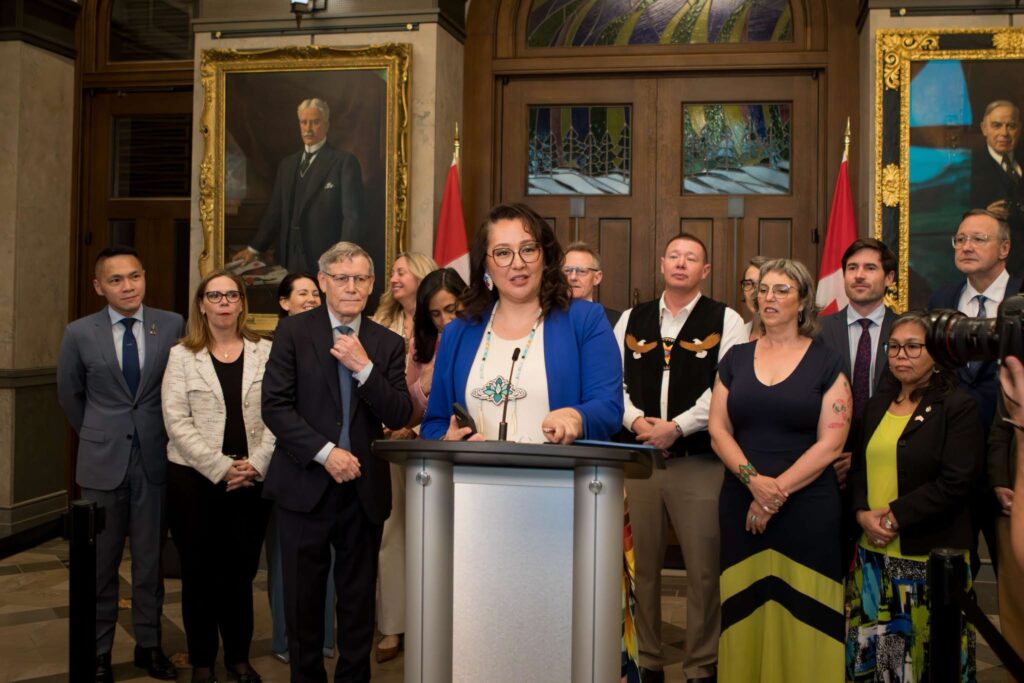
Mandy Gull-Masty, Minister of Indigenous Services Canada, announces Bill C-37, the First Nations Clean Water Act, on Tuesday, surrounded by fellow parliamentarians in ‘Ottawa.’ Photo courtesy Indigenous Services Canada
Gull-Masty said federal funding is in fact being ramped up, including the “single largest funding commitment ever made for First Nations,” amounting to $0.9 billion a year for five years, in addition to previous budgets.
“Across Canada there are laws and regulations that set minimum standards for drinking water,” the minister said in a statement. “But in First Nation communities, there are not.
“This legislative gap that impacts only First Nation people is unacceptable and must be addressed.”
READ MORE: ‘Carney is at a crossroads’ with First Nations, says AFN national chief
The federal government lists 36 First Nations with ISC-funded water systems under drinking-water advisories longer than a year.
(In “B.C.,” an additional seven First Nations still have long-term advisories for federally funded water systems, but those are overseen by the First Nations Health Authority).
“We know that is 36 too many,” said Gull-Masty, a member of Waswanipi Cree Nation in northern “Quebec.”
A majority of the federal long-term drinking advisories are in northwest “Ontario.”
One of them, Neskantaga First Nation, has been under a boil water advisory for 31 years. It’s the longest such advisory in the country’s history.
‘Without broad or meaningful input’
The proposed bill replaces the former Bill C-61 which bore the same name, but did not pass into law last year because Parliament was prorogued — or officially adjourned — cancelling all unfinished business.
It will offer investments in infrastructure, support for water treatment plant operators and source water protection, according to Gull-Masty.
For water sources adjacent to First Nations lands, the bill also “creates a regulatory pathway” for First Nations to sign voluntary agreements with federal, provincial and territorial governments on how to “protect those sources of water beyond reserve lines,” said the federal statement.

READ MORE: Through generations, my family at Grassy Narrows has been harmed by mercury pollution
Linda Debassige, Anishinabek Nation Grand Council Chief said that they are “cautiously optimistic,” and look forward to working to strengthen this legislation that will meet their Nation’s needs.
However, she pointed out, “When we look at the comparisons between the former Bill C-61 and this new version, there are striking differences.”
She called Bill C-37 a “significant departure from the collaborative approach” of its predecessor.
“Unlike previous legislative efforts, which were developed through meaningful dialogue and partnership with First Nations … C-37 was introduced without broad or meaningful input by First Nations,” Debassige said.
“Former Bill C-61 was a result of two years of co-development and over two decades of advocacy.”

Anishinabek Nation Grand Council Chief Linda Debassige speaks at a repatriation ceremony in ‘Ottawa’ in March. Photo by Julie Chadwick
‘An inherent right’
Gull-Masty, in her announcement, said her proposed legislation “reflects more than six years of engagement and consultation with First Nations,” as “First Nations have an inherent right to self-governance over water.”
She also said that she has had important conversations with First Nations leaders over the past year.
Debassige said that their letters of advocacy have been met with “deafening silence.”
“We don’t have access to parliamentary privileged dialogue or cabinet discussions in relation to this,” she added.
“Not including or engaging with these critical figures undermines the principals of self-determination and respect for First Nation sovereignty.”

READ MORE: Attawapiskat member files UN complaint over decades-long struggle for clean drinking water
She said it’s particularly concerning for legislation addressing “First Nations’ constitutionally protected right to self-government.”
Meanwhile Alvin Fiddler, Grand Chief of Nishnawbe Aski Nation, said they received consultation on the bill only late last week.
“We need to be involved in how the bill and the legislation will be implemented in our communities,” he said.
That’s needed so that “there are adequate resources dedicated to our communities,” Fiddler added, “for them to actually create that capacity to rebuild or replace the water treatment plants, to have trained staff, to have everything that they need in their community to run it in a way that they don’t go back to that boil-water advisory list.”

Water-treatment equipment cleans the drinking water for Hiawatha First Nation in ‘Ontario,’ ending its two-decade advisory in 2023. Photo courtesy Indigenous Services Canada
Wording changed on the right to water
There was also concern raised by multiple people about a change in wording from Bill C-61 to Bill C-37.
In the text of the original bill, it reads: “It is recognized and affirmed that it is a human right of every individual on First Nations land to have access to clean and safe drinking water.”
In the text of the new proposed bill, the same section reads, “It is declared to be the policy of the Government of Canada to further the progressive realization, for individuals on First Nation lands, of the human right to safe drinking water.”
READ MORE: Indigenous Youth in ‘B.C.’ brainstorm clean water solutions
Debassige responded, “It’s been a progressive realization for decades … Our nations have this right, right now.”
When questioned about the amendment, Gull-Masty replied that “progressive realization” refers to Indigenous Services Canada “knowing and understanding that in all the First Nations across Canada, not everybody is starting in the same place.”
“And we are acknowledging that we support communities from wherever their start line is,” she said.
Regional Chief Abram Benedict, with the Chiefs of Ontario, said they are “encouraged to see that this legislation has a recognition of source water, and acknowledgement of cultural and spiritual importance of water.”
With files from David P. Ball/IndigiNews
The post Clean-water legislation gets lukewarm reception from Indigenous leaders appeared first on Indiginews.
From Indiginews via This RSS Feed.
11
12
13
14
15
When the New England Clean Energy Connect transmission line started carrying electricity from Canada into Maine in January, supporters hailed the project as a triumph for renewable power. Now, after nearly six months of operations, the early numbers raise questions about whether the project will be able to advance the region’s energy transition as much as advertised.
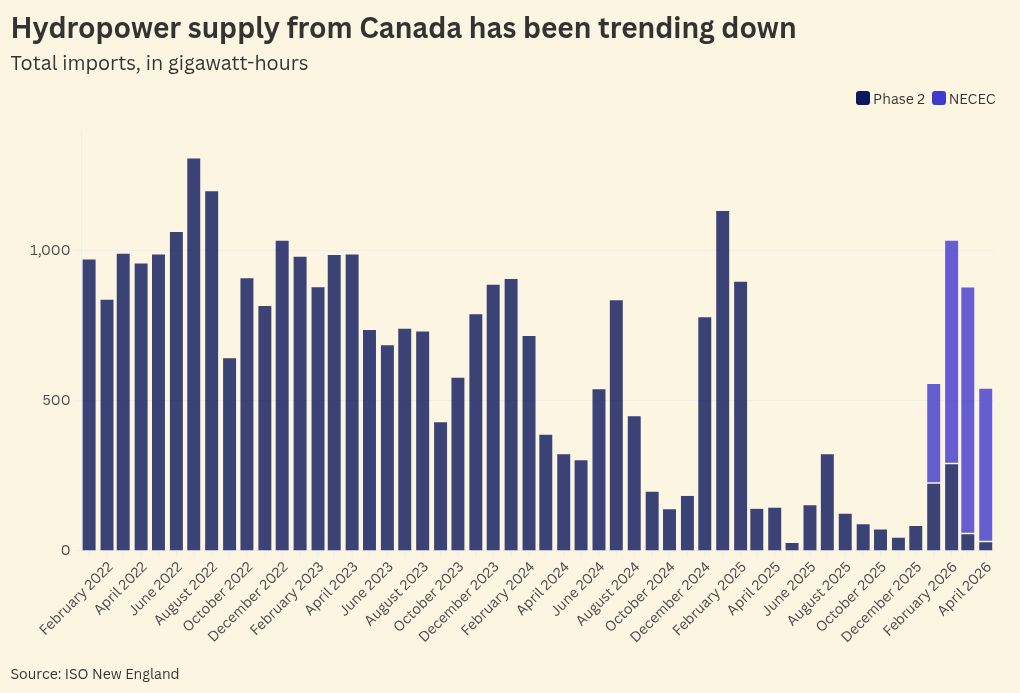
Energy flow into New England is up just marginally, and there have been roughly 27 days when no power at all traveled along the new line, commonly called NECEC. If current trends hold, New England will receive less hydropower this year over two transmission lines than it did over just one line in 2023 and previous years.
“What we’ve seen so far is not what some people expected to see,” said Joseph LaRusso, manager of the Clean Grid Program at climate nonprofit Acadia Center.
Potentially putting further strain on the supply of Canadian hydropower is the Champlain Hudson Power Express, a transmission line that started sending electricity from Quebec into New York City this month.
NECEC has its origins in a 2016 Massachusetts law that required the state to procure 1.6 gigawatts of offshore wind power and another 1.2 gigawatts of additional renewable energy. The plan was to contract with state-owned Canadian power supplier Hydro-Québec to tap into the region’s abundant hydropower resources and build a new transmission line to carry the electricity south.
Canary Media
The first proposal — a 192-mile project through New Hampshire — was abandoned in 2019 after public outcry about the impact on the state’s forests. The transmission line through Maine faced similar controversy. In 2021, a statewide referendum vote put the project on hold until 2023, when a jury ruled that the development could be restarted.
Two and a half years later, NECEC came online and started carrying the first electrons into New England. It’s certainly a notable achievement in a time when the Trump administration has been doing all it can to stop progress on clean energy, including offshore wind — the cornerstone of the Northeast’s decarbonization plans. And although the results so far have been mixed, some see potential for the line to make a sizable impact on New England’s clean energy future.
How much hydropower is coming from Quebec?
When NECEC came online earlier this year, Massachusetts Gov. Maura Healey, a Democrat, and climate advocates touted it as a major win for the state’s renewable energy goals and a way to save residents money on their utility bills. Massachusetts contracted with Hydro-Québec for 9.55 terawatt-hours of hydropower per year, roughly 20 percent of the state’s annual electricity demand.
The operations have not had the smoothest start. NECEC was completely inactive for several spans — from a half day on April 28 to nearly two weeks at the end of May and beginning of June. The most recent outage was due to “technical difficulties,” Hydro-Québec spokesperson Lynn St-Laurent said in a written statement.
“Once repairs were completed, deliveries resumed,” she said. “With any new transmission infrastructure, a period of optimization and fine-tuning is to be expected.”
Read Next

What’s driving up your expenses? Many Americans say climate change.
Still, most of the time, hydropower has flowed steadily on the new infrastructure. Through the end of April, Hydro-Québec exported about 2.4 terawatt-hours of power on the transmission line.
If the power is (mostly) moving as planned, why are some people still skeptical that the project will deliver the promised benefits? Because so far, it hasn’t done much to add to the total supply of renewable energy in New England.
Before NECEC, New England already imported significant amounts of hydropower on a transmission line known as Phase 2, which runs from Quebec into central Massachusetts. In 2019, the year the Massachusetts regulators approved the contracts between utilities and Hydro-Québec, more than 12 terawatt-hours traveled onto the New England grid over the line.
But starting in 2023, Hydro-Québec started selling less and less energy to New England over Phase 2. For nearly three weeks in early 2025, exports ceased entirely. Through the end of April this year, just over half a terawatt-hour has come south over that line. On paper, it can look a lot like NECEC isn’t allowing more energy into New England but is instead just giving it a new road to travel along.
“We’re not seeing much net new flows coming from our neighbors,” said Dan Dolan, president of the New England Power Generators Association. “We are running pretty close to the net energy flows we had in 2025, which were the lowest amount of imports that New England has ever gotten from Quebec.”
At the same time, Quebec has started importing power over the Phase 2 line, a rare occurrence before 2025. In the first four months of this year, more than 500 gigawatt-hours traveled into Canada on the line. Because New England’s electricity supply relies heavily on natural gas generation, the region is still burning fossil fuels to ship energy north even though it is receiving hydropower for its own use.
“We’re seeing a heavier natural gas burn on the rest of the generation fleet than I think many of those states had assumed going into this year,” Dolan said.
Power imports and exports
The main driver behind slowing exports seems to be the drought conditions that have lingered in Quebec for the past few years. During wetter periods, the hydropower industry uses large reservoirs to store water to help it ride out these drier times, said Gilbert Bennett, a senior adviser for WaterPower Canada, a hydropower trade group.
As generators wait for rainier days, their first obligation is to supply domestic customers, he said. That means there will likely be times when Hydro-Québec needs to import electricity over the Phase 2 line to offset some of the hydropower it is contractually obliged to send to Massachusetts over NECEC.
“Electricity flows between Québec and New England are dynamic and vary continuously based on market conditions and system needs on both sides of the border,” St-Laurent said.
Read Next

For first time, Americans are getting more of their electricity from solar than coal
Financially, New England customers should not be at risk from these ongoing shifts, LaRusso said. Massachusetts’ contract with Hydro-Québec includes provisions that require the Canadian company to pay financial penalties if it fails to deliver according to its contract.
“To the extent that imports are curtailed, Hydro-Québec is liable to make the electric utilities whole for the cost of replacement power,” LaRusso said.
It is less clear whether NECEC will boost Massachusetts’ renewable energy supply in the long run.
Still, the new transmission line has at times demonstrated its potential to help New England achieve a cleaner energy supply, LaRusso said. He pointed to May 16, a sunny day when solar power reduced demand on the grid and NECEC was going full tilt. Natural gas plants were running at low levels, and most of the power was heading to New York. For a short time, all the region’s power needs could be met by nonfossil fuel resources.
“Hypothetically, [grid operator] ISO New England could’ve turned off its gas generators,” LaRusso said. “It really gets you thinking of the resources available and how they could be managed and shared in the future.”
Bennett is also confident in the long-term outlook. In general, he said, climate change is forecast to create wetter conditions in Quebec. And the region is investing heavily in additional hydropower facilities as well as onshore wind. The years to come, he said, will bring plenty of renewable resources to share with Canada’s southern neighbors.
“Over the long term, we see a bright future,” Bennett said.
This story was originally published by Grist with the headline Is New England’s new hydropower transmission line paying off? on Jun 20, 2026.
From Grist via This RSS Feed.
16
21
Accountability advocates ‘shocked’ as Canadian government eliminates watchdog agency
(news.mongabay.com)
17

This story was originally published by Daily Montanan.
Micah Drew
Daily Montanan
American Prairie and other conservation organizations have filed appeals in the federal government’s decision to terminate bison grazing leases on Bureau of Land Management parcels in Montana.
As a result of the lease cancellation, American Prairie has halted an annual bison harvest program — which would have issued 17 hunting permits to members of the public this year — and tribal nations argue it will have a negative impact on food sovereignty programs.
The BLM issued its final decision in early May, canceling all seven bison-grazing permits for American Prairie with a September deadline to remove its herds from federal land.
On June 4, American Prairie filed its appeal with the Department of the Interior, and the week of June 8, conservation organizations Defenders of Wildlife and the Western Watersheds Projectalso filed appeals.
“BLM’s new interpretation has no basis in law and contradicts its own findings,” said Pete Frost, attorney at the Western Environmental Law Center representing Western Watersheds. “BLM reversed itself due to politics, not the law, nor the need to restore prairie grasslands.”
American Prairie is a nonprofit dedicated to conserving prairie land in Montana and manages more than half a million acres between private holdings and leased land. The organization also has a focus on species restoration, including bison, the national mammal.
The organization has around 900 animals in its herd, and has been grazing them under BLM authorization, with some leased acreage stretching back two decades.
But over the last few years, with appeals filed during the Biden administration, Montana officials have argued bison grazing is a risk to Montana’s ranching community.
Montana, along with the Montana Stockgrowers Association and other livestock groups, appealed a 2022 decision that authorized the American Prairie’s bison grazing leases, which had followed nearly three years of public scoping and environmental analysis by the bureau.
Under the Trump administration, direct appeals from Montana Gov. Greg Gianforte, Attorney General Austin Knudsen, and the state’s congressional delegation saw a response from Interior Secretary Doug Burgum, who “assumed jurisdiction” of the cases dealing with American Prairie’s grazing rights.
Conservation groups have said the decision to terminate those leases is political at its core.
Western Watersheds, in a press release, cited reporting by Public Domain pointing out Karen Budd-Falen, now the third-ranking official in the Interior Department, represented some ranching groups in the appeals of the original 2022 decision allowing bison grazing.
Montana officials, on the other hand, argue grazing bison doesn’t fit the purpose of those federal lands, and working lands should support ranching families who help feed the country.
Bison productivity requirement
In the May decision canceling the leases, the BLM focused on the 1934 Taylor Grazing Act, the legal framework that governs leases on federal lands. Using a new definition of livestock, the decision states grazing permits are limited to cases where the animals “will be used for production-oriented purposes.”
But American Prairie argues it has “contributed hundreds of bison to tribal food sovereignty programs, supplied bison as breeding stock to grow bison herds for meat production and economic benefits, and allowed the public to harvest hundreds of bison for meat consumption,” arguments that BLM has so far rejected.
“The agency overturned American Prairie’s grazing permits on unrelated factors: the organization’s conservation goals, management, purpose, and intent,” the appeal states. “In other words, BLM set up one standard based on the animal’s use and then — ignoring American Prairie’s strong evidence meeting that standard — the agency arbitrarily denied the permits on an entirely different basis.”
American Prairie notes the cancellation of hunting permits means a loss of $25,000, but the impacts of the new livestock definition could ripple past American Prairie’s lease holdings, with multiple tribal nations concerned it could limit their own ability to manage bison herds.
Earlier this year, the Coalition of Large Tribes — a group representing more than 50 Native American Tribes — protested BLM’s proposed decision, saying the new definition of livestock would impact tribal bison herds and “any related bison co-stewardship or surplus programs.”
The decision, as written, makes it “unlikely that any tribal government or tribal citizen buffalo herd would ever be eligible for BLM grazing leases,” the Coalition wrote in its protest.
According to American Prairie, the organization has supplied 645 bison to entities in eight states plus Washington D.C., including shipping bison to nine tribal nations — five in Montana.
“These animals are going to local tribes for their food sovereignty,” said Chamois Andersen with Defenders of Wildlife. “What an incredible opportunity to be managing the bison resource ecologically for Native nations to have that benefit.”
“The opportunity to graze on public land should not be exclusive to cattle – they’re not native. It should be open to our native grazer, bison,” Andersen said in an interview with the Daily Montanan. “They in fact have far more ecological benefits to habitat restoration – which BLM is supposed to do – not just provide forage for bovine cattle, but that the animal is contributing to the health of rangelands.”
According to a 2025 BLM infographic about the agency’s grazing program, there are 41 grazing permits for bison issued by the Bureau across the country, alongside 18,000 permits and leases overall.
When the decision to rescind the grazing leases was announced, Montana’s elected officials praised the federal government for prioritizing Montana ranchers over “an ideological experiment.”
“This final decision is a victory for the rule of law and the generations of Montanans who have stewarded our lands with care,” Gianforte said.
The post American Prairie, conservation groups appeal bison grazing decision appeared first on ICT.
From ICT via This RSS Feed.
18
19
20
21
Federal judge rules EPA illegally cut climate justice grants, including $20 million for tribe in Nevada
(ictnews.org)

This story was originally published by Nevada Current.
Jeniffer Solis
Nevada Current
A South Carolina federal judge ruled last week that the Trump administration’s termination of hundreds of environmental justice grants was illegal, a decision that could impact $20 million in federal funding rescinded from the Walker River Paiute Tribe in Nevada.
The Environmental Protection Agency’s decision to terminate the $2.8 billion Environmental and Climate Justice Block Grant Program was “arbitrary and capricious and unlawful,” U.S. District Judge Richard Mark Gergel wrote in an order Thursday, June 11.
The federal climate program was terminated in May 2025 following two executive orders issued by President Donald Trump targeting funding for renewable energyand diversity, equity and inclusion efforts at the federal level.
In Nevada, the program’s termination eliminated a $20 million EPA grant that would have funded a multi-year climate resiliency plan to deliver water, energy, and food infrastructure to about 1,200 tribal members who live on the Walker River Reservation.
The funding would have weatherized and increased energy efficiency and climate resiliency for 150 homes – about 30 percent of all existing homes on the reservation.
In the ruling, the judge wrote that the Trump administration’s decision to terminate a grant program authorized by Congress under the 2022 Inflation Reduction Act “for policy reasons” was a violation of the Administrative Procedure Act, which governs the process by which federal agencies develop and issue rules.
In practice, that means a federal agency does not have unilateral authority to refuse to spend congressionally mandated funds due to policy disagreement with Congress.
However, the judge stopped short of ordering the agency to resume the program. Restoring the program following its dismantlement last spring “would presumably require ordering EPA to rehire” staff charged with administering the program, said the judge, calling such an order “impractical.”
The judge wrote that plaintiffs “are of course free to pursue their claims for alleged unlawful termination of their grants in the” Court of Federal Claims, which hears monetary claims against the U.S. government. The judge also denied a request to extend the program’s September deadline for awarding grant funds.
The ruling is in response to a March 2025 lawsuit filed by the Southern Environmental Law Center and the Public Rights Project on behalf of several cities and nonprofits. A spokesperson for the law center said it’s too soon to know how the ruling will impact individual grant recipients, but that they are watching for how EPA responds.
A spokesperson with the EPA said the agency “is reviewing the decision.”
The Nevada Clean Energy Fund — a nonprofit bank that would have administered the $20 million EPA grant awarded to the Walker River Paiute Tribe — is not a part of the lawsuit, but said they are following the case and its impact on Nevada.
“The ruling was really good for the Nevada Clean Energy Fund, and for the program in general,” said Asheesh Bhalla, the general council for the bank. “The court stated very clearly and directly that the federal government’s termination of the ECJ block grant program was illegal. They said that very directly.”
“The court held that the executive branch had no authority to unilaterally refuse to administer those funds,” he continued. “We commend the court on their decision and look forward to the federal government complying with the court’s order.”
Bhalla said the ruling gave those impacted by grant terminations a path to recover withheld funds in the Court of Federal Claims, while also simultaneously allowing them to challenge the legality of agency-wide policies in federal district court under the Administrative Procedure Act.
“The court here clearly said that there are administrative claims, there are constitutional claims, and there are monetary claims,” Bhalla said.
Kirsten Stasio, the CEO of the Nevada Clean Energy Fund, said that while the judgement “isn’t unlocking funds for us right now” it was a legal validation that “communities in Nevada and across the US that were meant to benefit from these funds shouldn’t have been cut off from them.”
The loss of funding was a blow to underserved frontline communities in Nevada facing the impacts of climate change.
Part of the $20 million EPA grant awarded to the Walker River Paiute Tribe was earmarked for a planned water infrastructure project that would improve water quality and allow more than a hundred homes to be built at higher elevations further from the river, which periodically floods to dangerous levels.
The funding would have also covered the remaining cost of the tribe’s planned Community Resilience and Food Storage Hub – a fully electric and solar powered building with battery storage that could increase food and medication security while sheltering the reservations’ most vulnerable residents from growing weather emergencies and rolling blackouts.
The post Federal judge rules EPA illegally cut climate justice grants, including $20 million for tribe in Nevada appeared first on ICT.
From ICT via This RSS Feed.
21
22
23
24
25
view more: next ›