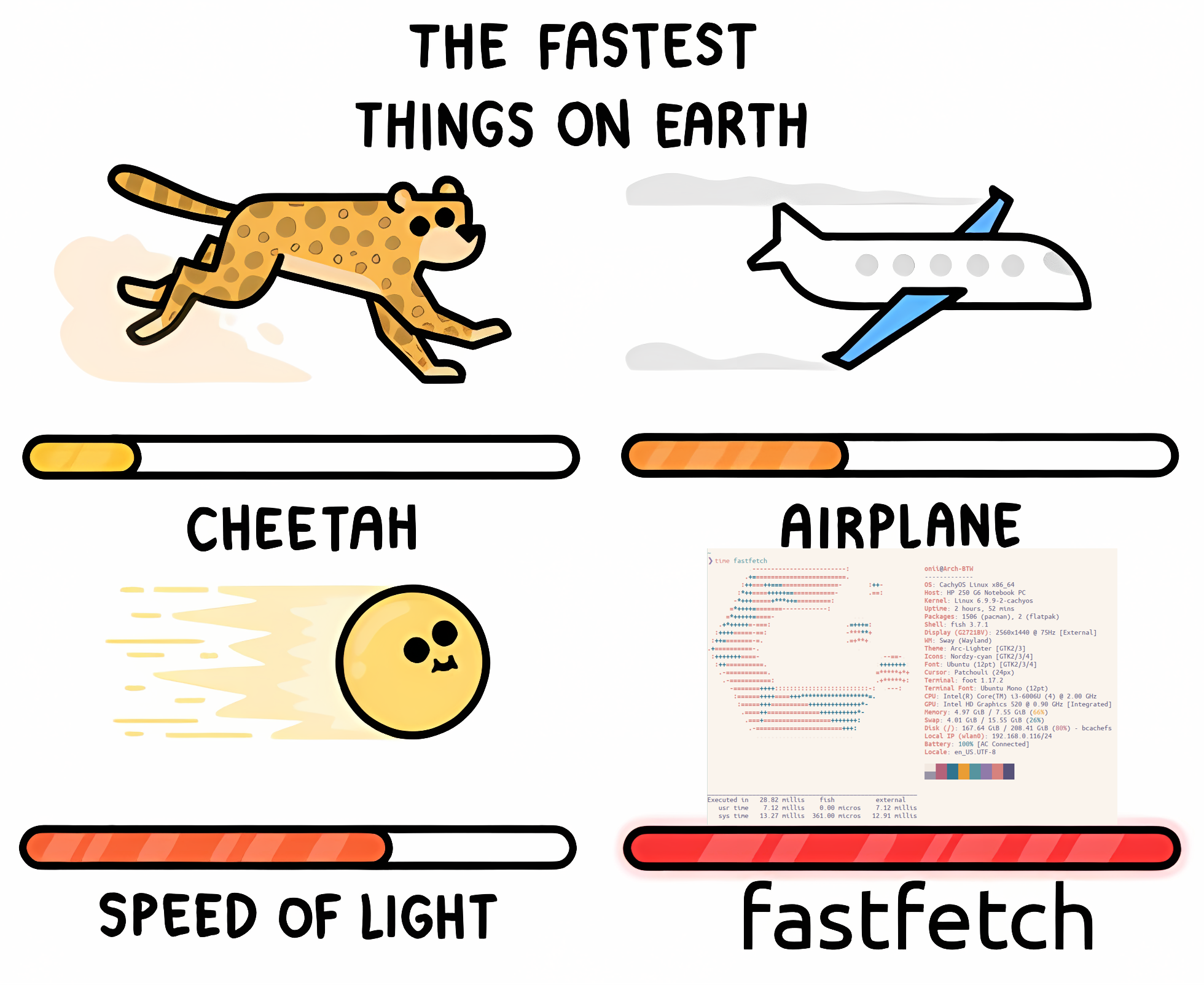
Honestly, it's still ridiculous to me how slow Python, Java, JS, Ruby etc. continue to feel, even after decades of hardware optimizations. You'd think their slowness would stop being relevant at some point, because processors and whatnot have become magnitudes faster, but you can still feel it quite well, when something was implemented in one of those.
linuxmemes
Hint: :q!
Sister communities:
Community rules (click to expand)
1. Follow the site-wide rules
- Instance-wide TOS: https://legal.lemmy.world/tos/
- Lemmy code of conduct: https://join-lemmy.org/docs/code_of_conduct.html
2. Be civil
- Understand the difference between a joke and an insult.
- Do not harrass or attack users for any reason. This includes using blanket terms, like "every user of thing".
- Don't get baited into back-and-forth insults. We are not animals.
- Leave remarks of "peasantry" to the PCMR community. If you dislike an OS/service/application, attack the thing you dislike, not the individuals who use it. Some people may not have a choice.
- Bigotry will not be tolerated.
3. Post Linux-related content
- Including Unix and BSD.
- Non-Linux content is acceptable as long as it makes a reference to Linux. For example, the poorly made mockery of
sudoin Windows. - No porn, no politics, no trolling or ragebaiting.
- Don't come looking for advice, this is not the right community.
4. No recent reposts
- Everybody uses Arch btw, can't quit Vim, <loves/tolerates/hates> systemd, and wants to interject for a moment. You can stop now.
5. π¬π§ Language/ΡΠ·ΡΠΊ/Sprache
- This is primarily an English-speaking community. π¬π§π¦πΊπΊπΈ
- Comments written in other languages are allowed.
- The substance of a post should be comprehensible for people who only speak English.
- Titles and post bodies written in other languages will be allowed, but only as long as the above rule is observed.
6. (NEW!) Regarding public figures
We all have our opinions, and certain public figures can be divisive. Keep in mind that this is a community for memes and light-hearted fun, not for airing grievances or leveling accusations. - Keep discussions polite and free of disparagement.
- We are never in possession of all of the facts. Defamatory comments will not be tolerated.
- Discussions that get too heated will be locked and offending comments removed. Β
Please report posts and comments that break these rules!
Important: never execute code or follow advice that you don't understand or can't verify, especially here. The word of the day is credibility. This is a meme community -- even the most helpful comments might just be shitposts that can damage your system. Be aware, be smart, don't remove France.
Many of these have C-bindings for their libraries, which means that slowness is caused by bad code (such as making a for loop with a C-call for each iteration instead of once for the whole loop).
I am no coder, but it is my experience that bad code can be slow regardless of language used.
Bad code can certainly be part of it. The average skill level of those coding C/C++/Rust tends to be higher. And modern programs typically use hundreds of libraries, so even if your own code is immaculate, not all of your dependencies will be.
But there's other reasons, too:
- Python, Java etc. execute their compiler/interpreter while the program is running.
- CLIs are magnitudes slower, because these languages require a runtime to be launched before executing the CLI logic.
- GUIs and simulations stutter around, because these languages use garbage collection for memory management.
- And then just death by a thousand paper cuts. For example, when iterating over text, you can't tell it to just give you a view/pointer into the existing memory of the text. Instead, it copies each snippet of text you want to process into new memory.
And when working with multiple threads in Java, it is considered best practice to always clone memory of basically anything you touch. Like, that's good code and its performance will be mediocre. Also, you better don't think about using multiple threads in Python+JS. For those two, even parallelism was an afterthought.
Well, and then all of the above feeds back into all the libraries not being performant. There's no chance to use the languages for performance-critical stuff, so no one bothers optimizing the libraries.
Java is still significantly faster and more efficient than Python tho - because it has ahead-of-time optimizations and is not executing plain text.
Idk numpy go brrrrrrrrrr. I think it's more just the right tool for the right job. Most languages have areas they excel at, and areas where they're weaker, siloing yourself into one and thinking it's faster for every implementation seems short sighted.
At it's heart, numpy is C tho. That's exactly what I'm talking about. Python is amazing glue code. It makes this fast code more useful by wrapping it in simple(r) scripts and classes.
Faster, sure. Efficient, fuck no. With Java you have to run around and write ton of boiler plate code to do something simplest in nature.
I'm mainly talking efficiency in terms of energy use. I won't deny that some ugly decisions have been made with Java :D
Energy use? That's a pointless metric. If that is the goal then whole idea of desktop should be scraped. Waste of memory and hard drive space. Just imagine the amount of energy wasted on booting GUI.
Have you ever heard of datacenters, portable devices or climate change?
If you want to talk about climate change then electronics is the wrong place to point the finger at. For start look at cement manufacturing. It requires huge amounts of energy to produce even though we have eco-friendly variants ready to go. And cement production amounts to 8% of all greenhouse gasses released annually.
Hell, just ban private jets and you've offset all of the bad things datacenters ever made. Elon had 10 minute flight to avoid traffic which consumed around 300l of fuel. Royal family makes so many flights a year that you could go into the wild and eat bark until the rest of your life and you wouldn't be able to offset their footprint in thousands of lives.
Bill Gates himself talks a lot about reducing carbon footprint we make and yet he refuses to sell his collection of airplanes. He has A COLLECTION of them.
Using higher level language that requires more operations than assembler is not a thing to worry about when talking about climate change. Especially without taking into account how much pollution have those managed to reduce by smartly controlling irrigation and other processes.
Python is the slowest (widely used) language there is. It's not hard to be faster.
For example, when iterating over text, you can't tell it to just give you a view/pointer into the existing memory of the text. Instead, it copies each snippet of text you want to process into new memory.
As someone used to embedded programming, this sounds horrific.
Yep. I used to code a lot in JVM languages, then started learning Rust. My initial reaction was "Why the hell does Rust have two string types?".
Then I learned that it's for representing actual memory vs. view and what that meant. Since then I'm thinking "Why the hell do JVM languages not have two string types?".
I'm not a java programmer, but I think the equivalent to str would be char[]. However the ergonomics of rust for str isn't there for char[], so java devs probably use String everywhere.
At least with Java, its the over(ab)use of Reflections and stuff like dependency injection that slows things down to a crawl.
There are a few reasons for this, some of the most important being:
- The languages were not designed with speed primarily in mind and as such made some design decisions that fundamentally cannot be optimized around
- Authors of programs in these languages prioritize things other than performance when writing the programs.
Speed is not just about processors becoming faster - this is a large part of why DSA is important to learn as a programmer.
That's because it's not relevant. Speed can be compensated for either by caching or outsourcing your load, if there's such a huge need to process large amount of data quickly. In day to day work I can't say I have ever ran into issues because code was executing slow. Normal operation Python is more than capable of keeping up.
On the other side of the coin you have memory management, buff and stack overflows and general issues almost exclusive to C, which is something you don't have to worry about as much with higher level languages. Development with Python is simply faster and safer. We as developers have different tools, and we should use them for their appropriate purpose. You can drive nails with a rock as well, but you generally don't see carpenters doing this all day.
You can sometimes deal with performance issues by caching, if you want to trade one hard problem for another (cache invalidation). There's plenty of cases where that's not a solution though. I recently had a 1ns time budget on a change. That kind of optimization is fun/impossible to do in Python and straightforward to accomplish Rust or C/C++ once you've set up your measurements.
Which is exactly what I said. Most of the times you can work around it. Sure cache invalidation can be hard, but doesn't have to be. If you need performance use more performant language. Right tool for the job.
"Slow"
They aren't as fast as a native language but they aren't all that slow if you aren't trying to use them for performance sensitive applications. Modern machines run all those very quickly as CPUs are crazy fast.
Also it seems weird to put Java/OpenJDK in the list as it is in its own category from my experience
Java is certainly the fastest of the bunch, but I still find it rather noticeable how long the startup of applications takes and how it always feels a bit laggy when used for graphical stuff.
Certainly possible to ignore that on a rational level, but that's why I'm talking about how it feels.
I'm guessing, this has to do with just the basic UX principle of giving the user feedback. If I click a button, I want feedback that my click was accepted and when the triggered action completed. The sooner those happen, the more confident I feel about my input and the better everything feels.
I've never experienced that. Also Android is OpenJDK based and the applications in Android work well and the system is well optimized
As someone who only codes solutions for himself I don't relate. All the extra time I would spend writting a C solution it would never attone the runtime loses of doing it in maybe python.
Anyway, this is only relevant if you're writing only for yourself. It's your poor users who suffer for your expediency.
Shaves off 1 sec and I do it 50+ times a day, checks out.
I used to write extensively with C++, but it has been a long time since speed mattered that much to one of my applications. I still marvel at the cache-level optimizations some people come up with, but I'm in the same mindset as you now.
My workload split of Data Movement vs Data Transformation is like 95:5 these days, which means almost all the optimizations I do are changing batch/cache/page/filter settings. I can do that in any language with http bindings, so I choose those that are faster to write.
Damn, that's a fast ass-cheetah!
What with passenger planes like the one depicted typically going 575-600 mph and the bar only 3 times as long, that dude is sprinting at upto 200mph!
(Link is to classic xkcd comic, not furry porn)
Link is to classic xkcd comic, not furry porn
Damn, you got my hopes up for a second there.
(Link is to classic xkcd comic, not furry porn)
I am both disappointed and pleased.
I used c++ in college, and I think it's useful to know c because so much relies on it. That said if I'm going to do something that needs performance I'll look to go first, then rust if go isn't a good fit, but that's mostly because I know go better. Both are excellent languages.
If I just need something functional quick and easily I'll turn to Python. If I need a net service quick node.js is great.
I was a huge C++ fan back when I was doing a bunch of competitive programming. If I need a performant project nowadays, I look to golang first. It gives me the speed of a compiled language with the usability of high-level language. I still solve the occasional Advent of Code in C++, though :)
ubuntu font!