this post was submitted on 12 Dec 2024
496 points (80.7% liked)
Comic Strips
22075 readers
3343 users here now
Comic Strips is a community for those who love comic stories.
The rules are simple:
- The post can be a single image, an image gallery, or a link to a specific comic hosted on another site (the author's website, for instance).
- The comic must be a complete story.
- If it is an external link, it must be to a specific story, not to the root of the site.
- You may post comics from others or your own.
- If you are posting a comic of your own, a maximum of one per week is allowed (I know, your comics are great, but this rule helps avoid spam).
- The comic can be in any language, but if it's not in English, OP must include an English translation in the post's 'body' field (note: you don't need to select a specific language when posting a comic).
- Politeness.
- AI-generated comics aren't allowed.
- Adult content is not allowed. This community aims to be fun for people of all ages.
Web of links
- !linuxmemes@lemmy.world: "I use Arch btw"
- !memes@lemmy.world: memes (you don't say!)
founded 2 years ago
MODERATORS
you are viewing a single comment's thread
view the rest of the comments
view the rest of the comments
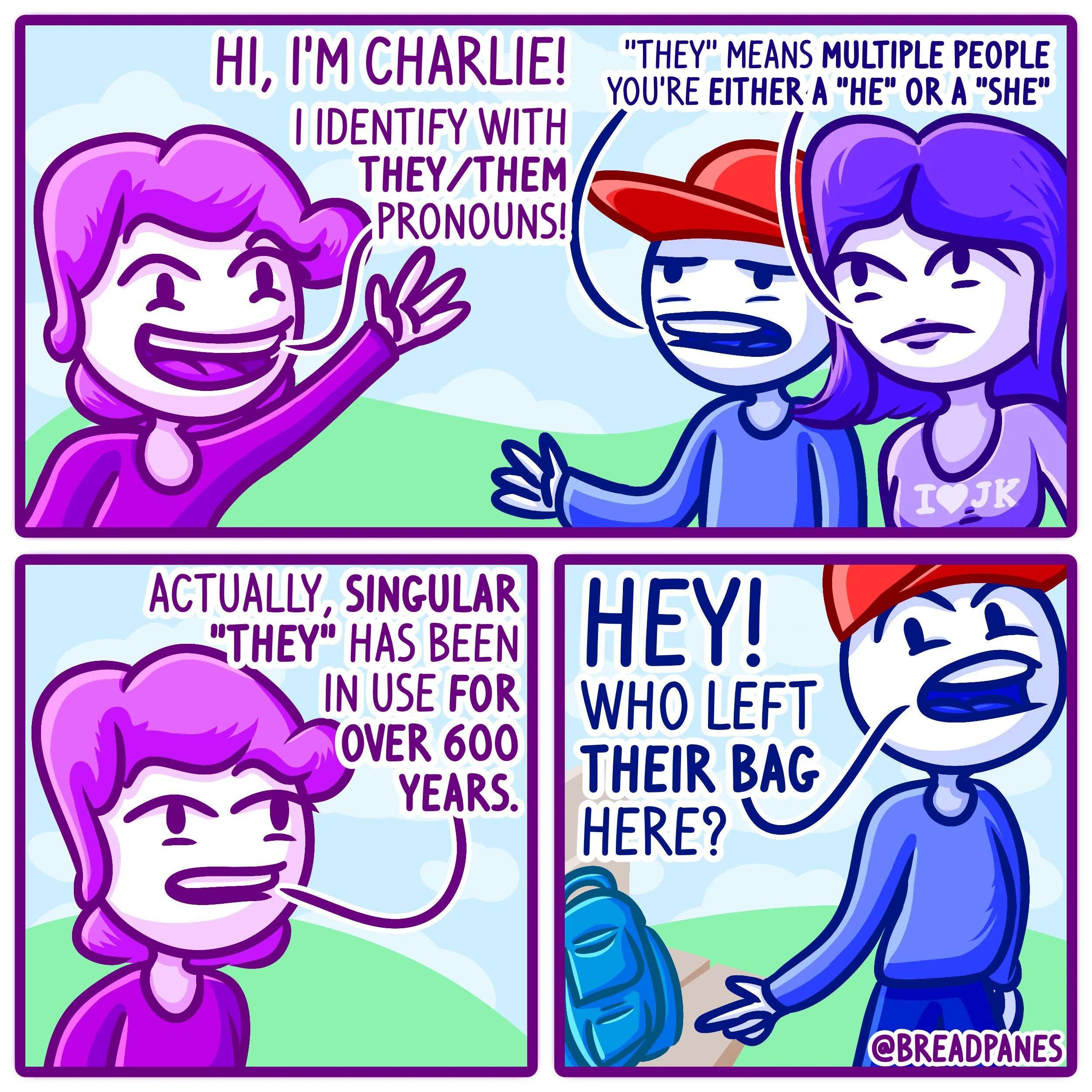
"he/him" probably isn't he/him in their non-gendered language. In some languages there's no he or she, there's only a pronoun that means "that person"
Armenian, Persian, Tagalog, Finnish, Georgian, Turkish, Swahili &c
That's true, but you can't help but notice that when people coming from this background are taught English, they are usually taught that 'male' pronouns are the default.
If anything, I would support the removal of 'he/him' for all the backlash it will generate.
in france "they" invented "iel", a gender neutral pronoun, to replace "il" and "elle". Young people (some?) adopted it rapidly and were using it naturally but the state banned the use of "inclusive language" on all official communications (which includes schools)
i remember thinking that inventing a new pronoun, like they did, was a better solution than choosing one of the two as gender neutral
Outright banned, I'm guessing because blindly following rules by the book, but I think it's not a move in the right direction.
In Spain people are trying to make neutral words by placing
@wherea/oshould go in the gendered words, I think it never made to any documentation but it wasn't banned yet, at least.