
Opensource

4763 readers
123 users here now

A community for discussion about open source software! Ask questions, share knowledge, share news, or post interesting stuff related to it!

CreditsIcon base by Lorc under CC BY 3.0 with modifications to add a gradient


founded 2 years ago
MODERATORS
501
502
503
504
505


Nextcloud checks about 50 open-source apps—file storage, groupware, chat/video, notes, project management, and so on. Each tool is weighted the same, and then the category scores are averaged into a single national figure. That design favors a balanced ecosystem over dominance in just one niche.

However, according to Nextcloud, the method favors SMEs and hobbyists—servers hidden behind firewalls, VPNs, or hosted by large enterprises don’t always show up—yet the index still offers a “pretty loud signal” about grassroots tech choices.

506
507
508


TL;DR

Hi all !

Back again for a massive Gosuki 1.2.0 release, a multi-browser real time bookmark manager.

I posted about this project a month ago and had very positive feedback. Many users asked for multi-device sync so now Gosuki offers two methods to automatically synchronize your bookmarks across devices. Integration/import from other self hosted bookmark managers is in the works.

This is a project I have been writing on and off for the past few years. It aggregates your bookmarks in real time across all browsers/profiles and external APIs like as Reddit and Github.

Features

  • A single binary with no dependencies or browser extensions necessary. It just work right out of the box.
  • Multi-browser: Detects which browsers you have installed and watch changes across all of them including profiles.
  • Use the universal ctrl+d shortcut to add bookmarks and call custom commands.
  • Tag with #hashtags even if your browser does not support it. You can even add tags in the Title. If you are used to organize your bookmarks in folders, they become tags
  • Real time tracking of bookmark changes
  • Multi-device automated p2p synchronization
  • Builtin, local Web UI which also works without Javascript (w3m friendly)
  • Cli command (suki) for a dmenu/rofi compatible query of bookmarks
  • Modular and extensible: Run custom scripts and actions per tags and folders when particular bookmarks are detected
  • Stores bookmarks on a portable on disk sqlite database. No cloud involved.
  • Database compatible with the Buku. You can use any program that was made for buku.
  • Can fetch bookmarks from external APIs (eg. Reddit posts, Github stars).
  • Easily extensible to handle any browser or API
  • Open source with an AGPLv3 license
509


cross-posted from: https://programming.dev/post/35278281

Hi everyone, I recently created an in-memory cache in Rust called PaperCache. It's the first in-memory cache that's able to switch between any eviction policy at runtime, allowing it to reduce its miss ratio by adapting to changing workloads. Currently, it supports the following eviction policies:

  • LFU
  • FIFO
  • CLOCK
  • SIEVE
  • LRU
  • MRU
  • 2Q
  • ARC
  • S3-FIFO

It typically has lower tail latencies than Redis (though with the trade-off of higher memory overhead as it needs to maintain extra metadata to be able to switch between policies at runtime).

Feel free to check out the website (https://papercache.io/) which has documentation, a high-level article I wrote on Kudos (https://link.growkudos.com/1f039cqaqrk), or the paper from HotStorage'25 (https://dl.acm.org/doi/abs/10.1145/3736548.3737836)

Here's a direct link to the cache internals: https://github.com/PaperCache/paper-cache

In case you want to test it out, you can find installation instructions here: https://papercache.io/guide/getting-started/installation

There are clients for most of the popular programming languages (https://papercache.io/guide/usage/clients), though some may be a little unpolished (I mainly use the Rust client for my own work, so that one is kept up-to-date).

If you have any feedback, please let me know!

510


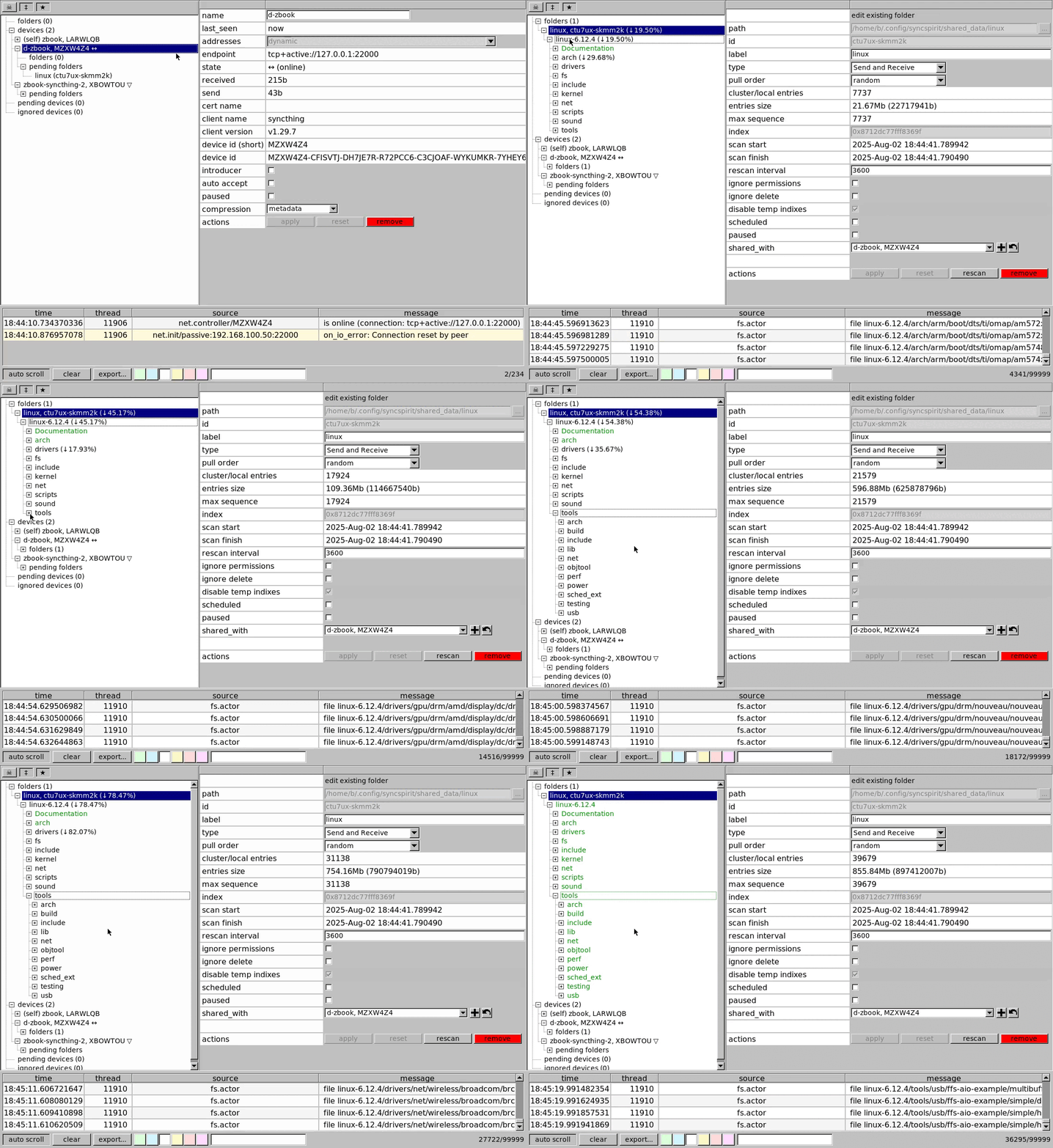
I'm glad to announce v0.4.1 release!

Syncspirit is independent BEP protocol implementation. Like syncthing is continuous peer-to-peer file synchronization tool.

https://raw.githubusercontent.com/basiliscos/syncspirit/refs/heads/master/docs/fltk-overview.gif

You can download ready-to-use binaries for [Linux x86_64]((https://github.com/basiliscos/syncspirit/releases/download/v0.4.1/syncspirit-fltk-v0.4.1-x86_64.AppImage) (AppImage), Windows (WindowsXP is supported) and Mac OS X (Apple silicon).

Notable changes:

  • unified shared folders model, which allows to inspect on a local and remove devices
  • possibility to import files from local storage
  • performance improvents, upto 5 times on a smaller files
  • fix compatibility with global discovery v3 protocol
  • support folder_type folder setting (send only, receive only, send & receive)
  • support pull_older folder setting (alphabetic, by size, by modification date)
  • support disable_temp_indixes (hardcoded to 1 for atm)
  • support ignore_permissions folder flag, permissions and no_permissions file flag
  • support ignore_deletes folder flag
  • support device auto-accept folder flag
  • support device introducer and skip_introduction_removals markers
  • support outgoing messages to be compressed using lz4

Syncspirit is a syncthing-compatible is written from the scratch software in C++ as classical desktop application.

Syncspirt source code uses GPLv3 license.

Any feedback is welcome!

WBR, basiliscos.
511
512
513
514
515


In April, we published a piece outlining some of the work underway to help strengthen the F-Droid project against unjust intrusion, interception and monitoring. We shared how contributors, maintainers, and developers in the free software world are increasingly navigating takedown demands, vague or impractical regulations, and aggressive enforcement actions and how we, as a community, need better tools and strategies to face these challenges.

516
517
518


cross-posted from: https://lemmy.world/post/33915876

This is a California state court case that could drastically change the landscape for Free and Open Source Software moving forward. And particularly that FOSS that is covered by Copylefted licenses like the GPL family of licenses.

The premise of the case is that by selling smart TVs with only the compiled version of GPL'd (and likely forked) code projects such as the Linux kernel, BusyBox, selinux, ffmpeg, etc, Vizio is blatantly violating the "Source Code Provision" of the GPL which requires that they provide along with this compiled code, also the source code or failing that a written offer of source code to any recipients of these compiled versions of these GPL'd applications and libraries.

(Now, of course, anyone can get the source code of the Linux kernel or BusyBox or any of the other applications at issue. But in the process, Vizio and their manufacturers have written kernel drivers for the hardware specifically on the TVs (which are derivative works of the Linux Kernel and therefore covered by the GPL), and probably made modifications to several of the other codebases in order to make them do novel things specifically for the smart TVs in question. Beyond that, the GPL requires Vizio to provide any programs/scripts/signing-keys/etc to compile and install the source code (or a, say, consumer-modified version of the source code) onto the TVs. It's the Vizio-specific/chip-manufacturer-specific modifications/derivative works and compiling/installing code that's most important.)

The "Software Freedom Conservancy v. Vizio Inc." case is seeking to force Vizio to comply with the GPL. Assuming the SFC is successful and the courts rule in their favor, the eventual result is expected to be a fully FOSS OS "distribution" (of, basically, GNU/Linux) that end users can install on their Vizio TVs in place of the factory-installed OS. This FOSS OS distribution, of course, would allow users to remove ads and other antifeatures from the TVs in question. And over time, it's highly probable that this FOSS OS smart TV distribution would expand to other models and brands of TVs. Roughly speaking, the goal of this lawsuit is to be able to create an "OpenWRT but for smart TVs."

But this case could definitely affect the industry not just for smart TVs. Smart phones, game consoles, automobiles, robot vacuum cleaners, sex toys. So many consumer electronics devices run on, for instance, the Linux or Android kernel (both of which are covered by the GPL). And a lot of these devices also include many other programs and libraries covered by the GPL. There's potential for lots of different "OpenWRT but for " sort of distributions. And if SFC v. Vizio succeeds, it could greatly increase the likelihood of all of these coming to fruition.

Vizio has been stalling for strategic reasons. But there's a court date set for 2025-09-22. My understanding is that there will be options to watch a live stream of it via Zoom for Business. (Yes, it's proprietary, unfortunately.) You can even apply for a grant to travel to California to attend the hearing in person (though I think that's kinda mostly for bloggers and journalists and such). Also, a lot of court documents about the case are linked on the page I linked in this post.

Ok. Time for a bit of legal nerd stuff. (IANAL, not legal advice, etc.) Previous GPL enforcement cases have been copyright cases brought by the copyright holders. This case is novel in that it's a contract case. There's a legal concept of a "third-party beneficiary" to a contract. If Alice and Bob make a contract that requires Alice to pay Charlie $100, then Charlie is a third-party beneficiary and thus can bring a suit for enforcement against Alice. In this case, copyright holders of GPL'd code made a contract (the GPL) with Vizio that requires Vizio to make sure anyone they distribute compiled GPL'd code to can get the source code (and compiling/installing scripts etc), so anyone Vizio sells a TV to is a third-party beneficiary and therefore can bring a suit against Vizio to get the court to force Vizio to hold up their obligations under the GPL. At least that's the legal theory under which SFC is bringing the suit.

If you want more info about this, this YouTube video is a panel of SFC folks doing a Q&A specifically about the Vizio case. It'll have some interesting tidbits of info.

I'm hopeful, and the courts have been sympathetic to the SFC's arguments so far. I'm crossing my fingers for sure.

519
520
521
522


We all love open-source software, but there are so many amazing projects out there that often go unnoticed. Let's change that! Share your favorite open-source software that you think more people should know about. Here’s how you can contribute:

  1. Single Option Per Comment: Mention one open-source software per comment to be able to easily find the most popular software.
  2. No Duplicates: Avoid duplicating software that has already been mentioned to ensure a wide variety of options.
  3. Upvote What You Love: If you see a software that you also appreciate, upvote it to help others discover it more easily.

Check out last year's post for more inspiration: Last Year's Post

Let's create a comprehensive list of open-source software that everyone should know about!

OC text by @PumpkinDrama@reddthat.com

523
524
4
Community Contributions (philippemnoel.posthaven.com)
525
view more: ‹ prev next ›