Linux

10644 readers
593 users here now

A community for everything relating to the GNU/Linux operating system (except the memes!)

Also, check out:

Original icon base courtesy of lewing@isc.tamu.edu and The GIMP

founded 2 years ago
MODERATORS
226


Zorin OS 18 arrived, hitting 1M downloads in just one month. It’s packed with new features and improvements, so many users are already itching to make the jump to the latest stable release of this user-friendly, visually appealing Linux distro. If that’s you, you’re in the right place.

While the upgrade process is relatively straightforward, it’s always best to do it the safe way—following the proper steps in the correct order with the right guidance. And that’s precisely the purpose of this article.

I’ll walk you through the process of upgrading from Zorin OS 17 to 18, covering all key points. For most cases, the entire process typically takes between 30 and 60 minutes. Needless to say, everything you’ll see below has been tested and proven to work. So, let’s do it.

227


In addition to the proposed Hierarchical Queued NUMA-aware spinlocks for better performance, another interesting performance-enhancing patch series posted in the past 24 hours for the Linux kernel is for improving the performance of single-threaded tasks running on high core count CPU desktops / workstations / servers.

Gabriel Krisman Bertazi of SUSE posted the request for comments (RFC) patch series to better the performance of single-threaded tasks with today's many-core CPUs. The optimization is focused around the Linux kernel's "rss_stat" structure that holds statistics around the Resident Set Size (RSS) for the process with the amount of memory in use.

228


It's very clear that the ricing community wants to set any given colorscheme in many apps automatically, most tools do so either with wallpapers (which is inherently opinionated), or the base16 spec. The original base16 repo hasn't been updated in over 2 years, and 16 colors simply isn't enough to make rich granular themes, especially when code has many different syntax elements. We need a successor that allows for more colors on both TUIs and GUIs, more than 16 colors (like 24 or even 32), mapped more granularly.

My story:

I've spent lots of time looking at how to have good colorschemes in apps that change dynamically, to make my desktop pretty and with variety. Many tools can apply colorschemes to apps using image / wallpaper colors like Matugen and Pywal. These tools are very well made, but I realized I actually prefer rainbow colorschemes like Catppuccin. Either way I got attached Matugen, fortunately it can be used without wallpapers and supports custom keywords, there are also base16 colorscheme managers like flavours and tinty.

But Cattppuccin's base16 theme didn't look right compared to its Neovim plugin. The plugin is very well integrated and colors a lot things for you that base16 plugins may not, I would have to set certain UI colors myself if I wanted them to match. Some of the major colors (variables, keywords, brackets, etc.) were shuffled around, so out of the box Catppuccin's base16 theme doesn't even match Cattppuccin's original vision / color harmony. All of this probably applies to other colorschemes as well. So if I want to switch between different schemes while staying true to each one, I would need to set up plugins for each app rather than automatically.

229
230
36
submitted 2 weeks ago* (last edited 2 weeks ago) by JeSuisUnHombre@lemmy.zip to c/linux@programming.dev


I have a couple thinkpads loaded with windows 11 pro, would it benefit me to switch them over to Linux? Would I be able to use all the essential programs (or equivalent programs) that I would need to cover all my bases?

Edit: I should probably include that I'm a complete noob as far as Linux goes. I have a decent handle on computers in the general but have never been close to being any sort of computer enthusiast. Basically, I understand what terminal is but have only used it with direct instruction.

231


Canva is seriously considering porting Affinity to Linux - a move that could transform desktop Linux and challenge Adobe.

232


With the great upstream support for AMD Radeon graphics in the Linux kernel and Mesa, most desktop users / gamers / enthusiasts are best off just using the latest code shipped by their distributions or via the enthusiast-supported third-party archives/repositories. But for those on older enterprise Linux distributions, Radeon Software for Linux 25.20.3 was recently released for shipping that packaged AMD Linux graphics driver stack. This 25.20 series is the big one where they are now officially supporting the Mesa RADV Vulkan driver in place of their own former Vulkan Linux driver.

Back in May was the announcement from AMD that they would be dropping their proprietary OpenGL and Vulkan drivers on Linux in favor of using the OpenGL and Vulkan drivers shipped by Mesa. They said that change-over would happen for the Radeon Software for Linux 25.20 release and now it's publicly available with the v25.20.3 build.

233


Over a year after the 3.5 release, Tmux 3.6, a terminal multiplexer that lets you split your terminal into panes, manage multiple sessions, and keep them running in the background, is now available, bringing a wide range of improvements and a few standout additions.

One of the most noticeable additions is the added native scrollbar support. The new pane-scrollbars option enables scrollbars directly inside panes.

The update also introduces support for the Mode 2031 theme, automatically reporting the dark or light theme. Alongside this, format operators receive several enhancements, including improved boolean expressions, new loop sorting behavior, and a broader set of variables that expose buffer, session, and cursor-style information.

YESSSSS

234


The Linux 6.18 kernel is anticipated for release this coming Sunday while this week a last-minute crisis was averted following reports of a kernel crash from recent ACPI code changes.

Borislav Petkov of AMD reported on Monday with the latest development code he was hitting a null pointer dereference within the ACPI code and in turn a crash at boot. This was noticed on an old AMD Phenom II era system with MSI MS-7599 motherboard

235


In the market for a new powerful laptop ready for the holiday season? Perhaps give a look to the new KDE Slimbook VII.

From the press email sent to GamingOnLinux: "Slimbook and KDE are celebrating their 8th anniversary with the launch of the new KDE Slimbook VII, the seventh generation resulting from a long-standing collaboration between specialized hardware and free software".

236


A Fedora special interest group is being proposed to help improve production stability of Fedora Linux and better handling incident management when problems do arise.

Stemming from recent Fedora package updates causing issues like a Mesa "stable" update causing breakage for Steam Play (Proton) games, a proposal was posted today for a Fedora SIG that would focus on production stability and incident management.

237


The GNOME Project released today GNOME 49.2 as the second point release to the latest GNOME 49 “Brescia” desktop environment series with various bug fixes and improvements.

Coming one and a half months after GNOME 49.1, the GNOME 49.2 release improves handling of sticky keys and tiled monitors, adds support for handling ignored modifiers when grabbing keys and buttons on X11, and adds extended layouts to the on-screen keyboard for German and Austrian users.

GNOME 49.2 also adds support for sorting the session list on the login screen by display name, reduces memory usage from thumbnails and correctly sorts loopback devices in the Nautilus file manager, and updates the keyboard shortcut for 300% (Ctrl + 3, 3) zoom in the Loupe image viewer to zoom to 300% instead of 200 %.

238


Two years and one week since the prior point release, Common Desktop Environment 2.5.3 is now available as the latest iteration of this Unix desktop environment built around the Motif toolkit. CDE has been open-source for more than a decade now but its development not exactly brisk. But for those resisting the likes of Wayland and other modern display tech -- especially with KDE announcing today Plasma 6.8 will be Wayland-exclusive -- CDE 2.5.3 is now available.

CDE 2.5.3 ships with various bug fixes, dtwm now supporting more mouse buttons, some compiler fixes and resolving some warnings, a systemd service file for dtlogin is added, and other mostly minor changes. Besides the dtlogin systemd service file, perhaps most notable otherwise are the fixes for satisfying the GCC 15 compiler

239


EDIT: v0.9 released

and a dark version
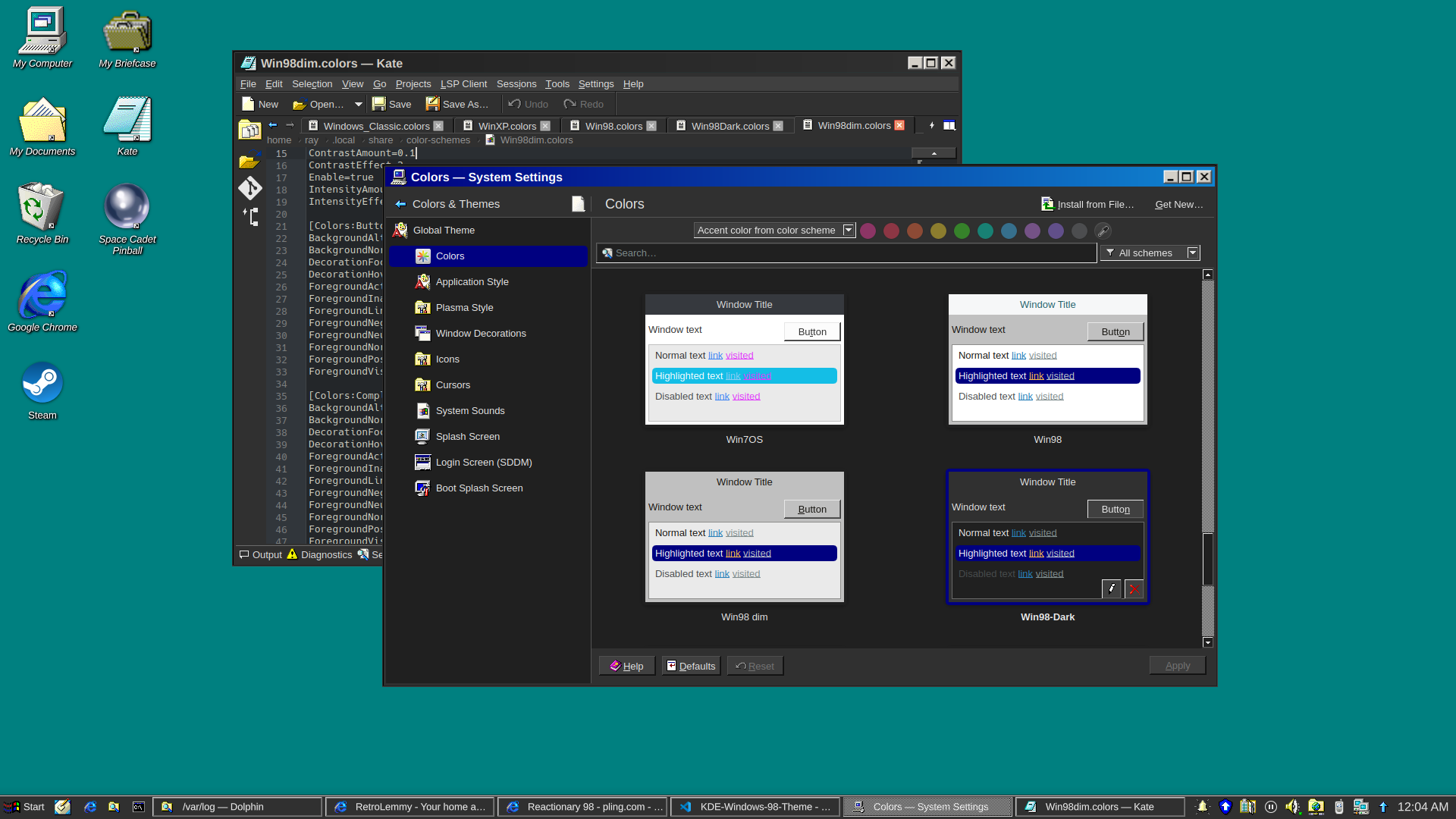

I really just put a bunch of pieces together. Forked from Reactionary Plus, but swapped out the icons, cursors, window decorations, color scheme, and made some slight tweaks to the layout.

More screenshots and changelogs here: https://store.kde.org/p/2330858

To install this, open System Settings, go to Colors & Themes -> Global Theme. In the top right there's a button for "Get New...", wait for it to load (it's very slow) then search for reactionary, and wait again, then install Reactionary 98.

This is my first time messing with any of this stuff, it was a bit janky lol.

240


I've never had to organize much in the way of videos/photos, until now. I'm going on a trip for a month or two and want to organize the pictures and videos I will be taking. I'm interested in datestamps and tags more than anything. Does anyone have a workflow that works for them? Any apps that make this easier that I haven't heard of?

EDIT: I'm wondering about things like, downloading media from my camera and having something sort it all in a schema of my choosing. Maybe other things that I don't know enough to even wonder. Or, maybe there is no there there.

241


In reference to the Arch User Repository, do you say Ore? Arr? Our? Do you say A U R? Or do you just say the full Arch User Repository?

242
243


Well folks, it’s the beginning of a new era: after nearly three decades of KDE desktop environments running on X11, the future KDE Plasma 6.8 release will be Wayland-exclusive! Support for X11 applications will be fully entrusted to Xwayland, and the Plasma X11 session will no longer be included.

244


Who here is using it, and how is it? I like the idea of having both a rolling release system which I'm not constantly having to reboot, and the deduplication looks interesting.

I love Arch, but even with the LTS kernel, I have to reboot far too often. How is AerynOS working for you?

245


FreeBSD 15.0-RC3 shipped just a few days ago as what was expected to be the final release candidate before FreeBSD 15.0 stable is officially unveiled next week. But squeezing out today is FreeBSD 15.0-RC4 to address last minute issues.

FreeBSD 15.0-RC4 was issued today for what is hopefully some final testing before still managing to christen FreeBSD 15.0-RELEASE next week.

246


Fedora-based Ultramarine Linux distribution has been updated to version 43, a release built on top of Fedora Linux 43 and shipping with updated components and a few surprise features.

Highlights of Ultramarine 43 include a new theme called Orchis for the Xfce edition, the latest KDE Plasma 6.5 and GNOME 49 desktop environments for the KDE Plasma and GNOME editions, Pinebook Pro support, updated Raspberry Pi 4 images, and support for the CachyOS kernel as a tweak in umcli.

247


For those continuing to make use of the X.Org Server, a new point release is now available in the 21.1 series. While most often X.Org Server stable releases these days are driven by shipping new security fixes, the X.Org Server 21.1.21 release is to fix several regressions introduced for various functional issues.

Red Hat engineer Olivier Fourdan released X.Org Server 21.1.21 this morning and it simply consists of various code reverts in order to address some reported problems with the X.Org Server usage, particularly when using NVIDIA graphics.

248


Only a month after the previous 42 release, Ultramarine Linux 43 is now out, powered by kernel 6.17 and based on Fedora 43. Developed by Fyra Labs, the distro bets on the Btrfs filesystem under the hood, and it is now beginning with the retirement of Ultramarine’s long-standing “Flagship” designation.

With that said, the Budgie edition, which previously held that role, is no longer the recommended default. The project notes that its original rationale for choosing Budgie was that Fedora did not offer it at the time.

But now Ultramarine is formally recommending the Plasma Edition going forward. According to devs, this change doesn’t remove Budgie from the lineup; it simply becomes “Budgie Edition,” still fully supported and updated with the latest fixes as the desktop approaches its 10.10 release.

249


Following approval of the /nix top-level directory with Fedora Linux, the Fedora Engineering and Steering Committee (FESCo) has additionally signed off on allowing the Nix package tool to appear in the Fedora 44 repository.

The change proposal to add the Nix functional package manager developer tool to Fedora has been cleared today by FESCo. With Fedora 44, developers wanting to package for Nix can now have an easier time doing so from Fedora.

250


The GNOME Project has officially released GNOME 48.7, a maintenance update for the old-stable GNOME 48 desktop environment series, describing it as a “boring bug-fix update”.

Many core modules in the GNOME stack received new version bumps: at-spi2-core moved from 2.56.5 to 2.56.7; Boxes from 48.0 to 48.1; Control Center from 48.4 to 48.5; Shell from 48.5 to 48.7; Mutter from 48.5 to 48.7; LibAdwaita from 1.7.7 to 1.7.9; GTK+-3 from 3.24.50 to 3.24.51; and others.

view more: ‹ prev next ›