Rust

7733 readers
7 users here now

Welcome to the Rust community! This is a place to discuss about the Rust programming language.

Wormhole

!performance@programming.dev

Credits

  • The icon is a modified version of the official rust logo (changing the colors to a gradient and black background)

founded 2 years ago
MODERATORS
476


Quite some exciting progress since the last progress report! There have been 180 commits since the last progress report.

As of today, rustc_codegen_cranelift is available on nightly! :tada: You can run rustup component add rustc-codegen-cranelift-preview --toolchain nightly to install it and then either CARGO_PROFILE_DEV_CODEGEN_BACKEND=cranelift cargo +nightly build to use it for the current invocation or add

477
1
submitted 2 years ago* (last edited 2 years ago) by snaggen@programming.dev to c/rust@programming.dev


I have seen posts that the rust project was setting up it's own Mastodon instance, and now it seems to be live. I assume we will se some official Rust news being posted on this account soon. And hopefully there will be other interesting accounts to follow on this instance in a not so far future.

478
479


Hi there,

I'm trying to do some native windows rust programming. I'm using native-windows-gui and native-windows-derive to do it, but if I try to mix that with tokio, I get the following:

No entry point found error for GetWindowSubclass. On console, I get:

error: process didn't exit successfully: `C:\source\myprojectanem\target\debug\myprojectname.exe` (exit code: 0xc0000139, STATUS_ENTRYPOINT_NOT_FOUND)

If I change

#[tokio::main]
async fn main() {

to:

fn main() {

The problem goes away, but obviously I can't use tokio then.

Any clue what the problem is and how to fix it?

480
481
0
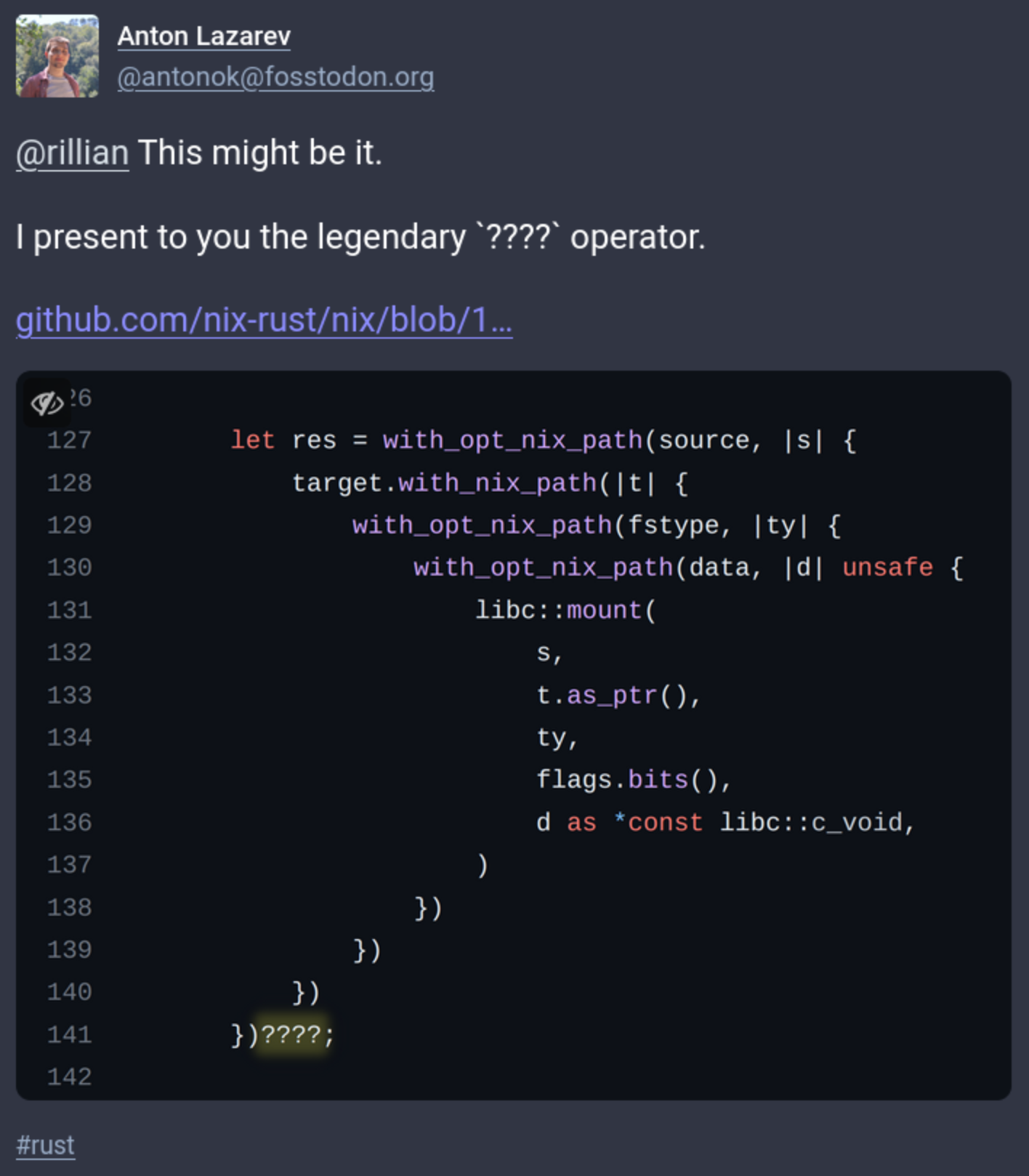
The ???? operator (programming.dev)
submitted 2 years ago* (last edited 2 years ago) by snaggen@programming.dev to c/rust@programming.dev


I found this funny.

The context is as explained by @laund@hachyderm.io

the issue is that you can't return from inside a closure, since the closure might be called later/elsewhere

and this post was the asnwer to the question by @antonok@fosstodon.org

you got me curious what the record for the longest ? operator chain on crates.io is

Original post: https://fosstodon.org/users/antonok/statuses/111134824451525448
482


Hi there,

I'm working on a bot to do social games on the fedi, and using the mastodon-async crate for communicating with the ActivityPub server in question. At the moment I'm using tokio mt as a runtime, though I'm new at async so if you think I shouldn't let me know.

The pattern I want to implement is the following:

  • At any given time, a user sends a "play" message to the bot.
  • If the player list is empty, the player is added to it awaiting someone else.
  • Otherwise, the bot checks if there are enough players on its list (who have previously sent a play message). For some games, enough is 1, since it's a 2-player game, for some it's 3 or more.
  • If there are enough players, play commences. list is cloned for that match, then emptied so other players can get in.

What I'm not very clear is how to keep this list to assure that sequence will be respected. I.a., if two play messages come reasonably quick together, I want one to be processed, then entered on the list, or get the match to start; then the other to get processed.

My current thoughts:

  • I could use a channel that receives the player accounts. When a new player is added, it performs the logic.
  • I could use a mutex with a list (or an option player value for the degenerate case of 2-player games).

Any thoughts on what the reasonable thing to do is here? I'm very new to async and while I realise there's probably lots of ways to do this, they're not all equally ergonomic and I want to avoid myself future pain.

483
484
485


Introduction

Hello everybody, About 5 months ago I started building an alternative to the Searx metasearch engine called Websurfx which brings many improvements and features which lacks in Searx like speed, security, high levels of customization and lots more. Although as of now it lacks many features which will be added soon in futures release cycles but right now we have got everything stabilized and are nearing to our first release v1.0.0. So I would like to have some feedbacks on my project because they are really valuable part for this project.

In the next part I share the reason this project exists and what we have done so far, share the goal of the project and what we are planning to do in the future.

Why does it exist?

The primary purpose of the Websurfx project is to create a fast, secure, and privacy-focused metasearch engine. While there are numerous metasearch engines available, not all of them guarantee the security of their search engine, which is critical for maintaining privacy. Memory flaws, for example, can expose private or sensitive information, which is never a good thing. Also, there is the added problem of Spam, ads, and unorganic results which most engines don't have the full-proof answer to it till now. Moreover, Rust is used to write Websurfx, which ensures memory safety and removes such issues. Many metasearch engines also lack important features like advanced picture search, which is required by many graphic designers, content providers, and others. Websurfx attempts to improve the user experience by providing these and other features, such as providing custom filtering ability and Micro-apps or Quick results (like providing a calculator, currency exchanges, etc. in the search results).

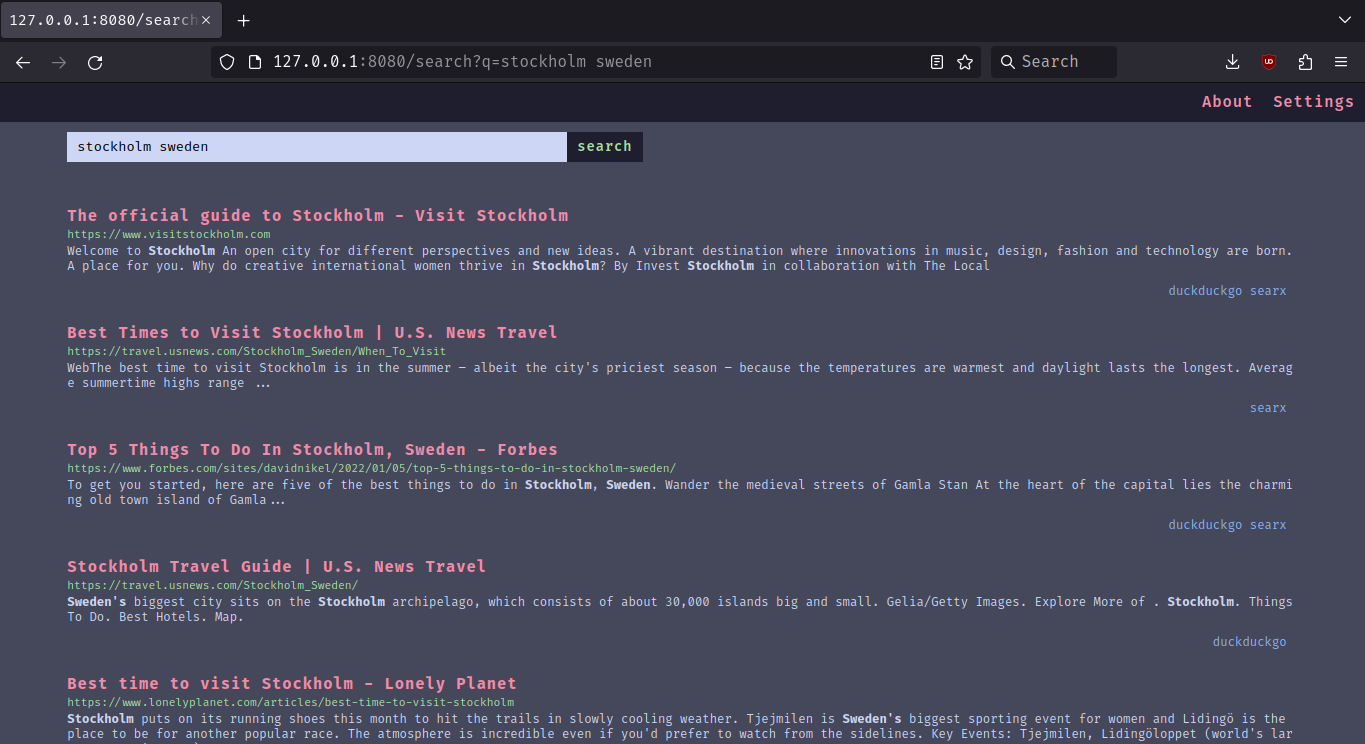
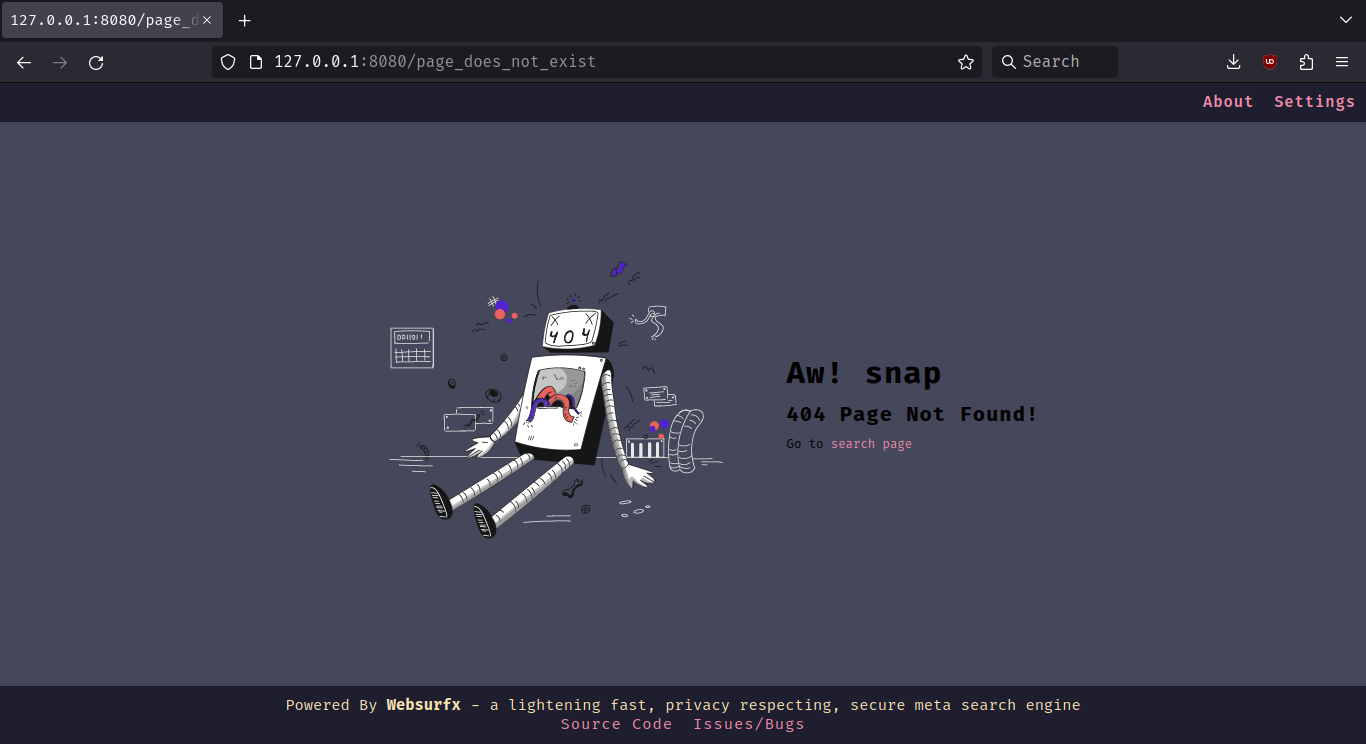
Preview

Home Page

Search Page
404 Page
What Do We Provide Right Now?

  • Ad-Free Results.
  • 12 colorschemes and a simple theme by default.
  • Ability to filter content using filter lists (coming soon).
  • Speed, Privacy, and Security.

In Future Releases

We are planning to move to leptos framework, which will help us provide more privacy by providing feature based compilation which allows the user to choose between different privacy levels. Which will look something like this:

  • Default: It will use wasm and js with csr and ssr.
  • Harderned: It will use ssr only with some js
  • Harderned-with-no-scripts: It will use ssr only with no js at all.

Goals

  • Organic and Relevant Results
  • Ad-Free and Spam-Free Results
  • Advanced Image Search (providing searches based on color, size, etc.)
  • Dorking Support (in other words advanced search query syntax like using And, not and or in search queries)
  • Privacy, Security, and Speed.
  • Support for low memory devices (like you will be able to host websurfx on low memory devices like phones, tablets, etc.).
  • Quick Results and Micro-Apps (providing quick apps like calculator, and exchange in the search results).
  • AI Integration for Answering Search Queries.
  • High Level of Customizability (providing more colorschemes and themes).

Benchmarks

Well, I will not compare my benchmark to other metasearch engines and Searx, but here is the benchmark for speed.

Number of workers/users: 16
Number of searches per worker/user: 1
Total time: 75.37s
Average time per search: 4.71s
Minimum time: 2.95s
Maximum time: 9.28s

Note: This benchmark was performed on a 1 Mbps internet connection speed.

Installation

To get started, clone the repository, edit the config file, which is located in the websurfx directory, and install the Redis server by following the instructions located here. Then run the websurfx server and Redis server using the following commands.

git clone https://github.com/neon-mmd/websurfx.git
cd websurfx
cargo build -r
redis-server --port 8082 &
./target/debug/websurfx

Once you have started the server, open your preferred web browser and navigate to http://127.0.0.1:8080/ to start using Websurfx.

Check out the docs for docker deployment and more installation instructions.

Call to Action: If you like the project then I would suggest leaving a star on the project as this helps us reach more people in the process.

"Show your love by starring the project"

Project Link:

https://github.com/neon-mmd/websurfx

486
487


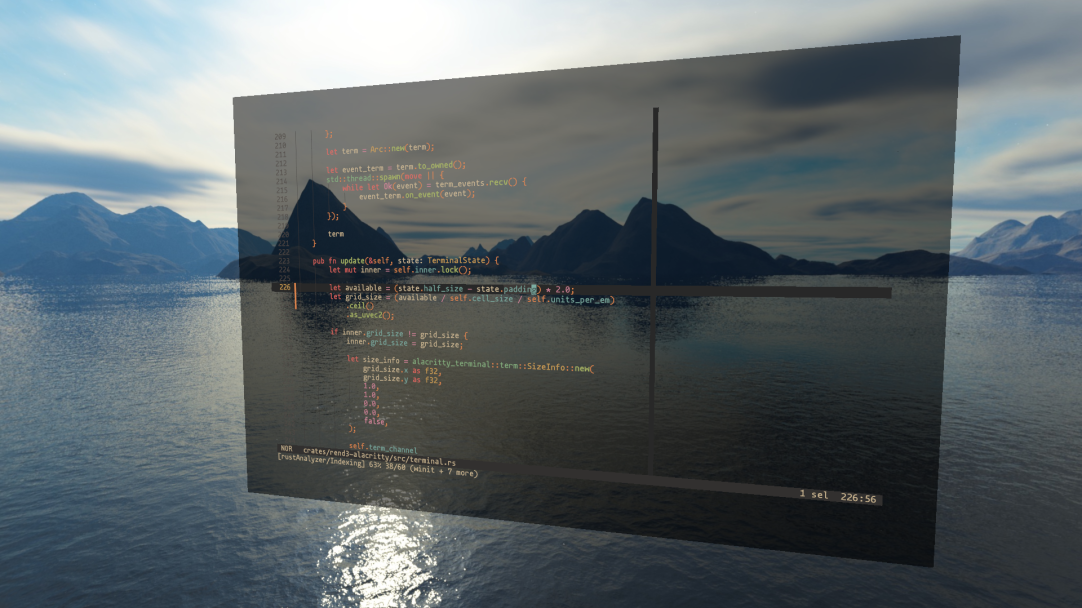
For a larger project requiring the ability to work with my computer in 3D, I developed a 3D terminal emulator. It uses the wonderful alacritty_terminal crate from the Alacritty terminal for VTE parsing and PTY initialization, and it uses wgpu and rend3 for the rendering code. The actual text rendering is done using multichannel SDF rendering, generated lazily at runtime to a texture atlas using the msdfgen crate.

A project like this would've been impossible if not for Rust's friendly library ecosystem and the Alacritty project's efforts to make their core terminal emulator code reusable for other means.
488


A great quick reference document that I've been using to help with understanding Rust. It's a confusing language to get started with.

489
490


I didn't know I needed it, but what I know is that I will download it.

491
492
493


Let me start by noticing, I am not interested in playing a game of Tic Tac Toe, nor programming any form of "AI". With that out of the way, let me give some background:

I have found Rust, with its ownership model, frequently nudges me to rethink whatever I am building. Usually it involves fixing some structs / enums, to avoid references. Correctly structuring an object can make me avoid lots of headaches later when I actually add functionality.

One thing I noticed that helps is understanding what kind of properties should the data have? Should it maintain a certain order, or can it be unordered? Are all of the values unique, or can it have duplicates? All of these details are very important. It is wrong to just shove everything into a Vec. A Vec implies ordering and duplicates, which could be a bad model. We need to choose something which most closely represents the data.

Ok, enough lecture. Onto the Tic Tac Toe grid. Observing this grid provides me with a few important properties:

A Tic Tac Toe grid can be rotated clockwise or counterclockwise, and the game is still the same. The grid can also be flipped over horizontally or vertically and the game will be the same. To decide if anyone won, we just need to see if any rows have 3 of the same value. The rest of the grid does not matter.

I am trying to figure out the best memory model would best represent this behavior. How to build a grid whose orientation does not matter?

Ideally, all of these values should be represented in memory exactly the same way:

  X|O|   X| |    | |
   |O| = O|O| = O|O|
   | |    | |   X| |

But how to do this? One way I was thinking, is perhaps instead of saving a grid at all, we should just be keeping track of all of the rows.

  • [X, O, E] (E = Empty)
  • [O, O, E]
  • etc for all the other rows..

However there are several problems with this model:

  1. The same cells are owned by multiple rows. This is not good. Perhaps the rows can hold a reference to the cells?
  2. The ordering of each row should not matter. So this shouldn't be an array. A better representation may be a Set or Bag/Multiset.

#1 continues to bug me. If we have rows holding references to all of the cells, then it will be hard to update any of them because of rust's restrictions on multiple mutable borrows. Or am I wrong here? How can I update a cell using a reference from a row? Where would the cell live anyway?

It doesn't seem to help to declare the rows inside of the cells, because that leads to cyclical references.

I continue to mull over this problem with not much success. I hope someone can help me discover a better path forward.

494
495
496
497
498


I've been trying to find something that allows me to see performance visualizations in my rust programs, but I haven't found any so far. I'm looking for something that's like SnakeViz in Python, but for Rust. If there's a better way to get about doing this, I'm all ears.

499


Quoting the author

I’ve starting working on a lemmy front end called lemmy-ui-leptos using leptos, a Rust UI framework with isomorphic support, and tailwind + daisyUI for the component styling. This could eventually replace the frankenstein’s monster that lemmy-ui has become.

500


From the release notes:

We are happy to release the new version of ratatui mouse, a community-maintained fork of tui.

In this version, we have introduced a new Scrollbar widget and enhanced the functionality of existing widgets like Block and Barchart. We have also made significant improvements to the stylization/widgets API, ensuring a smoother experience when creating TUIs. Additionally, we have addressed various bugs and implemented enhancements to optimize the overall user experience in TUI development.

Here is a blog post highlighting the prominent new features and providing practical examples of their usage: https://blog.orhun.dev/ratatui-0-22-0

view more: ‹ prev next ›