Rust

7733 readers
18 users here now

Welcome to the Rust community! This is a place to discuss about the Rust programming language.

Wormhole

!performance@programming.dev

Credits

  • The icon is a modified version of the official rust logo (changing the colors to a gradient and black background)

founded 2 years ago
MODERATORS
451


Do you customize your rustfmt, and in what way?

452
453
1
submitted 2 years ago* (last edited 2 years ago) by arendjr@programming.dev to c/rust@programming.dev


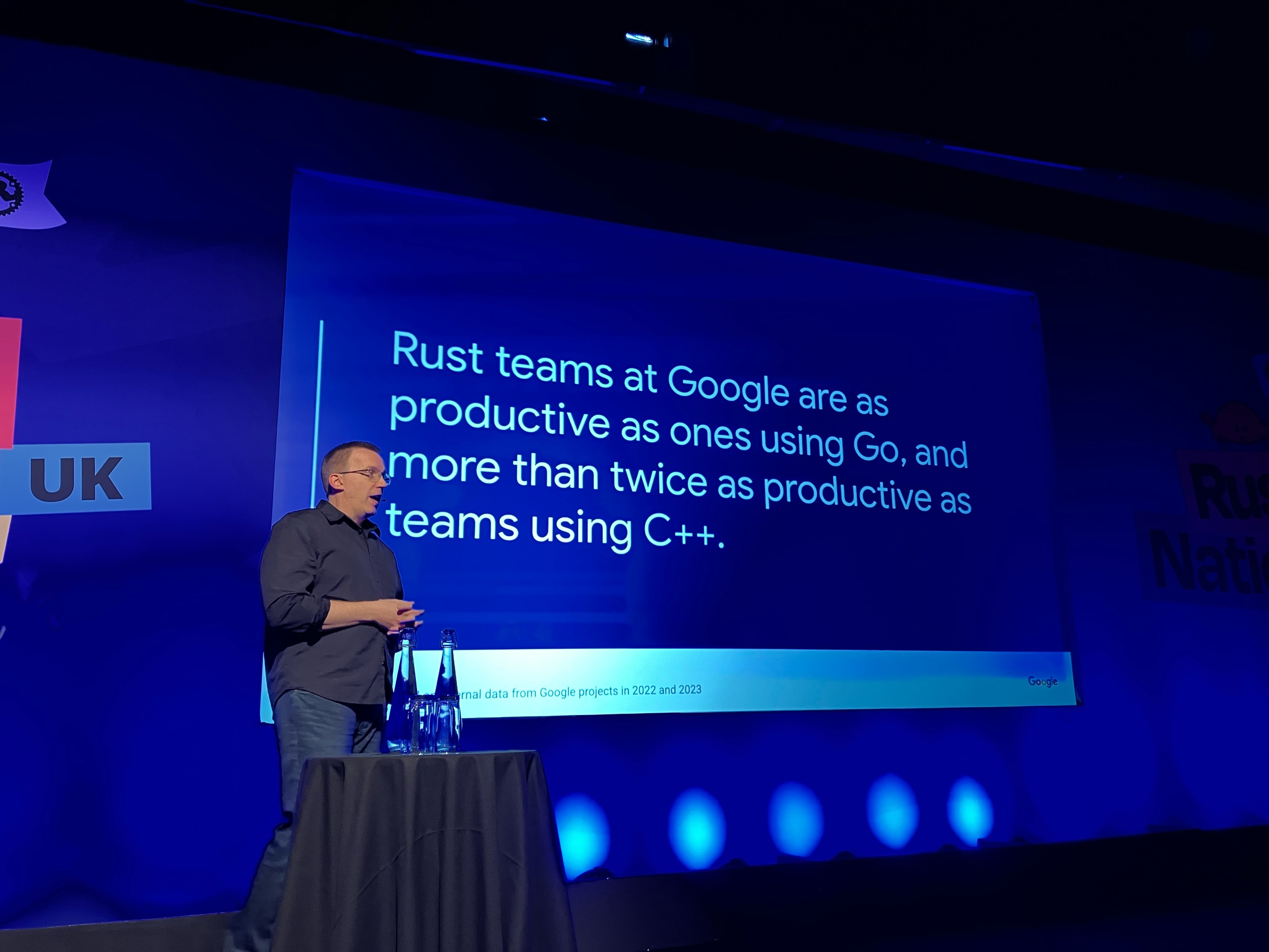
Slide with text: “Rust teams at Google are as productive as ones using Go, and more than twice as productive as teams using C++.”

In small print it says the data is collected over 2022 and 2023.
454
455


I have a struct that looks like this:

pub struct Game {
    /// A HashSet with the players waiting to play as account strings.
    lobby: HashSet<String>,
    /// capacity determines  how many people a match contains.
    capacity: u8,
    /// A vector of ongoing matches.
    matches: Vec<Match>,
    /// HashSet indicating for each player which match they are in.
    players: HashMap<String, usize>,
}

I realised that this won't work because if there are 3 matches (0, 1, 2) and I remove 1 because it ends, the players that used to point at 2 will be pointing outside the vector or to an incorrect match.

So I thought the obvious solution was to use a reference to the match: players: HashMap<String, &Match>. But this makes lifetimes very complicated.

What's a good way to deal with a case like these where data are interrelated in the same struct?

456
457
458


Always good to read about how you can speed up compile times. I mean, sword fighting on office chairs are all fun, but still....

459
460


cross-posted from: https://discuss.online/post/5803977

About this Book

The Rust programming language is extremely well suited for concurrency, and its ecosystem has many libraries that include lots of concurrent data structures, locks, and more. But implementing those structures correctly can be difficult. Even in the most well-used libraries, memory ordering bugs are not uncommon.

In this practical book, Mara Bos, team lead of the Rust library team, helps Rust programmers of all levels gain a clear understanding of low-level concurrency. You’ll learn everything about atomics and memory ordering and how they're combined with basic operating system APIs to build common primitives like mutexes and condition variables. Once you’re done, you’ll have a firm grasp of how Rust’s memory model, the processor, and the role of the operating system all fit together.

With this guide, you’ll learn:

  • How Rust's type system works exceptionally well for programming concurrency correctly
  • All about mutexes, condition variables, atomics, and memory ordering
  • What happens in practice with atomic operations on Intel and ARM processors
  • How locks are implemented with support from the operating system
  • How to write correct code that includes concurrency, atomics, and locks
  • How to build your own locking and synchronization primitives correctly

Available free of charge. But I doubt I'll ever read it. Never enough time and energy for everything.

461


Hi rustaceans! What are you working on this week? Did you discover something new, you want to share?

462
1
submitted 2 years ago* (last edited 2 years ago) by snaggen@programming.dev to c/rust@programming.dev


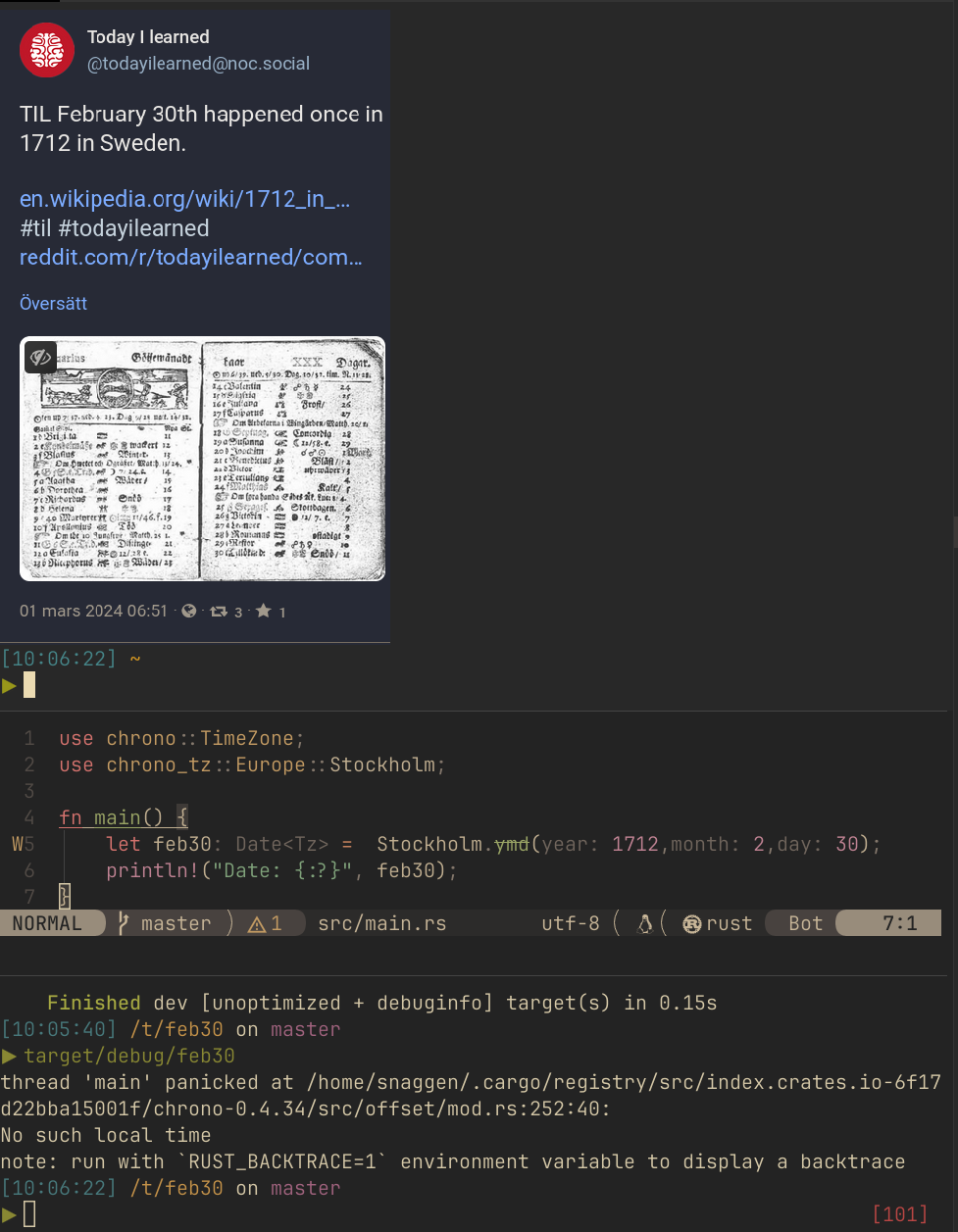
TIL: Sweden had February 30 in 1712 https://en.wikipedia.org/wiki/1712_in_Sweden , so I decided to see how chrono handled that.

use chrono::TimeZone;
use chrono_tz::Europe::Stockholm;

fn main() {
    let feb30 =  Stockholm.ymd(1712,2,30);
    println!("Date: {:?}", feb30);
}
 target/debug/feb30
thread 'main' panicked at /home/snaggen/.cargo/registry/src/index.crates.io-6f17d22bba15001f/chrono-0.4.34/src/offset/mod.rs:252:40:
No such local time
note: run with `RUST_BACKTRACE=1` environment variable to display a backtrace

Result (as expected): Not well! 😄

I also tested Java with

ZonedDateTime feb30 = ZonedDateTime.of(1712,2,30, 0,0,0,0, ZoneId.of("Europe/Stockholm"));

with simmilar result

java.time.DateTimeException: Invalid date 'FEBRUARY 30'

So, lets take a minute of silence for all the programmers of history related software, may the spagetti monster have mercy on their souls.
463


What are you building with Rust?

Are you using Rust at work? Hobby projects?

Why did you choose Rust for your project?

464
465
466
0
Rust in thunderbird (thunderbird.topicbox.com)
submitted 2 years ago by morrowind@lemmy.ml to c/rust@programming.dev
467


After adding some lines today to log some information I had missed that was vital for debugging I was wondering if there were any automated tools like linters or similar static analysis tools that help you identity the information to log and or return in error cases.

I am specifically talking about the information that should be identifiable automatically because it contributes to the control flow arriving in the current scope such as values of variables in the condition for the scope or parameters of functions that calculate those values (e.g. the file name in a permission error, the value of a variable that failed an if let or let else pattern match,...

468
0
submitted 2 years ago* (last edited 2 years ago) by BatmanAoD@programming.dev to c/rust@programming.dev


Almost five years ago, Saoirse "boats" wrote "Notes on a smaller Rust", and a year after that, revisited the idea.

The basic idea is a language that is highly inspired by Rust but doesn't have the strict constraint of being a "systems" language in the vein of C and C++; in particular, it can have a nontrivial (or "thick") runtime and doesn't need to limit itself to "zero-cost" abstractions.

What languages are being designed that fit this description? I've seen a few scripting languages written in Rust on GitHub, but none of them have been very active. I also recently learned about Hylo, which does have some ideas that I think are promising, but it seems too syntactically alien to really be a "smaller Rust."

Edit to add: I think Graydon Hoare's post about language design choices he would have preferred for Rust also sheds some light on the kind of things a hypothetical "Rust-like but not Rust" language could do differently: https://graydon2.dreamwidth.org/307291.html

469
470


From the conclusion:

The authoring agencies urge executives of software manufacturers to prioritize using MSLs [memory-safe languages] in their products and to demonstrate that commitment by writing and publishing memory safe roadmaps. The authoring agencies encourage software manufacturers to lead from the top by publicly naming a business executive who will personally drive the elimination of memory safety vulnerabilities from the product line.

471
472


I'm a complete beginner in programming with no prior experience, and I want a tutor/mentor to learn Rust for software(GUI, games, software in general) development and, eventually, kernel development(microkernels, IPC, specifically). I pay, of course. (Also, another note, I dislike UNIX (philosophy wise), so I would be looking to get experience in non-UNIX kernel development but also learn UNIX stuff as well.) Furthermore, to note, is I'm interested in game development.

I have a document from my previous tutor in this outlining the stuff I am keen to learn, practically a syllabus, so if you want to see it dm me :3.

473


I love browsing crates.io and blessed.rs for interesting and useful crates to experiment with. What are your favorite?

I'm especially interested in those simple ones that do one thing and do it will, like uuid, tempfile, and notify.

474
475


Abstract—New contributors are critical to open source projects. Without them, the project will eventually atrophy and become inactive, or its experienced contributors will bias the future directions the project takes. However, new contributors can also bring a greater risk of introducing vulnerable code. For projects that have a need for both secure implementations and a strong, diverse contributor community, this conflict is a pressing issue. One avenue being pursued that could facilitate this goal is rewriting components of C or C++ code in Rust— a language designed to apply to the same domains as C and C++, but with greater safety guarantees. Seeking to answer whether Rust can help keep new contributors from introducing vulnerabilities, and therefore ease the burden on maintainers, we examine the Oxidation project from Mozilla, which has replaced components of the Firefox web browser with equivalents written in Rust. We use the available data from these projects to derive parameters for a novel application of learning curves, which we use to estimate the proportion of commits that introduce vulnerabilities from new contributors in a manner that is directly comparable. We find that despite concerns about ease of use, first-time contributors to Rust projects are about 70 times less likely to introduce vulnerabilities than first-time contributors to C++ projects. We also found that the rate of new contributors increased overall after switching to Rust, implying that this decrease in vulnerabilities from new contributors does not result from a smaller pool of more skilled developers, and that Rust can in fact facilitate new contributors. In the process, we also qualitatively analyze the Rust vulnerabilities in these projects, and measure the efficacy of the common SZZ algorithm for identifying bug-inducing commits from their fixes.

view more: ‹ prev next ›