Mobile Suit Gundam

245 readers
5 users here now

A community for any and all things relating to Mobile Suit Gundam.

Rules

Related Communities

founded 1 year ago
MODERATORS
1


BACKGROUND

In CE73, FUJIYAMA Company first tried to enter the hotly contested Mobile Suit manufacturing business with the less-than-successful Raigo; a versatile Striker-pack compatible MS developed from the Strike-E, as well as a line of Striker packs of their own. Unfortunately, FUJIYAMA never managed to eat into Actaeon Indsutries’ market shares, as Strike E continues to see action (and purchase orders) by various factions, while Raigo was seen as little more than a Strike E copycat.

To make their product more competitive and rehabilitate its reputation, FUJIYAMA embarked on an ambitious plan to redefine the Raigo – Not contend with just making another Strike, they want to expand the machine’s capability beyond. Its competitor. Adding even more functionality on top of the standard striker-pack design.

OVERVIEW

The resulting Raigo YOROI combines the versatility of Strike’s modular backpack system, with the feature of another of Actaeon Industries’ product; the Blu Duel. FUJIYAMA acquired the blue prints of the original Duel Dagger from the first Alliance-PLANT war, and some battlefield footage and data from the Blue Duel. Using the information they developed a set of heavy armor dubbed the YOROI, mounted on top of the Standard Raigo’s body, with additional weapons and thrusters to compensate for the extra weight. Unlike the Blu Duel’s heavy integrated VPS armor that is fixed in place, the YOROI armor is detachable if the pilots find themselves in need of discard all or just some of the armor pieces. Instead of using VPS armor, the YOROI armor is lined with laminated plating, improving its defense against enemy beam weapons. Furthermore, by making the YOROI armor detachable and modular, pilots can choose to only use specific pieces rather than applying the entire armor set, reducing weight and bulk of the Raigo YOROI.

The Raigo YOROI uses the standard Alliance weapons hardpoint and Striker pack mounting point, compatible with all existing weapons and packs in the inventory of Earth Alliance. In addition, the YOROI can be ordered with the optional “Armed Furisode” combined weapon module mounted on the forearms, each consisting of a retractable beam shotgun and Armor Schneider combat knife. The weapons can be retracted when not in use, and extended when in use.

It is the hope of FUJIYAMA that by combining the features of both the Blu Duel and Strike E, potential customers that would’ve purchase two separate machines, will instead choose the Raigo; after all adopting only one MS makes bulk purchase more cost-effective, simplifies logistical chain, and make pilot and technician familiarization easier and quicker. Furthermore, by making the YOROI armor detachable and modular, potential customer can choose to only purchase certain pieces of armor rather than the entire set, further incentivizes the adoption of ever-so-modular Raigo rather than its two competitors.

Fixed weapons:

-Armed Furisode: arm-mounted beam shotgun and Armor Schneider knife.

-Shoulder-mounted railgun

-6-tube missile launcher

-M2M5 "Todesschrecken" 12.5mm Automatic CIWS

-ES04B Beam Saber, stored on hips

-Mk315 "Stiletto" Rocket-Propelled Anti-Armor Penetrator, stored in side skirt armor

Optional weapons:

-All* compatible Alliance weapons with Alliance-spec handplugs, hardpoints and Striker pack mounts.

*While the Striker pack mount is compatible with the Mk438 Multi-Striker nuclear armed Striker pack, and the Raigo is NBC-rated, no certification or live-test for deploying nuclear weapon has been conducted on the Raigo. Customers use the Multi-Striker pack at their own risk.

Comparison between the Raigo YOROI and the Raigo:

2


Despite losing the Battle of Endymion Crater due to the Atlantic Federation's Cyclops System, ZAFT was undeterred and continued to engage the Earth Alliance's space forces, to further eliminate the Alliance's military presence in space. The Republic of East Asia's resource asteroid Nova in Lagrange Point 4 soon became the newest target for ZAFT.

On June 14th C.E. 70, a ZAFT invasion force entered to Lagrange point 4 space, and laid siege to the Republic's stronghold in the region, the resource asteroid base Nova. While the initial fighting between ZAFT and the Republic of East Asia broke out around the asteroid base, the combat quickly escalated to surrounding colonies in L4, and many civilian space colonies in Lagrange Point 4 became devastated or destroyed as a result of collateral damage. Eventually the entire civilian population of these colonies had to be evacuated.

3
4


As the First Alliance-PLANT War raged on, ZAFT sought to counter Earth Alliance's presence on the Moon, so they invaded Luna and set up a base on the Dark Side of the Moon, dividing the Moon betwteen the two sides.

On June 2, ZAFT attacked a vital supply depot in the Endymion Crater. The Alliance 3rd Fleet, including the Moebius Zero corps was sent to drive ZAFT off. However, the battle was going badly for the Alliance and the 3rd fleet was being devestated by ZAFT forces. Before the fighting could conclude, the Cyclops System, installed under the base as an ice-melting system, suddenly went out of control and exploded.

The destruction of the Cyclops System left a bloodbath, destroying invading ZAFT forces and whats left of the Alliance 3rd fleet. Mu la Flaga was the sole survivor of the Moebius Zero Corps. Rumors circulate that the Cyclops System didn't go out of control on its own, and that Earth Alliance forces deliberately caused the system to overload, but it was never confirmed. In an attempt to save face, the Earth Alliance held Mu la Flaga up as the hero of the day, giving him the title "Hawk of Endymion". At the same time, ZAFT rewarded Rau le Creuset for his role in destroying the 3rd Fleet with command of the Nazca-class high-speed destroyer Vesalius and the le Creuset Team became an elite team within ZAFT, often tasked with vital high-risk high-reward missions.

5


After successfully taking the Strait of Gibraltar, ZAFT continued their push into the Mediterranean Sea and Africa. In order to take complete control of the Mediterranea, and deny the Earth Alliance of vital strategic sea routes, ZAFT began pressing toward the Suez Canal. To counter this ZAFT offensive, the Eurasian Federation sent its massive Armored corps to stop the enemy's advance. Among the men of the armored corps was the tank commander Morgan Chevalier.

On the evening of May 30th, ZAFT forces approaching from the Mediterranean Sea made landing and clashed with the Eurasian Armored Corps at El Alamein, near the Suez Canal. Despite ZAFT forces displaying incredible tactical maneuvers, the battle was not in their favor. The Eurasian forces had came prepared; with vast minefields, endless missiles and artillery barragess, and an overwhelming number of tanks and attack VTOLs. ZAFT's landing forces, particularly the Zuoots, suffered many losses despite their superior firepower.

As the battle progressed, ZAFT reinforcements entered the battle from the Qattara Depression, a place that was considered impassable by heavy vehicles and large military units due to the difficult terrain. But ZAFT's land battleships, equipped with the unique "scale motor" propulsion, managed to traverse the Qattara Depression. These ZAFT reinforcements led by Andrew Waltfeld caught the Eurasian Federation completely off guard, as Eurasians never thought traversing the terrain was even possible for a large military force. Once on the battlefield, the ZAFT land battleships deployed the BuCUEs which tore into the Eurasian rank and decimated the Eurasian forces. Thanks to the surprise attack from an unexpected direction and the impressive performance of BuCUE, ZAFT managed to defeat the huge Eurasian armored corps, and even Morgan Chevalier had to admit the future of warfare is in mobile suits.

After the defeat of the Eurasian Federation forces at El Alamein, there is little left that could stop ZAFT from taking control of Suez. With both the Suez Canal and the Strait of Gibraltar under ZAFT control, Earth Alliance lost all sea routes to the Mediterranean Sea from outside. The control of Suez also meant that ZAFT's Atlantic and Indopacific forces can link up, and securing the Mediterranean ZAFT forces in North Africa could begin to push south toward the Habilis mass driver complex.

6


With the Carpentaria base completed ZAFT finally established a stronghold on Earth, from which they can proceed to the next step of their Operation Ouroboros; capture or destroy all mass drivers controlled by Earth Alliance. As part of this Earth-side offensive, a ZAFT task force left Carpentaria base heading for Mediterranean sea.

In May 25th C.E. 70, the ZAFT Task Force was intercepted by the Eurasian Federation’s Mediterranean fleet near Casablanca, right outside of the Strait of Gibraltar. The fierce battle ensued, and the Eurasia Federation’s Mediterranean fleet was destroyed by ZAFT’s Naval forces, who was equipped with at the time state-of-the-art aquatic Goohn and aerial Dinn mobile suits, along with other MS and aircrafts.

With the defeat of the Eurasian Federation fleet, ZAFT task force entered into the Mediterranean sea. Soon they took control of the Strait of Gibraltar, a strategically vital choke point of the Mediterranean sea, and began to construct their Gibraltar base - the main base for ZAFT operation and expansion in the region.

By taking the strait of Gibraltar, ZAFT now controlled the entrance to the Mediterranean shortcut that links Indian ocean and Atlantic oceans, forcing the Alliance Navies to sail the long way around Cape Hope in southern tip of Africa to reach from one sea to the other. While Gibraltar base allows ZAFT to expand their operation deep into Africa, the Mediterranean region and the Atlantic Ocean.

7


On April 2, C.E. 70, taking advantage of the chaos of the April Fool's Crisis, ZAFT dropped base facilities from orbit into the Gulf of Carpentaria in the PLANT-aligned nations of the Oceania Union, and built the core structures of the Carpentaria base in 48 hours. The base was completed the following month, on May 20.

Carpentaria base itself straddles the Cape York and Arnhem Land peninsulas in Australia. It is the largest and most important base on the ground during ZAFT's operation of Earth.

With the base completed, ZAFT now has a strong foothold on Earth, and can proceed to the next of their Operation Ouroboros; capture all Alliance mass driver-equipped spaceports and lock the Alliance down on Earth.

8


I enjoyed this much more than the first movie. The wait for the last one is going to be brutal.

9
10
14
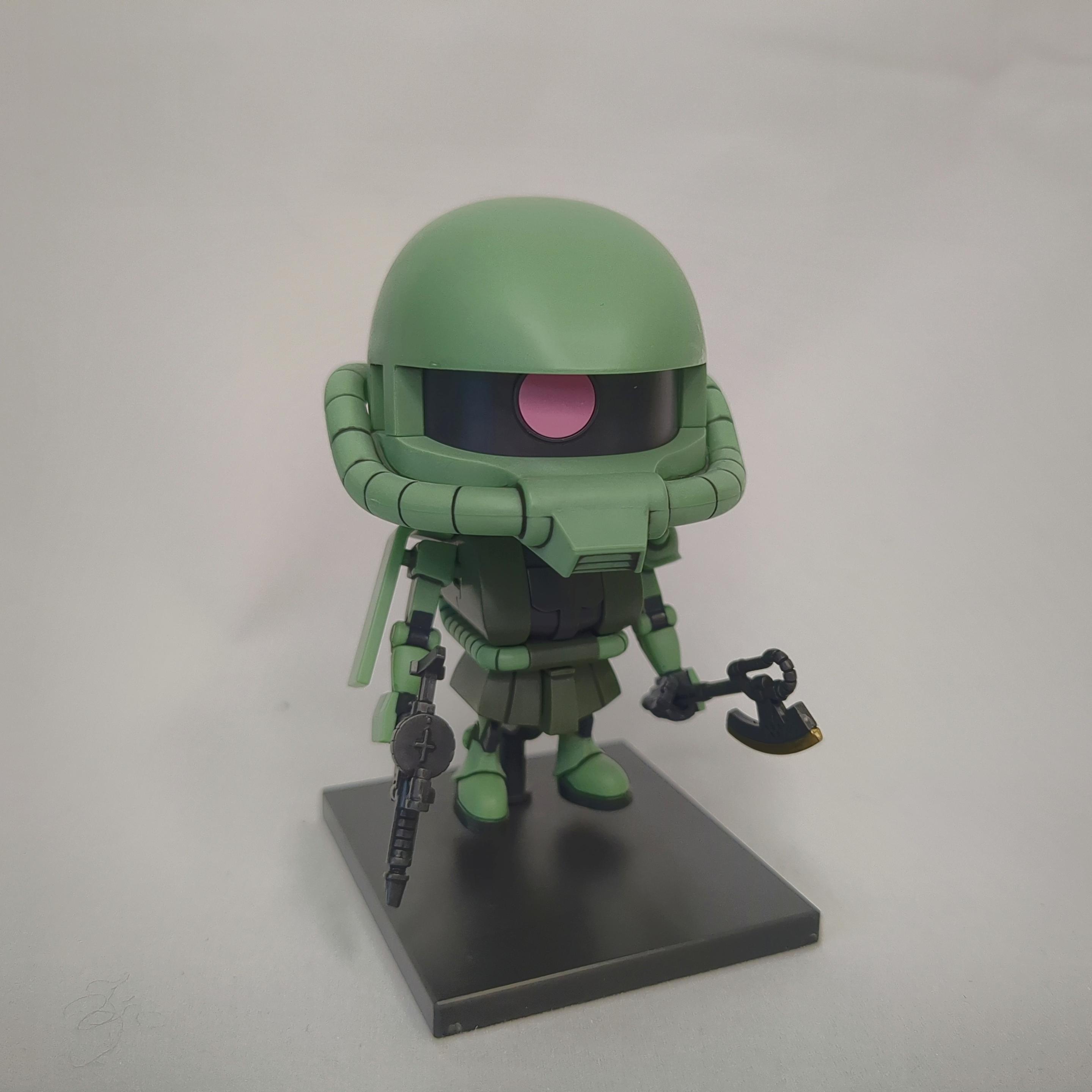
Zakupla-kun DX (files.ohai.social)
submitted 1 month ago by augus@ani.social to c/gundam@ani.social


cross-posted from: https://ohai.social/users/augus/statuses/116569096182149043

Zakupla-kun DX

This was a neat kit to build. Almost a surreal experience to clip a display runner out of an actual runner. The last image is a scan of the parts list, just to demonstrate how much goes into the display.

@gunpla

#gunpla #modelkits #plamo #gundam #zaku #gunplakun

11
12


After the failed attack on PLANT homeland on April 17th (intercepted at Jachin Due), ZAFT sought to remove the Earth Alliance from space entirely and destroy Alliance military targets such as Ptolemaeus lunar base and Endomiyon resource base.

On May 3rd, ZAFT forces dispatched to the Moon defeated the Alliance defenders and made landfall on Luna, soon they constructed a base in Lorentz crater to serve as their beachhead. From there, they would continue their offensive on the Moon, eventually dividing the Moon in Alliance-held and ZAFT-held sides, divided by the Grimaldi crater, soon to be known as Grimaldi front.

ZAFT's Lorentz base, from which they base their luna operation from, is in the Lorentz crater on the edge of the dark side of the moon - it can be seen during certain conditions.

13
 
 
14
 
 
15
 
 
16


After the repeated losses at the hands of ZAFT, the Earth Alliance needed to reverse ZAFT’s growing momentum in the war. To this end, the Alliance decided to launch a deep strike on the PLANT homeland, to force ZAFT on the defensive and push their priority back to Lagrange point 5. On April C.E.70, Earth Alliance launched 2 full-strength fleets, the 5th and 6th fleets, from Ptolemaeus base on the Moon and headed toward Lagrange Point 5.

On April 17, C.E.70, the incoming Alliance fleets were intercepted by ZAFT forces stationed at Jachin Due resource satellite. The battle that ensued resulted in the defeat of the Earth Alliance’s 5th and 6th fleets. The 5th fleet suffered particularly devastating losses, spending most of the remaining war rebuilding itself.

After ZAFT’s victory at Jachin Due, the PLANT Supreme Council decided to convert the resource asteroid into a full military space fortress.

17


Mere days after ZAFT forces successfully landed on Carpentaria and destroyed invading Alliance forces, they established the core of Carpentaria base, and began to reinforce their position by orbital dropping prefabricated base structure and even entire submarines down to Earth, securing their logistical route.

To stop ZAFT from gaining a permanent foothold on Earth, Earth Alliance dispatched the Atlantic Federation’s 21st Anti-Submarine Warfare fleet toward Australia. The aim is to stop a ZAFT naval convoy, consisting of supply submarines escorted by Vosgulov class carrier submarines, from reaching Carpentaria. The convoy landed in Tasman sea, and will travel through Coral sea and Torres Strait to reach their destination Carpentaria base.

On the 10th April,the Alliance fleet’s engaged ZAFT’s submarine convoy in the Coral Sea before they could enter Torres strait. In the battle, the ASW Fleet deployed many Kingfisher 33SP Anti-Submarine Warfare helicopters, one of which was piloted by Ensign Jane Houston. On ZAFT's side, Marco Morassim sortied in the new Ginn FEMWS, alongside Ginn WASP.

During the fighting, Alliance guided missile destroyers Canageon and Bradford tried to circumvent the ZAFT submarine carriers and MS to destroy the supply submarine convoy, but they were unsuccessful and were quickly destroyed.

In the end, The battle proved to be a total disaster for the Atlantic Federation; its entire 21st ASW Fleet, including the flagship Cumberland and the carrier Kingsbill, was wiped out along with all the other ships and Kingfisher helicopters, with only one survivor of the battle; the Kingfisher pilot Jane Houston.

18
19


After Oceania Union condemned Earth Alliance's invasion of South America, and voiced their their support of PLANT, Earth Alliance declared war on the Union as well. Although the Alliance's attention was mostly occupied by ZAFT, they eventually sent a fleet to subdue the Oceania Union. Set to arrive at early April.

Meanwhile, on April 2nd, using the chaos in communication and energy wrought by the deployment of N-jammers, ZAFT once again dropped its forces from orbit to destroyed the invading Alliance fleet, and securing the Gulf of Carpentaria on Northern Australia.

Once the site is secured, ZAFT orbital dropped per-fabriacted building modules down to Australia, and began the construction of their first stronghold on Earth; the Carpentaria base.

Core structures of Carpentaria base base built in just 48 hours, from there ZAFT continued to expand and complete the remaining construction.

20


A bit late but, here we go...

Using the tragedy of Junius Seven as justification, a number of PLANT Supreme Council councilors, including Patrick Zala, pushed for the eployment of Neutron Jammers on Earth and justify it as prevention of Alliance nuclear attack. Although the then-Supreme Council Chairman Siegel Clyne is reluctant, the majority support for N-Jammer deployment was large enough that he had to authorize the deployment as part of Operation Ouroboros.

On April 1st, a ZAFT fleet arrived on Earth orbit and engaged the Alliance forces there. Despite the Earth Alliance's best efforts, they could not stop the deployment, many of the craft broke through the atmosphere and launched the N-Jammers into the Earth. Causing energy crisis as nuclear powerplants shut down.

Certain unconfirmed records indicated that Rau le Creuset and Mu la Flaga engaged each other for the first time during the battle, although only briefly, with neither side giving much thought to each other.

21


Following the failure of the battle of Victoria, PLANT Supreme Council realized that without escalating the war and large-scale deployment on Earth, they have no way of stopping the Alliance forces from pouring out of Earth into space.

On March 15th, they voted to adopt the Operation Ouroboros, their new operation plan for winning the war. The campaign had 3 main objectives:

1.Prevent Alliance from using nuclear weaponry by deploying Neutron Jammers.

  1. Establish bases on Earth as foothold for ZAFT's future operations.

3.Take control of Alliance space ports, preventing them from sending large numbers of reinforcements into space. Particularly focused on mass driver-equipped space ports

This will trap Alliance forces on Earth, unable to threaten PLANT. While the Alliance forces on the Moon will either have to surrender, or starve to death.

22


On March 8th, for the first time in history, an orbital drop operation with heavy armored units took place.

Afte destroying the Yggdrasil station, the vital bridgehead that links Earth and Moon, ZAFT attempted to press on their advantage by commencing the first orbital drop operation, targeting the mass driver-equipped Habilis Space Port's near Lake Victoria. The goal of the operation to to cut off one of the supply routes from Earth to the Moon.

Lack of ground side support, and inexperience in Earth-side warfare however spelled the doom for the eager ZAFT; despite inflicting heavy causalities on Eurasia Federation and South African Union forces, the Alliance were able to defeat ZAFT invaders.

Following the defeat, PLANT Supreme Council was convinced that limited military action without significantly more force on the ground is not going to be viable, and approved of escalate the war with much more involvement on Earth as well.

23
 
 
24


With the destruction of Junius Seven, the First Alliance-PLANT War officially started. ZAFT demonstrated remarkable force projection capability as they began to undertake offensive actions far away from the PLANT homeland. The first target of ZAFT's new strategy was the space station Yggdrasil, located in Lagrange Point 1 near Luna, and served as the bridgehead for Luna's Alliance forces.

On the 22nd, the advancing ZAFT expeditionary force finally engaged Alliance's 1st, 2nd, and 3rd Fleets that were defending the station, and ZAFT deploy the N-Jammers for the first time in combat. The resulting battle between the two sides was fierce, and after intense fighting, the station was destroyed in the crossfire. Eventually, its ruins become part of the debris belt.

With the destruction of the space station, The Earth Alliance lost a vital bridgehead in space and suffered heavy casualties as the 1st and 2nd fleet were annihilated. However, it was a pyrrhic victory for ZAFT, as they also suffered heavy losses.

During the battle, Rau Le Creuset managed to destroy 37 Moebius mobile armors and 6 warships. Earning him the Order of the Nebula.

25


Oceania Union and United States of South America both gladly recognized PLANT's independence and accepted PLANT's offer of neutrality, in exchange for continued trade and good relation between them.

Alliance feared this pro-PLANT USSA might let ZAFT stations troops and weapons on South America, further threaten nearby Earth Alliance territory. To deny PLANT agricultural resources and seize the strategically important location Panama, the Earth Alliance launched the invasion of United States of South America on February 19th, one day after USSA recognized PLANT's independence. The Alliance also seized the strategically vital Porta Panama space port and its mass drivers.

On February 20th, the Oceania Union, despite its geographical remoteness, also received declaration of war.

view more: next ›