1
Forgotten Weapons
1991 readers
7 users here now
This is a community dedicated to historical arms, mechanically unique arms, and Ian McCollum's Forgotten Weapons content.
Posts requesting an identification of a particular gun (or other arm) are welcome.
https://www.youtube.com/@ForgottenWeapons
https://www.forgottenweapons.com/
Rules:
1) Treat Others in a Civil Manner. Personal insults of other members are not welcome here. Neither are calls for violence.
2) No Contemporary Politics Historical politics that influenced designs or adoption of designs are excluded from this rule. Acknowledgement of existing laws to explain designs is also permissible, so long as comments aren't in made to advocate or oppose a policy.
3) No Advertising This rule doesn't apply to posting historical advertisements or showing more contemporary ads as a means of displaying information on an appropriate topic. The aim of this rule is to combat spam/irrelevant advertising campaigns.
4) Keep posts and discussions on Topic Keep it related to arms or Forgotten Weapons or closely adjacent content.
5) NSFW content must be marked, and is only acceptable if it is on topic. NSFW means gore or nudity. If such content is somehow on topic and is not just posted for shock value it may be allowed but must be marked.
Post Guide Lines
These are suggestions not rules.
-Provide a duration for videos. eg. [12:34]
-Provide a year to either indicate when a specific design was produced, patented, or released. If you have an older design being used in a recent conflict provide the year the picture was taken. Dates should be included to help contextualize, not necessarily give exact periods.
-Post a full URL, on mobile devices it can be hard to tell what you're clicking on if you only see "(Link)".
-Posts do not have to be just firearms. Blades, bows, etc. are also welcome.
Adjacent Communities
If you run a community that you feel might fit in dm a mod and we might add your's.
Want to Find a Museum Near You? Check out the mega thread: https://lemmy.world/post/9699481
founded 2 years ago
MODERATORS
2
3
4
5
6
7
9
Link to article on ACR entries.
The McDonnell Douglas AIWS (Advanced Infantry Weapon System) was one of the ACR prototypes that did not make to Phase III of the program. The AIWS used lockless "chiclet" rounds. A saboted flechette was positioned in the center of the cartridge with the powder compartments on either side, with the "lockless" chamber closed off at the breech end with a slot at the top and bottom of the barrel. Ammunition is fed into the chamber from the magazine located on the left side of the weapon and a sliding pressure sleeve closes off the barrel’s openings.
The ARES-Olin AIWS also didn't make it past Phase II of the program. The AIWS uses a 5mm caliber (5×44mm in Phase I, 5×54mm in Phase II), 45 grain saboted tracer round in a telescoped configuration that feeds into the weapon using a 65-round plastic belt carried by a drum. Initially, the cartridge consisted of a brass casing with a plastic end cap at the front, and the projectile sheathed in a three-part sabot. When the weapon is charged and ready to fire, the chamber is sealed in a lower position by the trigger sear. When the trigger is pulled, the chamber moves upwards, releasing the firing pin slide. The firing pin locks up the action as it struck the primer, firing the weapon. As the projectile passes the gas port, the expanding gases push the firing pin and rammer slides backwards while the chamber drops into the feed position.

9
cross-posted from: https://lemmy.world/post/47437185
(I apologize for the photo quality. The lighting in this building was very harsh)
The Special Purpose Individual Weapon was part of a long-running weapons development program to develop a flechette-firing weapon that was supplemented by a grenade launcher. Rock Island Arsenal's Weapons Command received the project in 1962 as part of the organization of Army Materiel Command.
Four competitors submitted weapon designs: Harrington & Richardson Arms Company, Winchester Arms, AAl Corp., and Springfield Armory. Trials were held in 1964 with both Winchester and Harrington & Richardson being eliminated.
When Springfield Armory closed in 1968, AAI Corp. took over as the lead on the project and developed the XM19. By 1979, the Army concluded the XM19 did not meet the needs of the program, and it was abandoned. Despite its cancellation, the project's work on grenade launchers led to the development of the XM203, adopted in 1969 as the M203 40-mm. grenade launcher. The M203 replaced the M79 launcher.


10
11
12
cross-posted from: https://lemmy.world/post/47004062
Operation of the HK-53 was modified so that the HK-53 fired from an open bolt instead of the traditional H&K method of firing from a closed bolt, as open-bolt operation allows for better cooling of the barrel and bolt mechanism and made the HK-53 more compatible with the XM-723’s need to vent firing gasses to the outside of the vehicle. Finally, the original HK53 fire control group mechanism was used, and the cyclic rate of the HK-53 was almost doubled as per the firing port weapon competition guidlines requirements. In the end however, the US Army decided to adopt an AR15/M16 patterned weapon instead, being designated the XM231. Colt was given the contract and continued to modify their design finalizing the weapon as the M-231 (NSN: 1005-01-081-4582) which was adopted by the US Army in August, of 1979. Undeterred, Heckler & Koch continued to improve and shop around the HK-53 MICV (particularly to the German Bundeswehr, who was at the time looking for a firing port weapon for their Marder IFV), but no military ever adopted the weapon so the HK-53 MICV eventually became one of those interesting designs that never went into use, and is now a very rare item.
The M231 Port Firing Weapon was developed in the 1970s as a part of the M2 Bradley Fighting Vehicle Project. A modern relative of the WW2 Krummlauf, the weapon was intended to provide close-in firepower against infantry that might attempt to overrun the M2. It has no sights or buttstock, and fires from an open bolt only as 1100-1200 rounds/minute.


14
12
cross-posted from: https://lemmy.world/post/46985548
Close up of the Pedersen Device:
The Pedersen Device, 1918 Developed during World War I, the Pedersen Device converted a Model 1903 Springfield from a bolt-action rifle to a semiautomatic that fired a .30-caliber pistol cartridge. The device would give U.S. troops fire superiority as they crossed no man's land between trenches. The war ended before the device could be fielded in Europe, but the need for a semiautomatic rifle was clear.
Rock Island Arsenal's Prototype Semiautomatic Rifle, 1909-1913 On 7 April 1909, the chief of ordnance directed the design of a semiautomatic rifle for general use by troops based on the Model 1903 rifle. Two Rock Island Arsenal foremen, Hatch and Woodbury, were tasked with this project. Hatch's rifle was recoil operated, in which the entire barrel and chamber recoiled to cycle the weapon. Woodbury's design was gas operated, with a long piston set in a cylinder below the barrel. The pressure to cycle the piston was drawn from the bore of the rifle through ports set eight inches from the muzzle. Woodbury's design was chosen for further development, but the rifle's complexities slowed its development. In March 1913, the chief of ordnance directed Woodbury's rifle to be placed in condition for firing and testing. No information is known about the testing or the current location of Woodbury's rifle.


15
I was able to take these photos recently at the Rock Island Arsenal museum.
This is listed as an XM16E1 lower that was used as a testbed for features that would eventually lead to the M16A2. Why and how this XM16E1 lower is fenced is something of a mystery to me, but that's what both the display and front desk said.

The two most notable features are the "Brunton bump" which is a massive brass deflector built into the upper.


The other is the proto-A2 rear sight. In this version there is a hole in the carry handle allowing the shooter to see the drum setting.

The windage adjustment knob is squared rather than cut at an angle on the end like the final A2 sight.


16
17
18
19

21
7
Minimalist Outdoorsman’s Combination Gun: The Marbles Game Getter (1st Model)
(www.forgottenweapons.com)
22
23
24
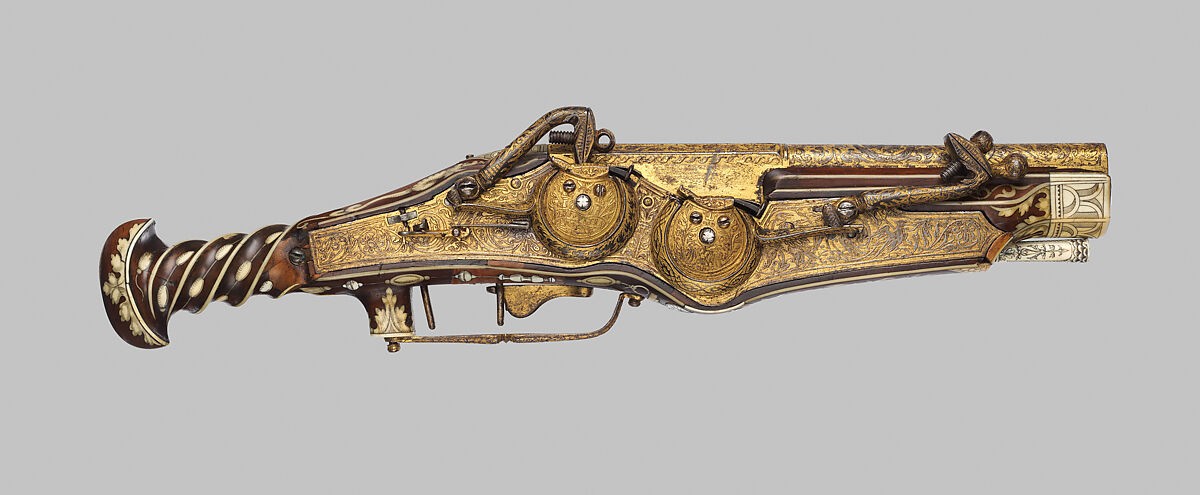
Ornate double-barreled wheellock pistol of Emperor Charles V, Germany, ~1540 AD
(media.piefed.social)
24
25
view more: next ›